
News
Catch up on what’s happening in the world of global citizenship education.
1,668 results found
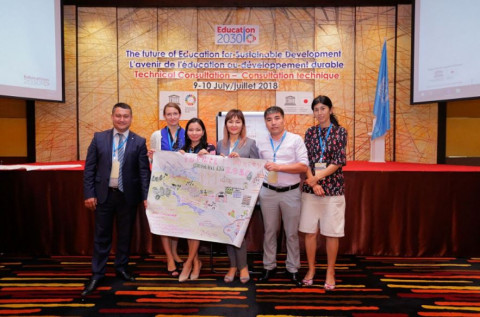 Future of Education for Sustainable Development 2018-12-13 UNESCO Almaty Cluster Office participated in the Technical Consultation Meeting on the Future of Education for Sustainable Development on 9 and 10 July 2018 in Bangkok, Thailand. Over 270 participants from 116 UNESCO Member States and Associate Members gathered to discuss the future direction of governments and UNESCO in promoting Education for Sustainable Development (ESD). With UNESCO’s Global Action Programme on ESD (GAP) ending in 2019, UNESCO is preparing the future programme for ESD, to be linked specifically to the Sustainable Development Goals (SDGs). UNESCO Member States and Associate Members were invited to Bangkok to discuss a draft position paper on the future of ESD, prepared by UNESCO. Opening the meeting, Ms Stefania Giannini, UNESCO Assistant Director-General for Education, said: “ESD is at the forefront of a major trend in education. We are increasingly asking if what people learn is truly relevant to their lives, if what they learn helps to ensure the survival of our planet. ESD can provide the knowledge, skills, values and attitudes that empower people to transform themselves and transform societies. ESD has therefore been duly recognized as part of the global education agenda – as a key element of Target 4.7 of Sustainable Development Goal 4 on Education. ESD is also a key enabler for the achievement of all the SDGs.” The technical consultation meeting provided room for reflection and discussion in different settings, such as town hall debates touching on themes such as the SDGs, transformative action and the technological future, a world cafй session, panel debates, group work and regional discussions. Central Asian group discussed the ESD future vision and proposed strategies to achieve this vision in Central Asia. Envision of future ESD in Central Asia by Central Asian group ©UNESCO An important theme was the role of community as a platform for ESD action. An inspiring example was presented by sustainability practitioner Ms Tomi Matsuba, who lives in the village of Omori, Japan. This village’s inhabitants practice a special sustainable lifestyle. The unique village, part of the silver mining area of Iwami-Ginzan, which is inscribed as a UNESCO cultural heritage site, has reinvented itself by exploring alternative paths to prosperity rooted in values of sustainability. Another panel debate addressed the challenging relationship between sustainable development and economic growth, and how education could help reconcile the two. Professor Arjen Wals, who holds the UNESCO Chair at Wageningen University, Netherlands, said: “For the economy to grow, people need to buy new things all the time, which leads to the depletion of natural resources and the creation of waste and pollution. Furthermore, the current growth paradigm reduces human beings to consumers”. The panelists agreed that a fundamental change in the way we think and act was needed, and that education must promote alternative values to consumption. The new ESD programme, to be developed on the basis of the position paper, is scheduled to take effect at the beginning of 2020, and to cover the period until 2030, in line with the target date of the SDGs. Technical Consultation Meeting URL:http://en.unesco.kz/future-of-education-for-sustainable-development
 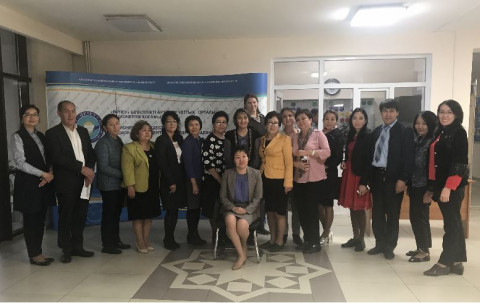 “Всемирный день учителей” в Казахстане под тематикой «Право на квалифицированного учителя» 2018-12-13 World Teachers' Day, celebrated annually on 5 October, focused this year on the right to qualified teachers. Considering that teacher educators have a vital role to play in training qualified teachers, UNESCO Almaty Cluster Office marked the occasion by organizing the Workshop for Teacher Educators on Mainstreaming Education for Sustainable Development in Kazakhstan. In collaboration with the National Center for Professional Development “Orleu”, the workshop trained 25 teacher educators, who deliver capacity building programs to teachers throughout the country. The workshop used the methodology for enhancing skills of teacher education institutions, under the framework of the UNESCO project’s «Sustainability Begins with Teachers in Central Asia.” During the opening of the workshop, Lina Benete, Head of the Education Unit at UNESCO Almaty, noted the importance of qualified teachers to achieve quality education and that the workshop was a start to a long-term collaboration with Orleu in the field of training and retraining of teachers in Kazakhstan. The main workshop objectives were to provide a common understanding around key concepts and principles of transversal competencies and Education for Sustainable Development (ESD) and ensure practical learning on developing activities, cases, interactive tests and projects for learners to instill competencies for sustainable development. The workshop included group work to develop an ideal lesson based on the concept of ESD as well as all presented tools such as Disney’s 3 Chairs method. Orleu teacher educators from its 16 branches across Kazakhstan provide annual professional development courses for more than 73,000 teachers at all education levels. Workshop participants ©UNESCO “For me, the understanding of transversal competences, the experience of developing a project as an instrument of education for sustainable development, and testing on the Kahoot platform became valuable.” Ildana Khalitova, workshop participant URL:http://en.unesco.kz/world-teachers-day-in-kazakhstan-right-to-qualified-teachers
 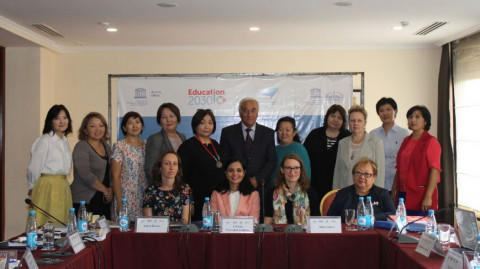 The First Meeting of the Working Group on Developing Online Curriculum to Mainstream Cross-Cutting Competences for Sustainable Development 2018-12-13 On September 20, 2018, UNESCO Almaty Cluster Office, in cooperation with the National Commission of the Kyrgyz Republic for UNESCO, organized the first meeting of the Working Group on Developing Online Curriculum to Mainstream Cross-Cutting Competences for Sustainable Development. The first meeting of the Working Group was organized in the frames of project on mainstreaming ESD and the 21st century competencies, with financial support from Estonia. The project will contribute to promoting quality education through the use of Information and Communication Technologies (ICT). In particular, it will provide digital content on Education for Sustainable Development (ESD) for secondary education in order to improve access to information and promote interactive learning and strengthening teacher competencies in ESD and ICT in education. Ten members of the Working Group, international experts from India and Estonia, UNESCO Almaty, and the UNESCO National Commission participated in the meeting. The event outlined the way forward for a project to develop online curriculum to mainstream interdisciplinary competences for sustainable development. As background for discussion, Aditi Pathak from the UNESCO Mahatma Gandhi Institute of Education for Peace and Sustainable Development (MGIEP) presented an online interactive learning platform developed for digital intercultural exchange. In another key presentation, Veronika Svists from an Estonian NGO “Mondo” spoke about the NGO’s offline and online materials on globalizing world and protection of human rights to support teachers in planning the learning process in different countries, including Estonia and Ukraine. Following the presentations, Working Group members identified specific education for sustainable development topics in line with the State educational standard of general school education in Kyrgyzstan. They also discussed the process for adapting existing content and developing new teaching and learning materials and developing an online interactive learning platform. As a result, the group came up with a preliminary project work plan, including the target audience, objectives of a course, subjects of modules, timeline, and potential distribution of responsibilities. UNESCO Almaty serves as the Secretariat of the Working Group. Related link URL:http://en.unesco.kz/the-first-meeting-of-the-working-group-on-developing-online-curriculum-to-mainstream
 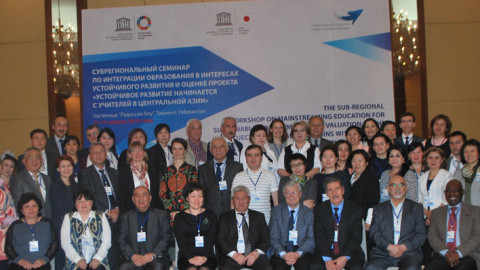 Results of the Project “Sustainability Begins with Teachers in Central Asia” 2018-12-12 UNESCO, with financial support from Japan, held the Second Sub-Regional Workshop on Mainstreaming Education for Sustainable Development and Evaluation of the Project “Sustainability Begins with Teachers in Central Asia” in Tashkent, Uzbekistan, on 11-13 April 2018. This workshop was the final workshop of the one and a half year “Change Project” to build capacities of Teacher Education Institutions to teach non-cognitive competences through the Education for Sustainable Development (ESD) approach. The event aimed to establish synergies between teacher development and education policy on Education for Sustainable Development; evaluate project activities on mainstreaming different ESD approaches into programmes of Teacher education institutions (TEIs); and agree on the sustainability of the project at sub-regional and national level in Central Asia. Representatives from the Ministries of Education and Science, national project coordinators, and 27 participants from TEIs in Kazakhstan, Kyrgyzstan, Tajikistan and Uzbekistan attended the seminar. In addition, international experts from Georgia, Sweden and Lithuania, education specialists from UNESCO Bangkok, Almaty and Tashkent offices, and other international and regional agencies, including the Regional Environmental Centre for Central Asia, Organization for Security and Co-operation in Europe (OSCE) and Institute for International Cooperation of the Deutscher Volkshochschul-Verband (DVV International), shared their expertise. Workshop participants ©UNESCO Tashkent The results of the workshop include the following items: Recognition of the necessity for the creation of a suitable learning environment that enables action for sustainable development; Recommendations for policy makers on integrating ESD into the national and regional education and sustainability policies; Building on the success of the “Change Project”, identified scaling up opportunities of the learning centered initiatives to mainstream ESD in policy, curriculum, pedagogical materials, capacity development, etc.; Agreed advocacy and communication activities on mainstreaming ESD at institutional, national and regional levels; Elaboration of the evaluation and sustainability tools, which will support project TEIs in implementing further changes to mainstream ESD within their institutions and country. A number of different activities, including workshops, trainings, roundtables and initiatives in Kazakhstan, Kyrgyzstan, Tajikistan and Uzbekistan were organized under the framework of the project "Sustainable Development Begins with Teachers in Central Asia". A large number of educators, university staff and students received new skills and knowledge in the direction of ESD. Institutional change plans, implementation strategies and new training methods have been developed. Video Link:https://www.youtube.com/watch?v=kbt4rXRgpcY Related Links: Sustainability Begins with Teachers in Tajikistan Trainings in Uzbekistan: Sustainability Begins with Teachers Using Modern Teaching Methods to Achieve Sustainability in Higher Education in Kazakhstan The project "Sustainability Begins with Teachers" in the Kyrgyz Republic Third Expert Meeting on Education for Sustainable Development Second Expert Meeting on "Sustainability Begins with Teachers" Sustainability Begins with Teachers in Central Asia – results of the UNESCO sub-regional workshop in Almaty Sustainability Begins with Teachers in Central Asia Workshop to Take Place in Almaty Sustainability Begins with Teachers of Central Asia URL:http://en.unesco.kz/results-of-the-project-sustainability-begins-with-teachers-in-central-asia
  UN General Assembly proclaims 24 January International Day of Education 2018-12-11 On 3 December 2018, the United Nations General Assembly adopted with consensus a resolution proclaiming 24 January as International Day of Education, in celebration of the role of education for peace and development. As the world education community gathered in Brussels for the Global Education Meeting, the UN General Assembly voiced a strong message recognizing the foundational role of education for peace and development. The adoption of the resolution 73/25 “International Day of Education”, co-authored by Nigeria and 58 other Member States, demonstrated the unwavering political will to support transformative actions for inclusive, equitable and quality education for all. By doing so, the international community reiterated that education plays a key role in building sustainable and resilient societies, and contributes to the achievement of all other Sustainable Development Goals as it dedicated a special day to celebrate education worldwide. With a view to enhance international cooperation in supporting the efforts towards the realization of Sustainable Development Goal 4, the resolution called on all stakeholders including Member States, organizations of the UN system, and civil society, non-governmental organizations, academic institutions, the private sector, individuals and other relevant stakeholders to observe the International Day of Education. UNESCO, as the specialized United Nations agency for education, will facilitate the annual observance of the Day in close collaboration with main education actors. Introducing the resolution to the General Assembly, H.E. Tijjani Muhammad Bande, Ambassador and Permanent Representative of Nigeria to the United Nations, underscored that proclamation of January 24 as the International Day of Education is an important step in order to promote education as a critical aspect of sustainable development. He emphasized that education is not only a human right, but a path for sustainable development. Prior to adoption of the resolution, on 30 November 2018, the Permanent Missions of Ireland, Nigeria, Singapore and the State of Qatar, together with UNESCO, UNICEF and UN Women organized a side-event of to create awareness and build momentum for the adoption of the resolution. The high-level meeting brought together distinguished ambassadors, policy-makers, representatives of diplomatic community and UN system, civil society and private sector. Ms Marie Paule Roudil, Director of UNESCO New York Office, stressed that education is not only a key goal on its own in the 2030 Agenda for Sustsinable Development but the one goal that gives people the means to realize it. “Gaining the knowledge, skills, values and attitudes to out sustainable development into practice and craft innovate solutions is crucial for global goals”, she said. She also outlined the contribution of education to poverty eradication, improving health outcomes, promoting gender equality, environmental sustainability and building peaceful and resilient societies, while sharing the findings of the latest Global Education Monitoring Report “Building bridges, not walls”. URL: https://en.unesco.org/news/general-assembly-proclaims-24-january-international-day-education
 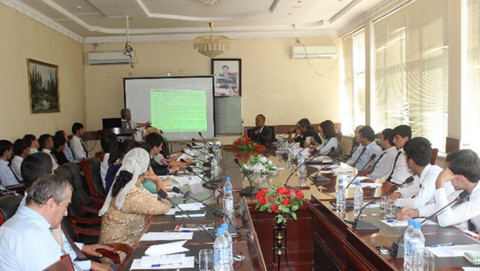 Sustainability Begins with Teachers in Tajikistan 2018-12-05 In September and October 2017, eight roundtables and four seminars were organized in the framework of UNESCO Project "Education begins with teachers in Central Asia" in Dushanbe, Tajikistan. About 100 teachers, educational professionals, and about 250 students from 5 national educational institutions in Tajikistan, including Tajikistan Technical University, Tajik National University, Russian Tajik Slavonic University, Tajik National Pedagogical University, and National Institute for Teachers’ Professional Development, actively participated in the roundtables and seminars. “We should be promoting SDGs in the curriculum of continuing education courses for teachers in secondary schools and integrating them into teaching and learning practices.” M.K. Badalov, Head of the Department of Science and Innovation of the Ministry of Education and Science of the Republic of Tajikistan Rustam Babajanov, National Coordinator of the UNESCO Project in Tajikistan, presented on the Sustainable Development Goals (SDGs) and their gradual implementation in the Republic of Tajikistan, in the context of the National Development Strategy of the Republic of Tajikistan. He highlighted the importance of sustainable development supported by the educational institutions. Workshop Participants ©UNESCO The discussions focused on the mainstreaming of SDG4, reflecting on a new global vision on quality education. In line with the Target 4.7 of SDG4, students should acquire the knowledge and skills to achieve sustainable development and lifestyle, respect for human rights, gender equality, culture of peace and non-violence, global citizenship, and cultural diversity. It is necessary to develop the skills of the 21st century in a young generation, taking into account the needs of the labor market. “The methods of education which we use in classes and extracurricular activities can help develop students’ critical thinking skills, empathy, conflict resolution, and interaction with people of different nationalities." Z.I. Asrorova, Associated Professor of the Russian Tajik Slavonic University As a result of the roundtables, participants discussed concrete ways of implementing SDGs, including developing sample topics for the potential introduction of SDGs into the curricula of secondary schools and drafting and adopting a syllabus. Links: Using Modern Teaching Methods to Achieve Sustainability in Higher Education in Kazakhstan The project "Sustainability Begins with Teachers" in the Kyrgyz Republic Trainings in Uzbekistan: Sustainability Begins with Teachers URL:http://en.unesco.kz/sustainability-begins-with-teachers-in-tajikistan
 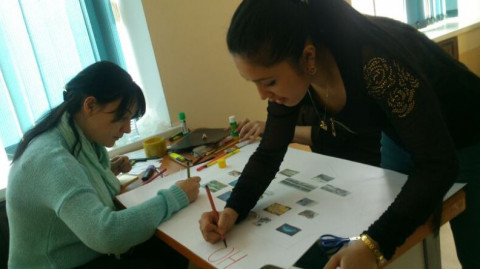 Trainings in Uzbekistan: Sustainability Begins with Teachers 2018-12-05 In Uzbekistan, the National University of Uzbekistan held four training seminars for teachers and students from various departments under in the framework of the third stage of the UNESCO Project "Sustainability Begins with Teachers in Central Asia”. Trainings were devoted to develop new skills to mainstream Education for Sustainable Development (ESD) and Global Citizenship. “The higher education textbook "Fundamentals of Sustainable Development and Nature Management" in the Russian and Uzbek languages aroused great interest among participants" Azamat Azizov, National Project Coordinator in Uzbekistan About 250 students and 80 educators and teachers of higher education institutions received new skills in the workshops at the National University of Uzbekistan from November 2017 to February 2018. The most active were teachers of departments of chemistry and journalism. ©UNESCO Almaty These activities and project results from four Central Asia countries will be presented during the sub-regional workshop on mainstreaming education for sustainable development and evaluation of the project “Sustainability begins with teachers in Central Asia”, on 11-13 April 2018 in Tashkent, Uzbekistan. Project is implemented by UNESCO Office in Tashkent, in cooperation with the UNESCO Almaty Cluster Office and UNESCO Regional Office in Bangkok with the financial support from the Government of Japan. The second sub-regional workshop aims at establishing synergies between teacher development and education policy on ESD; evaluating project activities on mainstreaming education for sustainable development and global citizenship; and agreeing on the sustainability of the project in Central Asia. Links: Sub-regional workshop on mainstreaming education for sustainable development and evaluation of the project “Sustainability begins with teachers in Central Asia” Using Modern Teaching Methods to Achieve Sustainability in Higher Education in Kazakhstan The project "Sustainability Begins with Teachers" in the Kyrgyz Republic URL:http://en.unesco.kz/capacity-building-of-educators-on-education-for-sustainable-development-and-global
 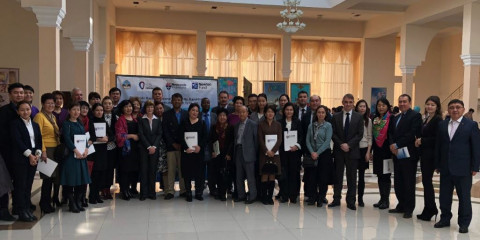 Using Modern Teaching Methods to Achieve Sustainability in Higher Education in Kazakhstan 2018-12-05 UNESCO Almaty project "Sustainability Begins with Teachers", gave impetus to a series of events and trainings were conducted on using modern teaching methods to achieve sustainability in higher education. On 23-24 November 2017, Ms Saule Zeynolla, National Project Coordinator presented "Active methods of teaching" in the section "Project and problem-oriented learning" at the International Scientific and Practical Conference at the Kazakh National University named after al-Farabi. The conference is an open and convenient platform for the exchange of views and experiences in the field of implementation of problem-oriented teaching in higher education. “It is necessary to include project based training to universities educational process to influence the achieving of the Sustainable Development Goals. Saule Zeynolla, National Coordinator in Kazakhstan UNESCO Almaty supports the project based training in educational processes of universities with a focus on sustainable development. An active participation of representatives of the largest universities of the Republic of Kazakhstan contributed to the development of practical recommendations and proposals. They will be considered when developing training programmes for university teachers on the implementation of the principles of sustainable development in the educational process. Workshop Participants ©UNESCO Almaty Trainings organized at the Caspian University and, the German-Kazakh University from November 2017 to January 2018. More than 70 university professors and teachers attended the workshops. The participants discussed the competence-based in teaching students and shared their experience of applying new pedagogical technologies. Workshop Participants ©UNESCO Almaty The implementation of individual and group projects was an important component of practice-oriented teaching. In addition, the participants discussed difficulties in preparing assignments for classes and the various formats for applying exercise in training and their effectiveness. Particular attention was paid to the peculiarities of the perception of information of students of a new generation as well as practical examples of using effective technologies for the organization of complicated lectures. The most useful topic was on receiving feedback from the students, the terms of individual adjustment of the course and methods of self-evaluation of students. The orientation of learning for a specific result and the focus on the practical application of the curriculum material is the result of a well-coordinated efforts of teachers. URL:http://en.unesco.kz/using-modern-teaching-methods-to-achieve-sustainability-in-higher-education-in-kazakhstan
 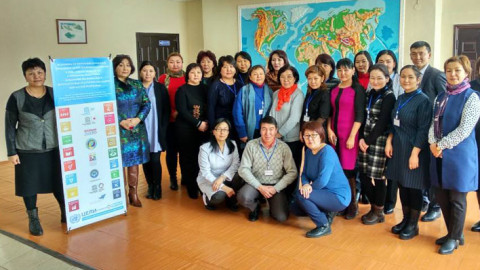 The project "Sustainability Begins with Teachers" in the Kyrgyz Republic 2018-12-04 Five trainings have been held in the Kyrgyz Republic over the past few months, involving more than 200 researchers, teachers, students and other education stakeholders. UNESCO Almaty has been implementing the project “Sustainability Begins with Teachers" in the Kyrgyz Republic, with the financial support of the Government of Japan and the assistance of the State Agency for Environmental Protection and Forestry under the Government of the Kyrgyz Republic. The following teacher education institutions, including Kyrgyz Academy of Education, Osh Humanitarian and Pedagogical Institute, Kyrgyz University. I. Arabaeva, Republican Institute for Advanced Studies and Retraining of Teachers, Academy of Public Administration under the President of the Kyrgyz Republic have been participating in the project. Participants ©UNESCO Almaty The main objective of the project is to integrate Education for Sustainable Development and Global Citizenship (Sustainable Development Goal 4.7) into the system of training and retraining teaching professionals. Trainings allowed to upgrade and improve the competences of participants, which in turn will affect the quality of education as a whole in the country. Teachers gained new knowledge, skills and understanding of social behavior and values that are necessary to ensure the transition to a sustainable society. On 26 November 2017, the Osh Humanitarian Pedagogical Institute held the Students' Campaign "Clean Nature - A Clean Future" in the framework of its Institutional Project, where students from the Faculty of Natural Geography actively participated. Participants ©UNESCO Almaty In the framework of this project, the joint clean up activity was organized at the Victory park together with "Tazalyk" company. The activity was devoted to a clean city action and for recycling of garbage and solid domestic waste. Related article: Sustainability Begins with Teachers of Central Asia Second Expert Meeting on "Sustainability Begins with Teachers" "Sustainability Begins with Teachers in Central Asia" – results of the UNESCO sub-regional workshop in Almaty Education for Sustainable Development should bring about change URL:http://en.unesco.kz/the-project-sustainability-begins-with-teachers-in-central-asia-in-the-kyrgyz-republic
  Третья встреча экспертов по проекту "Образование в интересах устойчивого развития" 2018-12-03 The third expert meeting for the project “Sustainability begins with teachers in Central Asia” took place in Almaty, Kazakhstan, from 31 January to 1 February 2018. The UNESCO Almaty Cluster Office organized the meeting in cooperation with UNESCO Tashkent, the UNESCO Asia-Pacific Regional Office in Bangkok and with funding from Japan. “Learning should bring about change and change is not always comfortable. Mr. Shepherd Urenje, representative of the Swedish International Centre of Education for Sustainable Development Contributing to the Global Action Programme (GAP) on Education for Sustainable Development (ESD) the project advocates for change in sustainable development practices of teacher education institutions in different regions, including Africa, Europe, South-East Asia and Central Asia. Twenty teacher education institutions from four Central Asian countries are implementing the “Change project” to bring incremental improvements and increase social awareness on ESD and Global Citizenship Education (GCED). The third expert meeting gathered ESD experts from Kazakhstan, Kyrgyzstan, Tajikistan, Uzbekistan, Georgia and Sweden to analyze the project implementation status in each participating country and facilitate the organization of a sub-regional workshop to be organized in Uzbekistan in April to evaluate the project. Mr. Shepherd Urenje, representative of the Swedish International Centre of Education for Sustainable Development argued that “learning should bring about change and change is not always comfortable. We are here because of the Global Action Programme, which is about scaling up Education for Sustainable Development projects. One important aspect is the link between the Ministries of Education and mainstreaming of activities on ESD across different levels of education, including higher education, primary and secondary education and pre-school education.” Azamat Azizov from the National University from Uzbekistan stressed that an awareness of the importance of Sustainable Development Goal 4 (SDG) and ESD are indispensable elements of the formation of quality education and country development. Galiya Nurmukhanbetova from the International Information Technologies University in Almaty shared examples of students’ initiatives to develop green technologies in Kazakhstan, such as Tazalyk application that promotes recycling; Eco-Stations in Almaty, where the solar panels allow people to charge phones while waiting for the bus, or electronic terminals that allow to consult the bus schedule with a voice search control for inclusivity. A lot of such projects on green technologies have been initiated by young people. Green technologies become a bridge to the goals of sustainable development and education for all. Related Links: Sustainability Begins with Teachers of Central Asia Second Expert Meeting on "Sustainability Begins with Teachers" Sustainability Begins with Teachers in Central Asia Workshop to Take Place in Almaty Sustainability Begins with Teachers in Central Asia – results of the UNESCO sub-regional workshop in Almaty URL:http://en.unesco.kz/education-for-sustainable-development-should-bring-about-change