
News
Catch up on what’s happening in the world of global citizenship education.
1,668 results found
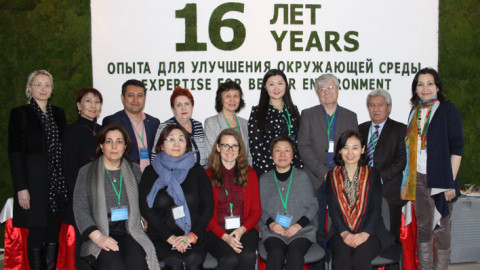 Second Expert Meeting on "Sustainability Begins with Teachers" 2018-12-03 The second expert meeting under the umbrella of the “Sustainability Begins with Teachers in Central Asia” project took place in Almaty, Kazakhstan, on 5-6 April 2017. UNESCO Almaty Cluster Office, in cooperation with the UNESCO Asia-Pacific Regional Office in Bangkok and the Regional Environmental Centre for Central Asia (CAREC) and with support of the Japanese Funds-in-Trust, organized the meeting to prepare for the sub-regional workshop for teacher education institutions (19-23 June 2017). The project “Sustainability Begins with Teachers in Central Asia” is a part of the Global Action Programme (GAP) that strives to reach sustainable development in all areas of education through five Priority Action Areas (policies, learning environment, trainers and educators, youth, and sustainable solutions). The project focuses on the GAP Priority Action Area 3 – “building capacities of educators and trainers,” which has already been put into action in Southern Africa, South East Asia and Central Asia. National and international experts from UNESCO, CAREC, Kazakhstan, Kyrgyzstan, Tajikistan, Uzbekistan, Georgia and Sweden participated in the meeting. They reviewed the project’s progress, clarified the focus, roles and actions for the upcoming workshop, outlined the programme and learning materials of the event, and discussed a preliminary plan for the sustainability of the project. Related article: Sustainability Begins with Teachers of Central Asia URL:http://en.unesco.kz/second-expert-meeting-on-sustainability-begins-with-teachers
  Sustainability Begins with Teachers in Central Asia – results of the UNESCO sub-regional workshop in Almaty 2018-12-02 On June 19-23, 2017, Almaty hosted a workshop for teacher educators of Central Asian countries on the UNESCO project. This is a global initiative to increase the professional level of pedagogical staff for the implementation of education for sustainable development through the training of teachers. The UNESCO Cluster Office for Central Asia in Almaty organized the workshop, in cooperation with the UNESCO Asia-Pacific Regional Bureau for Education, UNESCO Tashkent, the Asia-Pacific Education Centre for International Understanding under auspices of UNESCO (APCEIU), and the Regional Environmental Centre for Central Asia (CAREC). The event received financial support from the Japanese government. 70 experts from 9 countries, including representatives of ministries, universities, and teacher training institutions from Central Asia, and international experts from the Republic of Korea, Sweden, Georgia, and Philippines attended the workshop. Workshop participants ©CAREC The workshop introduced a new methodology, whereby each participating institution conducted a self-assessment on education for sustainable development (ESD) and global citizenship education (GCED) before the workshop. During the workshop, participants explored a variety of methods and approaches, which show different models of mainstreaming the 21st century skills. As a result, they developed action plans to implement subsequent changes in their institutions and teacher education and training systems in the region. The teacher education institutions will start implementing their action plans over the following nine months and meet again in Tashkent in April 2018. Key speakers and organizers shared their thoughts on the workshop results, the importance of promoting education for sustainable development and global citizenship concepts, and values necessary for achieving quality education. Shepherd Urenje, SWEDESD: «The main reason why these people are here is that the current education is not able to prepare the young generation to solve the problems of the 21st century. People like me cannot solve them because I am part of these problems: the way I think, the way I was educated and the way I define success have created these problems. But young people can confront these challenges in a different way. They can do it if we help them to learn differently, if we teach them how to think critically, if they will learn how to learn. At the workshop, we got a very enthusiastic group of people who are willing to implement changes while most of them are very experienced professors, and they’ve been doing a great work in their institutions. The most important things that come throughout the presentations and speeches are that they do realize that we need changes, they do realize that we have to use different methods and they do realize that we need to look at teaching and learning in a different way.» Yangsook Lee, APCEIU: «When we talk about education in terms of sustainable development it is not just about “you are getting there by these means”. It should be an ongoing and continuing process with the involvement of all stakeholders. Of course, it is not easy to change the education system and mindset of educators, but doing this workshop, however small, is meaningful for sharing experience and raising the awareness. ...after five days [of the workshop] I am very happy to see that each participating institution presented a better vision and more concrete action plans for educational transformation.» Ushio Miura, UNESCO Asia-Pacific Regional Bureau for Education: «Sustainable development demands a lot of re-thinking from all of us, about what we consider important in our lives, about our future, about our values… And education is critical in that process, to support all of us in changing the way we think, the way we live. There is no single method or solution for sustainable development. If there were, if it were that simple, then the whole world would not be struggling for sustainable development today. Different countries have different contexts. Even within one country, issues manifest differently in different communities. So, every community needs to look around, think and explore because solutions come from you, not from someone else who will tell you what to do. That is why during the workshop, the participants assessed their own institutions, to find what they have been doing well, and not so well, then think about what changes they would like to make.» Lina Benete, UNESCO Almaty Cluster Office: «This workshop focused on education for sustainable development and global citizenship. They are crucial for developing non-cognitive competences for the 21st century. These skills can enable students to get future jobs and have sustainable development in their countries. The workshop helped to establish synergies among teacher training, education policy, curriculum, and innovative pedagogical approaches. The participants of the workshop acquired the necessary knowledge and attitudes to transfer them to their students. Their skills combined with a fresh perspective can create transformation not just in their institutions but also in their countries. Now there is a strong network of Central Asian educators on ESD and GCED. We will work together over the next years to have sustainable development in Central Asia as part of the global effort.» Tatiana Shakirova, CAREC: « This workshop differs from many seminars, training and meetings on education for sustainable development (ESD) with its practical focus on changes towards sustainable development and ESD in the organizations themselves, preparing future teachers - universities and teachers training' centers. The workshop provided an opportunity to think about changes not only at the national level - political and legal but also about real changes in the minds, hearts, behavior, and lifestyle of teachers and their students. The project makes it possible to tell about the different views to the institutes and universities preparing teachers of the 21st century, ready for change and capable of promoting them.» You can download workshop's programme and concept note here: 1UNESCO Workshop_Agenda.docx Concept Paper_SD-GCED 1.docx Read article on CAREC website:http://carececo.org/en/news/ustoychivost-nachinaetsya-s-uchiteley-itogi-regionalnogo-seminara-v-almaty/ URL:http://en.unesco.kz/sustainability-begins-with-teachers-in-central-asia-results-of-the-unesco-sub-regional
 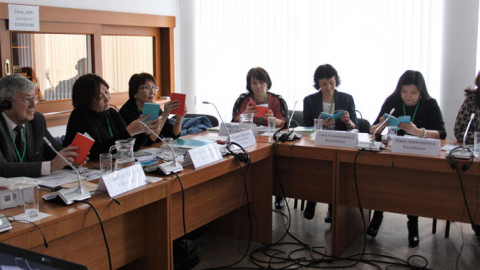 Sustainability Begins with Teachers in Central Asia Workshop to Take Place in Almaty 2018-11-30 The sub-regional workshop Sustainability Begins with Teachers in Central Asia will take place in Almaty, Kazakhstan, on 19-23 June 2017. The workshop will be organized by UNESCO Almaty Cluster Office, in cooperation with the UNESCO Asia-Pacific Regional Office in Bangkok, the Asia-Pacific Centre of Education for International Understanding (APCEIU) and the Regional Environmental Centre for Central Asia (CAREC), with support from the Japanese Funds-in-Trust. About 60 specialists, among which representatives from UNESCO and CAREC, international experts from Georgia, Sweden, Philippines, APCEIU, and national experts from Kazakhstan, Kyrgyzstan, Uzbekistan and Tajikistan, will participate in the event. The workshop will focus on revisiting priorities in teacher education courses, reorienting practice skills, improving education methods for reaching sustainable development in Central Asian region, and also on increasing social awareness of the concepts of Education for Sustainable Development (ESD) and global citizenship education (GCE) with the implementation of Change project approach. The 5-day programme will include practice sessions, round-table discussions, presentations, and planning of future activities. The participants of the workshop will learn about the role of United Nations Sustainable Development Goals (SDGs), different methods of work, Central Asian best practices in promoting ESD in teacher education institutions, educators’ competencies and approaches, and educational materials inculcating ESD and GCE into teaching and learning. Read previous related articles:Sustainability Begins with Teachers of Central AsiaSecond Expert Meeting on "Sustainability Begins with Teachers" URL:http://en.unesco.kz/sustainability-begins-with-teachers-in-central-asia-workshop-to-take-place-in-almaty
 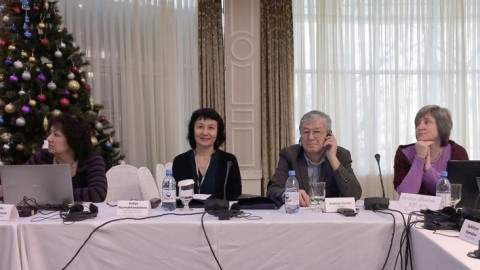 Central Asia: Sustainability Begins with Teachers 2018-11-30 04 January 2017The sub-regional planning meeting on Education for Sustainable Development (ESD) and Global Citizenship Education (GCE) projects for teachers has been held on 12-13 December 2016 in Almaty, Kazakhstan. The meeting has been organized by UNESCO Almaty Cluster Office in cooperation with UNESCO Tashkent, UNESCO Bangkok and support of the government of Japan as well as participation of Swedish International Centre of Education for Sustainable Development (SWEDESD) of the Uppsala University. The project “Sustainability begins with teachers” in Central Asia is a part of the Global Action Programme (GAP) under the category of Priority Action Area 3 “building capacities of educators and trainers”. The project advocates change in sustainable development practices of education pioneered by SWEDESD in Africa and serves to support teacher activism for sustainable development in Central Asia. UNESCO Almaty has invited ESD and GCE experts from Kazakhstan, Kyrgyzstan, Tajikistan and Uzbekistan to perform analysis of the programme implementation status for each state and facilitate knowledge-sharing among the experts. The participants presented interim research reports examining implementation of teaching, learning and curriculum policy and practice on ESD and GCE. How can Higher Education Institutions in Central Asia be empowered to ensure that teaching and learning approaches develop the skills for addressing the global challenges of the 21st Century?" Mr Shepherd Urenje, Representative of the Swedish International Centre of Education for Sustainable Development Representative of the Swedish International Centre of Education for Sustainable Development © UNESCO Almaty Local institutions, education centres and government agents in 4 countries act as initiators of “Change project” in several educational organisations simultaneously. They execute programmes under the supervision of 4 assigned expert coordinators on ESD and GCE as proposed during the meeting. The strategy seeks to bring incremental improvements and increase social awareness of ESD and GCE priorities by giving ownership of the process to local educators of Central Asia. The panel of international agency specialists has discussed and planned the execution of “Change Project” for sustainability in Central Asia. Invited participants have conducted research on last years` integration attainment of ESD and GCE programmes in respective countries. Furthermore, research experts seek to address the gaps in implementation practices on the grassroots and medium level of education. By the end of the meeting all participants agreed on the stages of “Change project” implementation in Central Asia with assistance of Regional Environmental Centre for Central Asia (CAREC) and supervision by SWEDESD and UNESCO. Meeting Participants © UNESCO Almaty URL:https://en.unesco.org/news/central-asia-sustainability-begins-teachers
 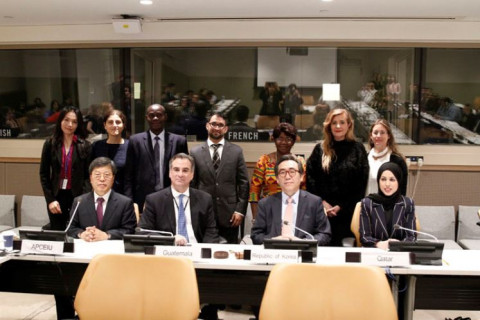 2018 UN Global Citizenship Education Forum 2018-11-26 On 13 November 2018, APCEIU, together with the Permanent Mission of the Republic of Korea to the United Nations co-organized the 2018 United Nations Global Citizenship Education Forum at the United Nations Headquarters. The Forum was co-sponsored by the Permanent Mission of the State of Qatar to the United Nations, Permanent Mission of the Principality of Andorra to the United Nations, Permanent Mission of Guatemala to the United Nations, and UNESCO New York Liaison Office. Approximately 70 participants, including Ambassadors to the United Nations, high-level officials of the United Nations, academia, and international organizations, attended the Forum. Under the overarching theme "GCED as a key enabler of Sustainable Development Goals (SDGs), the Forum shared best practices of GCED and sought for collective efforts to promote GCED across the globe. In the opening remarks, Ambassador Cho Tae-yul of the Republic of Korea to the United Nations mentioned that the new role of education in addressing global issues such as violent extremism and climate change has been emphasized as the countries are getting much more closely interconnected than ever before. With an emphasis on the transformative education to build a more inclusive and peaceful society, he underlined the joint endeavour for the designation of the International Day of Global Citizenship Education. The first session was kicked off by Chung Utak, Director of APCEIU who moderated the session. During the session, best practices of GCED in Colombia, Ghana, Mexico and Oman were shared with the audience. Ana Maria Velasquez, Associate Professor of the Universidad de los Andes, introduced the Colombian context originated by peace agreement which took place at the end of a prolonged conflict, and emphasized the demand for GCED to achieve a sustained peace. Joyce Afutu, Director of Communications and Corporate Affairs, National Commission for Civic Education claimed that Ghana has been leading the way in implementing GCED by sharing various practices taken in Ghana such as teachers’ capacity-building workshops, UNESCO ASPnet Schools, and community-based group activities. Adding to that, Cyomara Inurrigarro who is a teacher at Normal Miguel F. Martinez School in Mexico introduced her story of promoting GCED in UNESCO ASPnet Schools in Nuevo Leon region through the pre-service teacher training programme on GCED. Lastly, Khalaf Marhoun Al'Abri, Assistant Professor of Education Policy, Sultan Qaboos University presented about the Omani efforts in applying GCED to pre-schools, public schools and higher education systems. The following session mainly addressed methods of promoting GCED and designation of the International Day of GCED. See the panellists as follows: Moderator: H.E. Elisenda Vives Balmana, Permanent Representative of the Principality of Andorra Panellists H.E. Bakhtiyor Ibragimov, Permanent Representative of the Republic of Uzbekistan Patrice Ssembirige, Curriculum Specialist, National Curriculum Development Centre of Uganda Lily Gray, Liaison Officer, UNESCO New York Liaison Office Eunhee Jung, Founder and President of IVECA(International Virtual Schooling) and Co-chair of IDEGC Steering Committee While sharing a variety of researches and practices on GCED at national level, the panellists reaffirmed GCED is the key enabler of SDG 4.7. It was actively debated that a global citizen is a person who holds universal values such as justice, equity, respect, dignity and understands global issues, and embraces their own heritage (identity) but transcends cultural differences. Furthermore, it was also mentioned that “GCED for all” can be achieved when it comes to consolidated partnership between multiple stakeholders. Also, it was suggested that since GCED for quality education and SDGs are closely interconnected, collective action and international cooperation are necessary in designation of the International Day of GCED. Finally, the importance of designation of International Day of GCED was emphasized because when the International Day of GCED is designated, voice about GCED will be louder through the UN, a powerful platform. Closing the Forum, Ambassador Chull-Joo Park, Deputy Permanent Representative of the Republic of Korea, emphasised the continued implementation of GCED at regional, national levels by quoting the passage “act locally, think globally”. For webcast, visit the following website:http://webtv.un.org/meetings-events/other-meetingsevents/watch/2018-united-nations-global-citizenship-education-forum-global-citizenship-education-as-a-key-enabler-of-sdgs/5966500284001 URL:2018 UN Global Citizenship Education Forum > APCEIU News - APCEIU (unescoapceiu.org)
 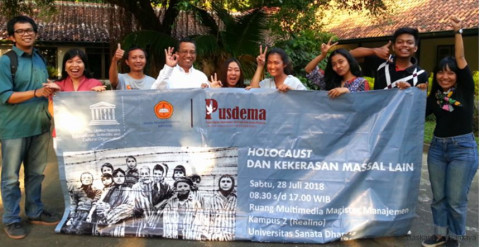 “Esperamos ayudar a los docentes indonesios a informar mejor a sus alumnos sobre las cuestiones relativas al Holocausto y otros genocidios” 2018-11-09 Interview with Baskara T. Wardaya on education about the Holocaust and genocide in Indonesia Baskara T. Wardaya is the director of the Centre for Democracy and Human Rights Studies (PUSDEMA) at Sanata Dharma University in Yogyakarta, Indonesia. In December 2017, he participated with Juharyanto from the State University of Malang, East Java, and Kartika Pratiwi from Kotakhitam Forum, Yogyakarta, Indonesia the International Conference on Education and the Holocaust (ICEH). With support of UNESCO and the U.S. Holocaust Memorial Museum (USHMM), the team has consequently developed a series of workshops on education about the Holocaust and genocide for Indonesian teachers. The first workshop was held on 28 July 2018 at Sanata Dharma University. Why is it important to teach and learn about the Holocaust and genocide in Indonesia? In Indonesia, the Holocaust is a topic that is rarely discussed in public, in the media, as well as among academics. Indonesians have very little access to resources on this topic and there are very few Indonesian academics, who are experts in this field. In general, people’s knowledge about and their interest in the history of the Second World War and the genocide of the Jewish people is rather limited. As educators, we cannot afford to let an unspeakable atrocity like that slip from human collective memory. The Holocaust was one of the darkest chapters in human history, and we should study it and draw as much lessons as we can from it. These lessons, in turn, are very important and useful for teaching and learning about other cases of genocide and human rights violations, including those that took place in Indonesia. In 1965, between 500.000 to 1.000.000 Indonesian civilians became victims of mass killings, because they were allegedly supporting communist ideas. Until today, there is a strong general resistance toward any discourse about these past human rights abuses. Attempts of dealing with the past are usually met by a strong opposition. This affects particularly survivors and victims, whose perspectives are often neglected. In addition to that, strong anti-Israeli and anti-Jewish sentiments are unfortunately quite present in Indonesia. This is why it is very important for us Indonesians to learn about the Holocaust. We need to teach and learn not only what happened, but also why and how it happened, who was involved, and what was its long-term impact. Learning about this devastating event can help us to draw lessons that are important to face our own violent past and problems in the Indonesian society today. How does your project contribute to the advancement of education about the Holocaust and genocide in Indonesia? With our project we aim to help Indonesians, especially teachers, to be more familiar with topics related to the Holocaust and other cases of human rights abuses. To achieve this, we are holding two workshops for teachers at Sanata Dharma University, Yogyakarta. The first workshop took place on 28 July 2018. During this workshop, we introduced participants to the history of the Holocaust and provided detailed background information on its context and its social, political, religious and personal dimensions. We also provided teaching materials tailored to teaching and learning about the Holocaust and addressing the challenging human rights situation in Indonesia. We have encouraged the participants of the first workshop to integrate these materials and new insights into their lessons. The second workshop that we will organize in September 2018 will give teachers the opportunity to share and reflect upon their experiences. There will be time to discuss classroom practices to teach about the Holocaust and other human rights issues. We hope that our workshops will allow teachers to better inform their students about these important topics and to generate interest to learn more about them and their relevance today. How did you help workshop participants to approach the topic? We used different approaches to involve teachers in our workshop sessions. One was by way of personal stories: when we were in Washington to attend the International Conference on Education and the Holocaust (ICEH), we were introduced to Alfred Munzer, who survived the Holocaust as a child, because he was hidden by an Indonesian family that was living in the Netherlands. During the workshop we used his story to illustrate how the history of the Holocaust can be connected to Indonesia in unexpected ways. We screened a documentary about Alfred Munzer that shows how he harbors a strong emotional connection to Indonesia until today. To further link lessons from the history of the Holocaust to Indonesia, we also discussed the human rights violations that took place in Indonesia in the 1960s. Many of the lessons from the Holocaust, like the dangers of propaganda and scapegoating certain demographic groups, can also be applied to our national violent past. Through discussing previous knowledge of these two historical events and by building on this foundation to create a deeper understanding, we hope to motivate teachers to share this knowledge with their students. For this reason, we also provided the participating teachers with teaching materials and methodologies to help them build their own lesson plans. The feedback we have received from workshop participants reveals that there is a great motivation to put this new knowledge into practice. After the workshop, one teacher said: “As an educator I have a moral obligation to teach my students about the Holocaust and other cases of human rights violations that took place in the past.” Another workshop participant pointed out that “a tragic event like the Holocaust can happen anywhere. Because of that we need to learn about the Holocaust [and from its lessons]. We need to teach our students, as part of the younger generation, to prepare for a better life together.” What do you hope to achieve with your project? We think that it is relevant for learners in Indonesia and across the world to learn about the Holocaust, even if their country has not been directly affected by these historical events. Such education can help learners to understand that the genocide of the Jewish people was a tragedy that reached far beyond its victims and perpetrators and from which we have to draw lessons for all of humanity. We hope that our projects contributes to that. We aim to help high school teachers and students ”to become proactive contributors to a more peaceful, tolerant, inclusive and secure world." This is one of the objectives of Global Citizenship Education and part of the Education 2030 Agenda. We also hope to raise awareness for the violence that shook Indonesia in the 1960s and the ways it has marked Indonesian society. We hope that a better understanding of this past will sensitized learners to recognize similar patterns in the future and to prevent such events from happening again. How has the support of UNESCO and the USHMM been beneficial for the success of your project? UNESCO and the USHMM are two internationally-known and highly-respected institutions. Both institutions have been a great support from the beginning of our project: from first initiating the idea of holding a workshop on Holocaust education in Indonesia during the 2017 ICEH to supporting the implementation of our project today. The ICEH helped us to realize that education about the Holocaust and genocide can be implemented on a global level and that there are many education leaders around the world engaged in the same topics as us. That was a highly motivating experience. We are also very grateful for the financial support we have received from UNESCO and the USHMM and the international leverage both institutions provide to us. Thanks to all of this, we can show that what we are doing at our center at Sanata Dharma University in Indonesia is part of a global initiative that prepares young people to work for a better collective future as members of a common humanity. More on Education about the Holocaust and genocide URL:https://en.unesco.org/news/we-hope-help-indonesian-teachers-better-inform-their-students-about-holocaust-and-genocide?language=es
 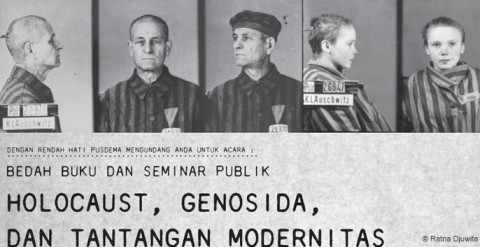 UNESCO-supported Indonesian conference on education about the Holocaust attracts wide interest 2018-11-09 With the support of UNESCO and the U.S. Holocaust Memorial Museum, a team of Indonesian educators organized on 6 October 2018 a public seminar on the “Holocaust, Genocide and Contemporary Challenges,” followed by a private teachers’ workshop at the Centre for Democracy and Human Rights Studies (PUSDEMA), Sanata Dharma University in Yogyakarta. More than 160 people, including witnesses of the 1965 mass killings in Indonesia, educators, university students and academics, attended the event. The morning session featured a discussion about the key findings of the book “Holocaust and Modernity: In the Shadows of Auschwitz” in presence of the author Dr Antarini Arna, Prof. Dr. A Sudiarja and Dr. Yoseph Yapi Taum from Sanata Dharma University. “We needed a lot of extra chairs to accommodate everybody,” said Baskara T. Wardaya, director of PUSDEMA and team member of the Indonesian project team. “There was an immense interest in the topic, which was new to many in the audience.” The seminar also included a video message by Holocaust survivor Alfred Munzer, recorded by the U.S. Holocaust Memorial Museum. Dr. Munzer survived the Holocaust in the Netherlands as a hidden child, protected by an Indonesian family. He addressed the audience and thanked them for their interest to learn and teach about the atrocities committed by the Nazi regime and their commitment to prevent future genocide. The public seminar was followed by a private workshop for 30 high school teachers and students in the afternoon. It was the second time the Indonesian project team organized such a workshop. “This second workshop allowed teachers to present how they had integrated the knowledge acquired during the first workshop into their classrooms. Some teachers were even accompanied by their students,“ explained Baskara. “They were all very enthusiastic. Some students showed short documentary films on the Holocaust and on the 1965 mass killings in Indonesia that they had produced.” The event was organized within the framework of the International Conference on Education and the Holocaust (ICEH), a capacity-building programme organized by UNESCO and the U.S. Holocaust Memorial Museum that aims to globally advance the institutionalization of education about the Holocaust and genocide. Indonesia participated with a team of educators in the second ICEH in December 2017. For more information about the project and the first workshop read this interview with Baskara T. Wardaya and visit the ICEH project page. URL:https://en.unesco.org/news/unesco-supported-indonesian-conference-education-about-holocaust-attracts-wide-interest
 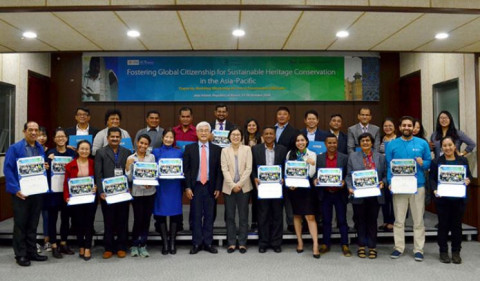 Fostering Global Citizenship for Sustainable Heritage Conservation among Local Government Officials 2018-11-01 A joint workshop with UNITAR CIFAL Jeju was held during 17-20 Oct 2018 Heritage sites have been damaged or destroyed as a result of direct hits, or as collateral damage related to armed conflicts, terrorism, and climate change. These challenges call for global citizens who recognize the value of heritage and put concerted efforts to protect the non-renewable resource beyond national boundaries. Against this background, APCEIU and UNITAR CIFAL Jeju International Training Center co-organized a Workshop on Fostering Global Citizenship for Sustainable Heritage Conservation for four days between 17 and 20 of October 2018 in Jeju Island, Republic of Korea. This workshop was designed for local government officials from the Asia-Pacific region to equip them with knowledge and skills on global citizenship and sustainable heritage conservation. The participants have analyzed the current status of their local heritage conservation to identify issues and challenges faced by communities, and discussed on the critical role of citizens and communities along with policies to ensure the sustainable conservation of heritage. A total of 23 participants from 15 countries consisting of officials from national and local government as well as local organizations related to heritage policy and management attended the workshop. This workshop aimed to enhance participants’ understanding of global citizenship and leadership capacity to implement innovative practices of heritage conservation for sustainable development. At the opening of the workshop, mentioning numerous global challenges that threaten the sustainable life and development, Director Utak Chung stressed the importance of local government officials’ roles by reminding them of their assumed role and responsibility to bring changes to their own society. The workshop was facilitated in the participatory format through presentations, dialogue, group works and activities to help participants deepening their understanding on sustainable heritage conservation and fostering global citizenship. During the four days of the workshop, participants presented their case studies, exchanged knowledge as well as opinions and at the end, established action plans to be implemented in their respective local settings. This workshop was a platform for local government officials to build capacities and build up network in the Asia-Pacific region. URL:Fostering Global Citizenship for Sustainable Heritage Conservation among Local Government Officials > APCEIU News - APCEIU (unescoapceiu.org)
  Connection between Global Citizenship Education and the SDGs will be explored during Forum at UN Headquarters 2018-11-01 31 October 2018- The Asia-Pacific Centre of Education for International Understanding - APCEIU is organizing, jointly with the Permanent Mission of the Republic of Korea to the United Nations, the 2018 UN Global Citizenship Education Forum under the theme "Global Citizenship Education as a Key Enabler of SDGs". The event will take place at United Nations Headquarters in New York on 13 November 2018. The United Nations and its agencies have elevated the concept of global citizenship education (GCED), which aims to empower people to develop the understanding, skills and values to take action to resolve global challenges and contribute to a more peaceful, tolerant, inclusive and secure world. GCED contributes to the realization of the values and vision of the United Nations, and the Sustainable Development Goals (SDGs) in particular, by fostering respect for human dignity, strong and peaceful relationships with diverse people, support for people in need, and environmental responsibility. Progress toward achieving the Goals depends on the actions of global citizens who are motivated to uphold the values and vision of the United Nations at the local, national and international levels. Mutual respect and understanding, tolerance, diversity, security and sustainable development as well as prevention of violent extremism. This Forum will highlight the key dimensions of GCED. This main objectives are, among others, to showcase and share the ongoing efforts to promote GCED through showcasing best practices and experiences from the field in implementing SDG 4.7, guide participants to identify a set of policy opportunities and imperatives for the effective implementation of GCED, and, inform about the latest trends and developments underpinning the post-2015 education agenda, specifically GCED. It will bring together officials of ministries of education, national research and development institutes, ambassadors from the Permanent Missions to the United Nations, delegates from international organizations and civil society from concerned fields. For more information please visit this website URL:https://academicimpact.un.org/content/connection-between-global-citizenship-education-and-sdgs-will-be-explored-during-forum-un
 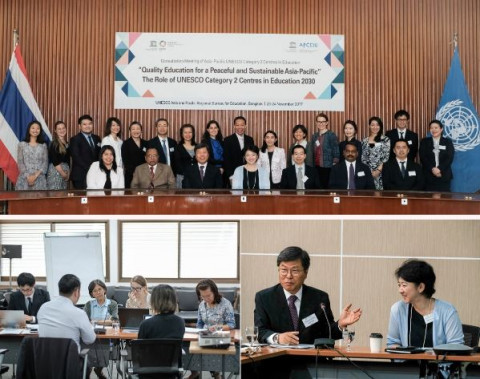 Regional Collaboration for SDG 4.7 explored at the Consultation Meeting of the Asia-Pacific UNESCO Category 2 Centres in Education 2018-10-30 The Consultation Meeting of the UNESCO Category 2 Centres in Education, entitled “Quality Education for a Peaceful and Sustainable Asia-Pacific: The Role of UNESCO Category 2 Centres in Education 2030” was held from 23 to 24 November 2017 in Bangkok, Thailand. Co-organized by the UNESCO Asia and Pacific Regional Bureau for Education (UNESCO Bangkok) and APCEIU, the meeting aimed to share the achievements and challenges of the participating organizations in the implementation of SDG 4 and to identify ways within their work plans on how to promote SDG Target 4.7 as a cross-cutting theme. This meeting is a first of its kind, which serves as an important opportunity to reflect on the year that was and open the discussion on how to promote synergies and increase the impact of planned activities together. The meeting gathered 25 participants from UNESCO Category 2 Centres in the Asia-Pacific, as well as Category 1 Institutes, relevant UNESCO field offices and UNESCO regional bureaus. The participating UNESCO Category 2 Centres include existing centres (APCEIU, INRULED, SACTD, SEA CLLSD), and the newly established centres (ICHEI, IMLI), making up to a total of six centres in education located in the region. The said centres are as follows: Asia-Pacific Centre of Education for International Understanding (APCEIU), Seoul, Republic of Korea International Research and Training Centre for Rural Education (INRULED), Beijing, People’s Republic of China South Asian Centre for Teacher Development (SACTD), Meepe, Sri Lanka South East Asia Centre of Lifelong Learning for Sustainable Development (SEA CLLSD), Manila, Philippines International Centre for Higher Education Innovation (ICHEI), Shenzhen, China International Mother Language Institute (IMLI), Dhaka, Bangladesh In her welcoming remarks, Ms Maki Hayashikawa, Director ai of UNESCO Bangkok extended her gratitude to APCEIU for contributing to the organization of the meeting. She also stated that “The meeting is timely as we have just finished with the General Conference, and UNESCO is in the process of finalizing its work plans for 2018-2021”. Reflecting the message from UNESCO Bangkok, Mr Utak Chung, Director of APCEIU, has mentioned that within the challenging environment that UNESCO is facing, cooperation among UNESCO entities, including regional bureaus, field offices, Category 1 Institutes and Category 2 Centres, is crucial in realizing the goal of the Organization, including SDG 4. The Meeting explored and identified the role of UNESCO Category 2 Centres in Education 2030 by reinforcing cooperation and community-building and sharing achievements and strategies for realization of SDG 4 in the Asia-Pacific. It also explored possible areas of cooperation between UNESCO Category 2 Centres, Category 1 Institutes and Field Offices, with particular focus on SDG Target 4.7. The sessions on the first day included presentations from participating institutions on implementation and actions of SDG 4, with a special focus on SDG 4.7. Followed by the presentations, a mapping activity was held to identify SDG 4.7 activities and actions of each participating organization to explore the status of the SDG 4.7 implementation in the region. It was identified that many of the participating organizations have activities that focus on capacity-building of educators and research and development. Following this mapping activity, group discussions focusing on collaboration, particularly on mainstreaming SDG 4.7 in SDG 4 implementation activities of the organizations took place. The meeting ended with a presentation of UNESCO Bangkok on its plans for the new UNESCO biennium (2018-2019), sharing the status of the region on SDG 4, and areas of possible collaboration. A communications strategy between UNESCO bureaus, field offices, Category 1 Institutes and Category 2 Centres was proposed to sustainably promote cooperation. Joint programming, including the co-organization of activities that tackle the diverse topics of SDG 4.7 and the topics that different UNESCO Category 2 Centres are covering, has been proposed for further discussion in 2018. URL:Regional Collaboration for SDG 4.7 explored at the Consultation Meeting of the Asia-Pacific UNESCO Category 2 Centres in Education > APCEIU News - APCEIU (unescoapceiu.org)