
News
Catch up on what’s happening in the world of global citizenship education.
1,668 results found
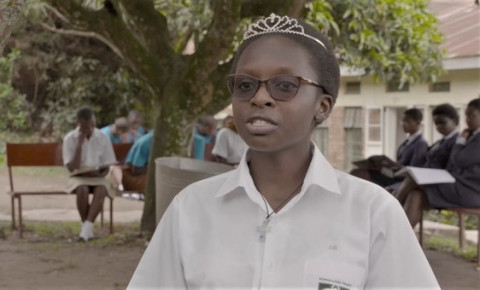 Climate change: educating students to fight the crisis 2020-03-13 With the latest UN climate report containing worrying evidence that climate change is having a major effect on all aspects of the environment, how can teachers help children and adults to sort through the growing mass of information, avoid being overwhelmed, and come to an understanding of the challenges, and potential solutions, to what the UN Secretary-General has called “an existential crisis”? A UN programme for schools is looking to make education a central part of the international response to climate change, and empower students with the knowledge they need to fight the crisis, and adapt to its impacts. For Natukunda Edetruda, a student at Immaculate Heart School, Uganda, it is important for young people to play a key role in fighting climate change. “The future lies in the hands of the youth, and the youth have a role to play to either destroy it or to keep it. I believe that change begins with an individual and, as an individual, I believe that I should be empowered to protect the environment”. Natakunda’s school is one of 258 educational establishments, in 25 countries, that took part in a pilot project organized by the UN Educational, Scientific and Cultural Organization (UNESCO) Associated Schools Network (ASPnet), aimed at integrating sustainability, including climate action, into every aspect of school life. Students and teachers at Immaculate Heart school have taken part in a diverse range of sustainability-related activities, including using recycled glass to make glaze for use in ceramics classes, and constructing a water filter to prevent diseases associated with dirty water. Other schools in the programme focused on improving the built environment. Waldorf School in Namibia has offset the environmental impact of the school building by planting trees and vegetation, and St. Jude School in Costa Rica has replaced its air conditioners with more environmentally-friendly alternatives, and the students of Cours Saint Marie de Hann in Senegal made a hanging garden from recycled bottles and tyres. The feedback from schools has been extremely positive, demonstrating a number of positive outcomes. Participating schools greened their premises, improving water, waste and energy management, and the overall health and well-being of school communities; students and teachers developed a stronger environmental conscience, and a vision of how their schools and communities can become more sustainable, and resilient to climate change. "Schools can empower students to change their behaviour and take action for the planet Sabine Detzel, outgoing International Coordinator, UNESCO Associated Schools Network" “There is an enormous wave of optimism that comes out of a project like this’ says Sabine Detzel, outgoing International Coordinator of ASPnet. “You see that people are interested to engage and are ready to do things, and that schools, in a very short time, can be transformed so that they motivate and empower students to change their behaviour and take action for the planet”. The success of the pilot project, which ran from 2016 to 2018, has prompted ASPnet to invite all its member institutions – some 11,500 schools in 180 countries – to adopt a similar approach and develop action plans to counter climate change at the local level. Getting climate-ready The UNESCO programme demonstrates the importance of making climate action a part of every aspect of school life, from teaching to the way schools are run, and the impact they have on the local community. The agency has produced a guide for schools, called Getting Climate-Ready, which advocates for this “whole-school” approach. Several benefits have been identified by teachers, such as more meaningful and hands-on learning opportunities, significant reductions in the schools’ ecological footprints, and savings through more efficient use of resources. For example, at Colégio Israelita Brasileiro, a school in Rio de Janeiro, everyone at the school, from janitors to teachers, students and support staff, participates in climate-related learning activities. These include building solar and bamboo bicycle racks, and converting used cooking oil into biodiesel. The activities have created bonds between different members of the school community, and brought about a sense of belonging and pride. At the First Experimental Lyceum, a school in Gennadeio, Greece, an innovative approach has been taken to climate action teaching: biology and chemistry students worked in groups to investigate climate change, virus transmission and the dynamics of ecosystems, using computer simulations. The findings were then applied to their school building, to find its environmental weaknesses and develop a plan to improve it. This approach was found to engage students, and enrich their knowledge about real-world problems. Whilst some subjects have an obvious link to climate action (for example, geography and the sciences), the guide suggest ways that many other subjects can include the topic. History, for example, can examine how societies have, in the past, reacted to environmental challenges. Language and literature classes can help students to develop the communication skills needed to respond to local and global issues, mathematics students can produce graphs showing the change in school energy use, and civics students can interview local officials on the actions they are taking to address the problem. ‘Almost all countries’ educating children about climate change Encouragingly, nearly all countries have committed to climate change education, a UNESCO report released in December 2019 has revealed. The study found that the most common commitment is to the raising of public awareness, and that cognitive learning is more commonly discussed (i.e. integrating climate knowledge into classroom teaching), rather than social and emotional or behavioural learning. However, it also showed that actual progress is currently hard to monitor, because of a lack of data. The UN is calling for nothing less than a transformation of the global economy in which technology, science, finance and ingenuity are all focused on ensuring a sustainable future for all. However, this will only happen if school-leavers have the skills needed to answer the demands of this new, greener economy, and that will require strong leadership from all sectors of society, including governments, international organizations, the private sector and civil society. ** ASPnet Established in 1953, ASPnet contributes to the transformation of education systems and policies, through the creation of innovative content and teaching techniques, current membership covers over 11 500 schools from all levels of education in 180 countries, ASPnet is currently looking for partnerships with organizations interested in engaging with climate change education, and willing to contribute funding. Interested organizations can email ASPnet here. URL:https://news.un.org/en/story/2020/03/1059151
  Предстоящее Десятилетие языков коренных народов (2022–2032 гг.) будет сосредоточено на правах носителей языков коренных народов 2020-03-09 Participants at the High-level event, “Making a decade of action for indigenous languages,” on 28 February issued a strategic roadmap for the Decade of Indigenous Languages (2022-2032) prioritizing the empowerment indigenous language users. More than 500 participants from 50 countries, including government ministers, indigenous leaders, researchers, public and private partners, and other stakeholders and experts, adopted the Los Pinos Declaration, at the end of the two-day event in Mexico City, which was organized by UNESCO and Mexico. The Declaration places indigenous peoples at the centre of its recommendations under the slogan “Nothing for us without us.” The Declaration, designed to inspire a global plan of action for the Decade, calls for the implementation of the internationally recognized rights of indigenous peoples, expressed notably in the UN Declaration on the Rights of Indigenous Peoples of 2007, the UN System-wide Action Plan (SWAP) on the Rights of Indigenous Peoples of 2017, and other standard-setting instruments such as UNESCO’s Convention against Discrimination in Education (1960),the UN’s International Convention on the Elimination of All Forms of Racial Discrimination (1965), International Covenant on Civil and Political Rights, and International Covenant on Economic, Social and Cultural Rights (1966). In its strategic recommendations for the Decade, the Los Pinos Declaration emphasizes indigenous peoples’ rights to freedom of expression, to an education in their mother tongue and to participation in public life using their languages, as prerequisites for the survival of indigenous languages many of which are currently on the verge of extinction. With regard to participation in public life, the Declaration highlights the importance of enabling the use of indigenous languages in justice systems, the media, labour and health programmes. It also points to the potential of digital technologies in supporting the use and preservation of those languages. Building on the lessons learnt during the International Year of Indigenous Languages (2019), the Declaration recognizes the importance of indigenous languages to social cohesion and inclusion, cultural rights, health and justice and highlights their relevance to sustainable development and the preservation of biodiversity as they maintain ancient and traditional knowledge that binds humanity with nature. Current data indicates that at least 40% of the 7,000 languages used worldwide are at some level of endangerment. While reliable figures are hard to come by, experts agree that indigenous languages are particularly vulnerable because many of them are not taught at school or used in the public sphere. More statistical data will become available once UNESCO’s Atlas of Languages, a database about practically all human languages, becomes available later this year. **** More about the International Year of Indigenous Languages and its outcomes URL:https://en.unesco.org/news/upcoming-decade-indigenous-languages-2022-2032-focus-indigenous-language-users-human-rights
 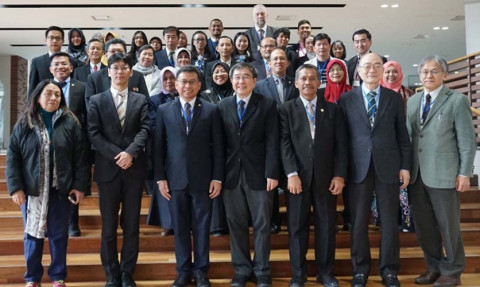 SEAMEO-The University of Tsukuba Symposium VIII: Education for Inclusive Growth on 4th Industrial Revolution for Society 5.0 2020-03-01 he University of Tsukuba Japan as one of the active Affiliate member of SEAMEO has worked collaboratively in many areas with SEAMEO Secretariat since the beginning of its membership. One of the long-established collaborations between both institutions is SEAMEO-The University of Tsukuba Symposium that was convened annually since 2013, with the constant support of the Ministry of Education, Culture, Sports, Science and Technology, Japan. The 8th SEAMEO-The University of Tsukuba Symposium was held on 13-14 February 2020 at Tokyo Campus of the University of Tsukuba, Japan. With the theme ‘Education for Inclusive Growth on 4th Industrial Revolution for Society 5.0,’ the symposium aimed to provide a platform for clarifying the emerging issues in educations shaped by the fourth industrial revolution, and for sharing educational reform, challenges, and issues within the scopes of global citizenship beyond region, education for sustainable development, human characters developed through school subjects, and soft skills and lifelong learning in this fast-changing Society 5.0 driven by Industry 4.0. The symposium has been successfully convened with a total of 54 Participants who actively engaged during the event. The symposium managed to presents one Keynote address during the opening, three keynote speeches in a plenary session, and a total of 20 paper presentation in five plenary sessions. Thirteen SEAMEO Centres represented by the Directors or Deputy Director shared their flagship programmes and research findings related to the Symposium theme. Professor Dr Kiyoshi Karaki, Chair of Global Teacher Education Committee, the University of Tsukuba, Japan welcomed all delegates in his welcoming remarks and extended his appreciation toward sustainable collaboration between SEAMEO and the University of Tsukuba. Later, in his welcome address Mr Yoshihide Miwa, Director, Office for International Strategy Planning, International Affairs Division MEXT, Japan shared various efforts on SDGs that carried out at universities, elementary, middle and high schools in Japan, and how the education sector in Japan responded to the Society 5.0. Dr Kritsachai Somsaman, Deputy Director for Administration and Communication, SEAMEO Secretariat, recalled the recommendations from the 4th Strategic Dialogue for Education Ministers 2019 in Kuala Lumpur that call for all SEAMEO Units to commit to inclusive and equitable education and lifelong learning for all, using technology to improve learning outcomes and work collaboratively with international and regional organisations and partners as well as stakeholders to train teachers and learners to thrive in the future of Artificial Intelligence and Digital Era. He iterated that the theme of symposium "Education for Inclusive Growth on the 4th Industrial Revolution for Society 5.0" align with that recommendation, encourage the delegates to address these concerns, seeking significant input not only within and between SEAMEO units but also substantive engagement by the Ministries of Education and key education players. Dr Bundit Thipakorn, Senior Vice President for Academic Affairs King Mongkut’s University of Technology Thonburi, and Former Secretary General, Ministry of Education, Thailand delivered his keynotes by emphasizing the needs for improvement in education and training frameworks to prepare people with the flexibility and critical thinking skills that students will need in the future workforce. Professor Masami Isoda, the Director of CRICED, The University of Tsukuba, thanked all keynote and panel speakers and all delegates for their active participations to make the symposium successful. He invited all speakers to submit full papers for consideration in the SEAMEO Journal publication. Finally, he extended his invitation for the next SEAMEO- The University of Tsukuba Symposium IX in 2021 with the proposed theme ‘Resilience for Global Citizenship.’ URL:https://www.seameo.org/Main_news/193
 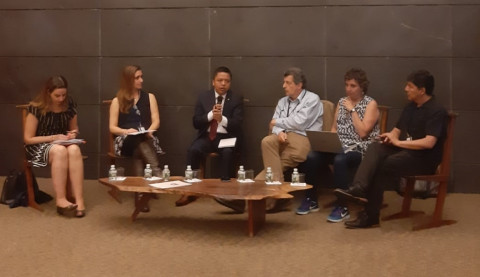 Conversatorio paralelo al Foro de la ONU: “Hay que educar para la ciudadanía y la democracia” 2020-01-06 During the event organized by CLADE, the challenges of education in Latin America and the Caribbean were addressed, in a context of setbacks for human rights and multilateralism, as well as of fragility of democracies. Leer + Review of SDG 4: “Quality education must be centered on people and their dignity” “One of the main challenges is to guarantee educational quality and, for that, reflect on what kind of quality we want, towards the guarantee of an education that trains people for global citizenship and the strengthening of democracy.” This was one of the reflections that were shared during the high-level discussion “Human rights at risk: impacts for education in Latin America and the Caribbean.” The meeting was held yesterday (July 10) in New York, in the context of the UN High-Level Political Forum, and as an initiative of the Latin American Campaign for the Right to Education (CLADE). The participants in the opening table of the event were: Héctor Alejandro Canto Mejía, Deputy Minister of Education of Guatemala; Naiara Costa, from the Division of the SDGs (Sustainable Development Goals), Department of Economic and Social Affairs of the United Nations (UN / DESA); Roberto Bissio, from Social Watch; and Camilla Croso, general coordinator of CLADE. During the discussion, the challenges of education in the region were addressed, in a context of setbacks for human rights and multilateralism, as well as of fragility of democracies. Cultural diversity; school coverage in primary and secondary school; teacher training; migration; respect for diversity and gender equality in education; educational financing; the increased privatization, while public systems are stigmatized; and the challenge of guaranteeing a quality lifelong education for all, were topics highlighted in the presentations. “All human rights are at risk when we do not comply with the human right to education,” said Camilla Croso at the opening of the conversation. Next, the Deputy Minister of Education of Guatemala, pointed out some challenges for the realization of the human right to education in his country. “The main challenges are guaranteeing coverage and, in parallel, advancing the rate of completion, transition from primary to secondary school, quality and equity in the education system,” he said. He added as another challenge the guarantee of quality lifelong education for all. “An education that provides training for global citizenship and democracy.” Roberto Bissio emphasized the importance of ensuring human rights and protecting the people who defend these rights beyond the achievement of the Sustainable Development Goals. “The central question is to what extent the SDGs legitimize the struggle for rights. We can not forget that in Latin America and the Caribbean human rights defenders are at constant risk,” he said. Naiara Costa addressed the role of the United Nations and multilateralism for the realization of human rights and the promotion of sustainable development. “To achieve the SDGs, it is essential to connect the global level with the local, national and regional levels”, he said. Debate Representatives from the following organizations: Argentine Campaign for the Right to Education; Bolivian Campaign for the Right to Education; Campanha Nacional pelo Direito à Educação – Brazil; Forum for the Right to Public Education in Chile; Salvadoran Network for the Right to Education; Collective of Education for All of Guatemala; Forum Honduras Honduras; Peruvian Campaign for the Right to Education (CPDE); Socio-educational Forum (Foro Socioeducativo), of the Dominican Republic; Popular Education Network among Women of Latin America and the Caribbean (REPEM); ILGALAC (International Lesbian, Gay, Bisexual, Trans and Intersex Association for Latin America and the Caribbean); Global Campaign for Education; ActionAid International; and EDUCO, among other organizations and networks, participated in the debate. Vernor Muñoz, from Global Campaign for Education, recalled, as an obstacle to education and other human rights, the criminalization of social protest, especially of students and teachers in different countries of Latin America and the Caribbean, which also operates in the symbolic field and in the media. Roberto Baeza, from ILGALAC, spoke about comprehensive sexual education and school violence against LGBTI people. “Gaps in inequality in education and other sectors are widened with the advance of fundamentalisms. The trans population does not have access to their right to education, they are who most leave the school because of experiences of discrimination,” he said. Marcela Browne, from the Argentine Campaign for the Right to Education, said that in the debate on the fulfillment of the right to education, it is necessary to ask: “What are the risks of external debt and tax fraud for educational justice in the region? New document During the event, CLADE launched the publication “Civil Society Advocacy for the Human Right to Education: Stories and Lessons Learned from Latin America and the Caribbean – Volume 3”. Read more and download the document here CLADE at the UN High-Level Political Forum Almost four years after the adoption of Sustainable Development Goal 4 (SDG 4), about education, the United Nations High-Level Political Forum (HLPF) 2019, official platform for monitoring the Sustainable Development Goals (ODS) internationally, took place from 9 to 18 July in New York. In this edition, the HLPF focuses on the revision of SDG 4, as well as goals 8 (decent work and economic growth), 10 (reduction of inequalities), 13 (climate action), 16 (peace, justice and solid institutions) and 17 (partnerships to achieve the objectives). CLADE participated in the HLPF and its side events with a delegation of 14 people from 9 countries: Argentina, Bolivia, Brazil, Chile, El Salvador, Guatemala, Honduras, Peru and the Dominican Republic. CLADE members in the countries that were reviewed by the UN this year (Guatemala and Chile) prepared reports with contributions on the status of SDG 4 at national level. In addition, CLADE members from Brazil and El Salvador prepared reports, highlighting the challenges of education in their territories, since these countries had indicated that they would participate in the review process carried out by the UN, but finally this did not happened. URL:https://redclade.org/en/noticias/conversatorio-paralelo-al-foro-de-la-onu-hay-que-educar-para-la-ciudadania-y-la-democracia/
 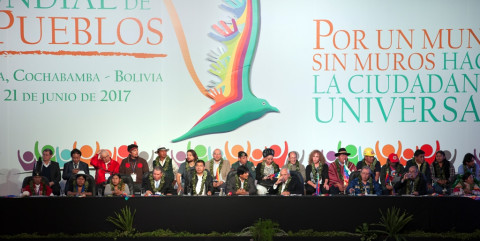 Declaration of the World People‘s Conference for a World without Walls towards Universal Citizenship 2020-01-03 The social movements and citizens of the world gathered in Tiquipaya, Bolivia, on June 20 and 21, 2017, after hearing the testimonies of migrants and refugees, and collectively debated from our historic memory and the plurality of our identities, adopt the following Declaration, in order to state our vision and proposals before the States and the International Community regarding the so-called migratory crisis. The peoples of the world are aware of the need to continue to push more strongly a new world order, whose characteristics are: The establishment of relations of complementarity, equity and solidarity between persons and peoples; the recognition and universalization of access to basic services as fundamental rights, which cannot be object of profit and speculation by private groups. The widest citizen participation in the elaboration and implementation of public policies transcending oligarchies, dynasties, monarchies and other forms of political hierarchies. A new international financial architecture, with no multilateral organizations at the service of transnational capital and to guarantee the social ownership of natural resources. Harmonious coexistence with Mother Earth and respect for her rights; assuming that nature can live without humans, but human beings cannot live apart from it, violating her rights and destroying the habitat. The construction of true peace, which is not only the absence of armed conflicts, but also the overcoming of structural violence that result in equitable access to wealth and development opportunities. We have verified as the main causes of this crisis, war armed conflicts and military interventions, climate change and huge economic asymmetries between and within States. These destructive situations have their origin in the dominant world order, which in its excessive greed for profit and appropriation of the common goods generates violence, promotes inequalities and destroys Mother Earth. The migratory crisis is one of the manifestations of the integral crisis of neoliberal globalization. Human mobility is a right rooted in the essential equality of human beings. However, in most cases, it does not respond to a voluntary decision of people but to situations of necessity that reach the extremes of forced migration. The pain associated to uprooting is accompanied by situations of injustice, exclusion, discrimination and exploitation suffered by people in transit and in receiving countries that violate their dignity, their basic human rights, and in many cases, endanger their own lives, are a plus. Hegemonic discourses, fostered by transnational media corporations, promote a negative view of migrants, hiding the contributions they make to the host countries’ economy, demographics, society and culture. We see with concern the advance of neo-colonial, intolerant and xenophobic positions that undermine cooperation among the peoples and constitute a real threat to world peace. Paradoxically, these positions are sustained from the centers of global powers, responsible for structural violence, planetary inequity and climate change, to the detriment of the creditors of social and environmental debt: the poor. That is why, from the social grassroots, we promote the following Decalogue of proposals to tear down the walls that divide us and build a Universal Citizenship that enshrines the right of all to have and fully enjoy the same rights, for living- well of humanity. To overcome the hegemonic perspective on migration policy that proposes a “regular, orderly and safe” migration management with a humanist vision that allows to “welcome, protect, promote and integrate” migrants. To reject the criminalization of migration that covers up false approaches to security and control. In particular, we demand the elimination of “detention centers for migrants”. To demand the destruction of physical walls that separate peoples; invisible legal walls that persecute and criminalize; mental walls that use fear, discrimination and xenophobia to separate us between brothers and sisters. In the same way, we denounce the media walls that disqualify or stigmatize migrants, and we are committed to promoting the creation of alternative means of communication. To create a world ombudsman of the peoples for the rights of migrants, refugees, stateless and in political asylum persons, and victims of human trafficking and smuggling, that promotes free mobility and human rights. We ask the people and government of Bolivia to manage the creation of a coordination secretariat to enforce the resolutions of this declaration of the World People’s Conference for a World without Walls towards Universal Citizenship. To require that governments create and/or strengthen Regional Citizenships that may allow the intraregional mobility and full exercise of rights, as a bridge towards a universal citizenship. To demand that public expenditures destined to war and criminalization of migrants be used for the creation of integration programs that guarantee full exercise of the rights of migrants and their families. To promote local policies conducive to integrating cities and societies where the rights to housing, healthcare, education, and social security of migrants are made effective during their daily life, under the principles of complementarity, solidarity, brotherhood and diversity. To convene all governments of the world to fight in a jointly manner against criminal networks that smuggle human beings, and to declare human trafficking and smuggling as a crime against humanity. To update, strengthen and advance the multilateral system and its international instruments vis-à-vis migrants, refugees and their families, specially: a) The “International Convention on the Protection of Rights of all migrant workers and members of their families” since it has not been ratified by any northern country receiving migrants; b) The Convention relating to the Status of Refugees under UNHCR and add new conceptions referred to displaced persons and climate refugees. c) To actively participate in the negotiation of the Global Compact that shall take place in 2018 at the United Nations; d) To proclaim the International Decade for a World without Walls towards a Universal Citizenship at the General Assembly of United Nations; Overcome the approach of “rigid borders” with a vision that understands them as bridges of integration for the unity among peoples and the reception of migrants, and with a vision that addresses the fight against transnational organized crime in a framework of cooperation between States. Promote living well in the places of origin of migrants so that mobility is always voluntary and not forced, as an effect of poverty, violence and climate change; denounce the impact of the irresponsible actions of transnational corporations and apply sanctions to those that violate the stay of the families in their place of origin. Promote popular mobilization on a global scale so that the inalienable rights of people are recognized in intra and international instances to overcome the blockades, interventions and walls unilaterally raised by the powerful to perpetuate inequality and social injustice in the world. URL:https://fsmm2018.org/declaration-of-the-world-peoples-conference-for-a-world-without-walls-towards-universal-citizenship/?lang=en
 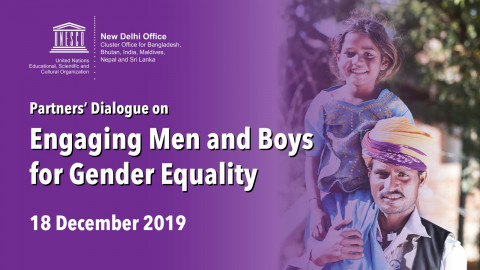 Transforming MENtalities and Promoting Gender Equality in India 2019-12-19 Against the background of the global and pervasive epidemic of violence against women, the United Nations Educational, Scientific and Cultural Organization (UNESCO) organized a Partners’ Dialogue on Engaging Men and Boys for Gender Equality on 18 December 2019, at the UNESCO House, New Delhi. The Dialogue witnessed the convergence of media, civil society organizations, donor agencies, bi-lateral and multi-lateral organizations, research institutions, and the private sector to discuss the challenges of addressing gender based violence in India and share lessons on engaging men and boys to work for Sustainable Development Goal 5 on Gender Equality. "UNESCO’s goal is to help erase gender based violence through the medium of education, culture and the sciences. We will support India in achieving its Sustainable Development Goals targets. This would require designing a conducive environment where men and boys are able to reflect on their roles, and become partners for equality, towards inclusion, peace and prosperity. This Dialogue has laid down a roadmap for partners in India to converge and take concrete steps in this direction." - Eric Falt, UNESCO New Delhi Director in his opening remarks A UNESCO preliminary stakeholders’ analysis presented during the Dialogue, identifies organizations and interventions working with men and boys across India to transform masculinities. The non-exhaustive analysis highlights the positive impact of campaigns like HeForShe (UnWomen), Mardon Waali Baat (The YP Foundation) and Bell Bajao (Breakthrough India), among many others. This analysis underscores the need for engagement with boys and men to eradicate gender based violence in India. The report further states that the social development ecosystem needs to prioritize the transformation of mentalities among boys and men. The Dialogue began with academics and thought leaders deliberating on the historical roots and conceptualization of masculinities (i.e. what it is to be a man in a given society), in India. A major barrier highlighted during the dialogue was lack of awareness on these issues together with the lack of alternative models for what it is to be a man, to counter balance the hegemonic or prevailing conception of masculinities, which contribute to gender inequality or violence against women. Subsequently, civil society and research organizations like the YP Foundation and The Abdul Latif Jameel Poverty Action Lab (J-PAL) presented findings of interventions that worked with men to address gender based violence and masculinities. The role of the private sector, multi-lateral bodies and national policy frameworks, was discussed in the final session of the day. The Dialogue concluded with the stakeholders identifying priority areas such as educational reforms, shifts in societal values and the role of community leaders. These thus delineates the path to move towards a society where men at the same time do not see their self-realization hindered by stereotypes or social constraints, and are empowered to make positive contributions to a peaceful and prosperous world where men and women can equally thrive. For further information contact:Rekha Beri, Public Information (r.beri@unesco.org)Nitya Agarwal, Public Information(n.agarwal@unesco.org) URL:https://en.unesco.org/news/transforming-mentalities-and-promoting-gender-equality-india
 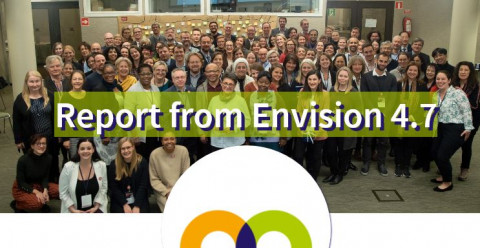 Report from Envision 4.7 2019-12-18 We have put together a report from our global event Envision 4.7 taking place in Helsinki in November 2019! The event brought around 200 people together to discuss ways to take the SDG Target 4.7 forward. In the report you can find summaries of all the speeches, panel discussions, workshops and working groups that were held at the event, together with a summary of discussions around all the different topics. You can also find pictures and drawings from the event at the report, you can find it from the link below! The atmosphere around our global event was also captured as a video, where you can see numerous of the event participants talk about the importance for SDG Target 4.7, transformative lifelong learning, the event itself and the roadmap that was co-created at the event. We truly hope you like it! But the story does not stop here – we are now in the process of setting up ways forward for the biggest outcome of Envision 4.7: a strong roadmap for the future implementation of SDG Target 4.7 in Europe. The event was supported by the Ministry for Foreign Affairs and the Ministry of Education and Culture of Finland. Many thanks to everyone who were involved at making the event and the roadmap happen! URL:https://www.bridge47.org/news/12/2019/report-envision-47