
News
Catch up on what’s happening in the world of global citizenship education.
225 results found
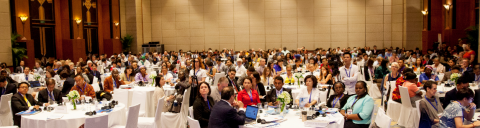
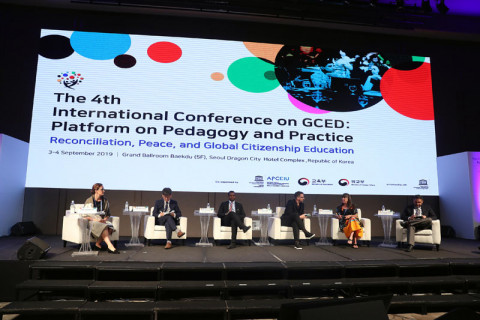 The 4th International Conference on Global Citizenship Education: Reconciliation, Peace, and Global Citizenship Education 2019-09-19 The 4th International Conference on Global Citizenship Education took place from September 3rd to September 4th at Seoul Dragon City Hotel. The conference was co-organized by the Asia-Pacific Centre of Education for International Understanding under the auspices of UNESCO (APCEIU), the Ministry of Education and the Ministry of Foreign Affairs of the Republic of Korea, in partnership with UNESCO. Under the main theme of ‘Reconciliation, Peace and Global Citizenship Education’, the conference explored GCED’s potential for building and maintaining long-lasting peace particularly in post-conflict societies and highlighted the need to promote the use of transformative pedagogy while also systematically mainstreaming GCED in terms of policy, curriculum and teacher training to fully harness its potential. At this year’s conference, over 700 education policy-makes, teachers, experts from the academia and the private sector, representatives from international and civil society organizations and youth representatives came to participate from 77 countries. Distinguished guests among the participants included Kim Sung Geun, Deputy Minister of School Innovation of the Ministry of Education of Republic of Korea, Kim Joon Hyung, Chancellor of Korea National Diplomatic Academy, Stefania Giannini, Assistant Director-General for Education, UNESCO, and Nihal Ranasinge, Secretary of the Ministry of Education of Sri Lanka. The International Conference on Global Citizenship Education sets itself apart with its interesting session composition that fosters active participation from the participants. Rather than unilateral presentations made by the speakers, the conference included a wide range of sessions from plenary sessions that offer an overall view of the conference, to various concurrent sessions with panel discussions, case presentations and participatory workshops. Through these sessions, the conference served as a discussion platform that not only emphasizes the importance of GCED itself, but also the connection between reconciliation and GCED, as well as how GCED can make a tangible contribution to the reconciliation process. Notably, this year’s EIU/GCED Best Practice Awards Ceremony was held during the conference, through which the awardees shared their cases with the other participants, encouraging the practice of GCED. After the opening ceremony, the first day’s events kicked off with a keynote speech by Prof. Lim Jie-Hyun, a history professor at Sogang University, under the theme of ‘Reconciliation, Peace and Transnational Perspectives on GCED’. Through his speech, Prof. Lim pointed out how collective distortion of memory that stems from nationalism can bring conflict and discord. He then put forward the formation of a global ‘mnemonic solidarity’ that transcends national boundaries as the main agenda for world peace and reconciliation in today’s era. The first plenary session featured a discussion among several expert panels under the theme of ‘Promoting GCED in the context of a difficult past and process of reconciliation’. This panel discussion highlighted the need for historical settlement and social consensus for reconciliation in order for a post-conflict society to make its way towards true cohesion by examining various cases of the Republic of Korea, Colombia, the Republic of South Africa, Canada and Rwanda. The second plenary session entitled ‘Realizing GCED’s potential for reconciliation: fundamental questions on learning and transformative pedagogy’, consisted of panel discussions and question and answer with GCED experts from Canada, Oman, Ethiopia and Malaysia. Throughout the session, the panels communicated with the audience on GCED’s capacity to transform education and bring about change on both the individual and the community, while insisting that GCED, as a transformative pedagogy that transforms attitudes and behaviors, should align itself with local communities and international affairs. At the following ‘GCED Play’, a group of elementary students performed a play around the theme of non-violence within classrooms and reconciliation. The play, as a product of the students’ creative efforts and the assistance of School Life and Culture Division, Korean Ministry of Education and the Foundation for Preventing Youth Violence (FPYV), delivered messages of reconciliation over school violence and adults that teach discrimination to children. Concurrent session 1, which was the last session of the first day, composed of free discussions on transformation from educators’, learners’ and communities perspectives under the main theme of ‘GCED transformative pedagogy from various perspectives for reconciliation’. At the participatory workshop facilitated by Suseong-gu Office, a local government in the Republic of Korea, for instance, the GCED Maker Clubs dealt with various topics such as the students’ definition of GCED and GCED’s relationship with Korea-Japan relations through a number of formats including skit and gallery walk. The second day started with a special dialogue between Cho Heeyeon, the Superintendent of Seoul Metropolitan Office of Education and Jun Morohashi, the Head of Executive Office and Regional Programme Coordinator of UNESCO Asia-Pacific Regional Bureau for Education. The Superintendent shared the Seoul Metropolitan Office of Education’s efforts for peace education and the global citizenship he experienced in regards to how an Iranian national under the threat of religious persecution, acquired refugee status with the help of his fellow students and the Office of Education. The following session entitled ‘Voices of Youth’ was a talk concert where youth speakers shared their experiences of GCED practice with the participants. The speakers, all participants of the UNSECO APCEIU’s 2019 GCED Youth Leadership Workshop left a deep impression upon the other participants through their stories of realizing the need for global citizenship and practicing it in the wake of events such as school closures and Russia-Ukraine crisis. The second concurrent session included diverse sessions on learning space, historical issues and transformative pedagogy and GCED in the digital age under the theme of ‘innovating GCED’s transformative pedagogy; trends that will bring about reconciliation’. The last concurrent session entitled, ‘systemic approach to mainstream GCED’, featured sessions on the role of policy facilitating GCED to be integrated into the education system, GCED curriculum development and teacher training. Specifically the session on policy provided much insight to the participants on what makes an effective policy by exploring education policies in South America, Southeast Asia and South Africa. At the closing ceremony, the very last session of the conference, Choi Soo-Hyang, the Director of Division for Peace and Sustainable Development of UNESCO’s Education Sector reflected on the lessons of the International Conference through her closing remarks, expressing her hopes that GCED would evolve as an international education movement with various names and forms in the near future. This year’s conference was highly credited for providing a basis for the educational community within the international community with the sharing of GCED practices as its medium and serving as a bridge between the developed and the developing countries, thus opening a sustainable platform for international cooperation on GCED. You can find more detailed information on the Conference at: http://gced.unescoapceiu.org/conference URL:The 4th International Conference on Global Citizenship Education: Reconciliation, Peace, and Global Citizenship Education > APCEIU News - APCEIU (unescoapceiu.org)
 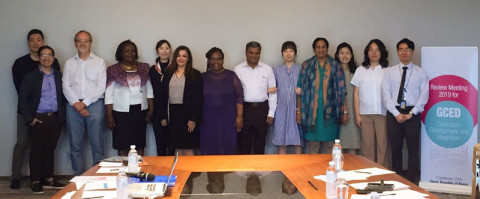 Review Meeting 2019 for GCED Curriculum Development & Integration 2019-09-11 APCEIU convened the Review Meeting 2019 for GCED Curriculum Development & Integration on 5 September 2019. This Meeting intended to provide a venue to share the results of the situational analyses conducted by national experts and international experts and to discuss roadmaps for development of GCED-integrated curricula in their countries--Kenya, Lebanon, Philippines and Sri Lanka. Furthermore, this Meeting also offered the representatives of each of the 4 beneficiary countries an opportunity to build GCED capacities by participating in the 4th International Conference on GCED. Through the Meeting, the participants were able to identify the challenges, the issues and the opportunities for GCED in the implemented and the intended curricula of each of the 4 countries. During the session for developing roadmaps facilitated by Mr Andy Smart from NISSEM* networking group, the participants had a chance to rethink the terminology concerning GCED-integrated curriculum and the importance of content and pedagogy. To conclude the 1st year of this 3-year project fruitfully, the 4 beneficiary countries will accelerate the implementation process from now on. Also, a total of 8 situational analyses reports (2 reports for each country) are expected to be published at the end of this year. *NISSEM: Networking to Integrate SDG Target 4.7 and SEL Skills into Educational Materials URL:Review Meeting 2019 for GCED Curriculum Development & Integration > APCEIU News - APCEIU (unescoapceiu.org)
 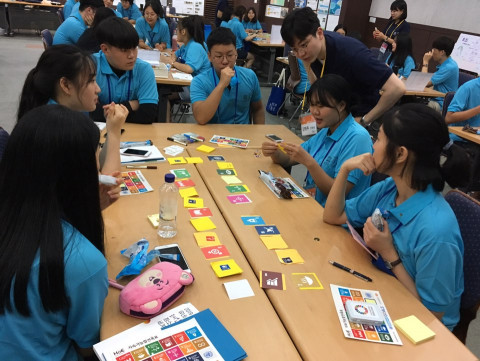 '2019 유네스코 레인보우 청소년 세계시민여행' 개최 2019-09-09 ▲ 각 학교에서 진행 중인 '레인보우세계시민 프로젝트'와 본인 생활속에서 실천하는 SDG(Sustainable Development Goal) 목표에 해당하는 카드를 골라서 조원들에게 소개하고 있다. 유네스코한국위원회는 지난 17일부터 19일까지 경기도 이천 유네스코평화센터에서 ‘2019 유네스코 레인보우 청소년 세계시민여행’을 개최했다. 2박 3일간 치뤄진 이 행사에는 ‘나의 변화가 세상의 변화를 만든다’는 구호 아래 ‘유네스코 레인보우 청소년 세계시민 프로젝트’에 참여 중인 고등학생 49명이 참가하여 세계시민의식의 실천을 위한 열띤 논의를 하였다. 참가 학생들은 멸종위기종 보호를 위한 노력을 소개한 고등학생 특강, 지역에 필요한 제품을 지역 사람들이 스스로 만들게 하는 소셜 벤처 특강, 난민과 양성 평등에 대한 주제 활동 등 다양한 세계시민 활동을 통해 ‘자신의 변화가 일으키는 나비효과’의 중요성을 배웠다. 또한 소속 학교의 레인보우 프로젝트를 공유하며 학교별로 당면한 문제에 대한 해결 방안을 함께 모색해 보았고, 세계시민협의회 활동을 통해 자신의 문제와 지역사회, 더 나아가 지구 공동체의 문제를 함께 고민해 보는 자리를 갖을 수 있었다. URL:https://www.unesco.or.kr/news/press/view/2300/page/0?
 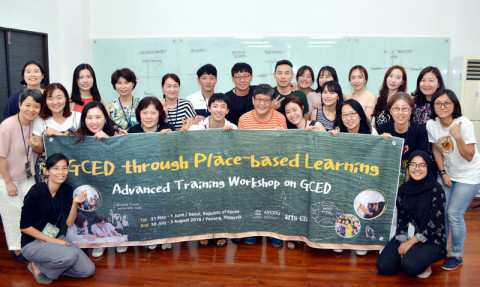 Sharing GCED Action Ideas Utilizing Place-Based Learning Approach 2019-09-02 An advanced training workshop to build capacity of Korean educators on developing and implementing GCED teaching methods was held in Malaysia. Co-organized by APCEIU and Arts-ED, a Malaysian educational NGO, the workshop hosted twenty primary and secondary school teachers from July 30 to August 3 in Penang. With ‘GCED through Place-Based Learning (PBL) Approach’ as the main theme of the workshop, participants explored the utility of PBL as a tool to implement GCED. The workshop featured experience-centered programmes such as PBL case studies, PBL field visits, lectures, and visits to local schools followed by action plan design and presentation. The participants could not only learn about the core principles of PBL but also observe actual cases of implementation at schools and the local community in Penang. They have also visited Chowrasta Market for two days, a famous traditional marketplace of Penang, as a fieldwork, which provided an opportunity to learn and apply PBL tools such as issue mapping and interviewing vendors and customers. Through this year’s workshop, participants had a chance to learn and reflect through case studies and fieldwork on PBL, a transformative learner-centered teaching method, while developing their own GCED projects through group discussion and feedback. Moreover, they visited schools that implement PBL principles to discuss with the Malaysian teachers concrete strategies that utilize local issues. Towards the end of the workshop, each group presented plans for their new projects based on the fieldwork as well as sharing GCED action ideas that utilize PBL approach in their own local context. APCEIU plans to highlight the potentials of PBL as a method to implement GCED while discovering and gathering future outcomes to introduce model cases to the domestic and international audience. URL:Sharing GCED Action Ideas Utilizing Place-Based Learning Approach > APCEIU News - APCEIU (unescoapceiu.org)
  APCEIU calls upon the collective efforts of GCED & ESD at the UNESCO 2019 Forum 2019-08-18 The UNESCO 2019 Forum on Education for Sustainable Development and Global Citizenship took place on 2-3 July 2019 in Hanoi, Vietnam, under the overarching theme “Learning and Teaching for Peaceful and Sustainable Societies: From early childhood to primary and secondary education”. This Forum was organized by UNESCO, in cooperation with the Ministry of Education and Training of Viet Nam and the Viet Nam National Commission for UNESCO, with the additional support of the Ministry of Education, Culture, Sports, Science and Technology of Japan (MEXT), the UNESCO Japanese Funds-in-Trust for the Global Action Programme on Education for Sustainable Development, and the Asia-Pacific Centre of Education for International Understanding (APCEIU). The Forum was kicked off with the opening and congratulatory remarks by the representatives of the organizers. APCEIU Director, Mr Hyun Mook Lim, in his remarks, highlighted the common vision of ESD and GCED which aims to make our world more just, inclusive, peaceful and sustainable. On top of that, he urged the collective efforts of ESD and GCED in a holistic way to mainstream them into curricula and policies despite some differences between them. Also, APCEIU organized concurrent session 5.2 entitled “The role of teacher training in promoting the social and emotional and behavioural dimensions of learning of ESD and GCED”. By bringing a panel of experts and practitioners together, the session provided rich insights based on the research results from the experiences in teacher exchange which had impacts on minds and attitudes of teachers and students. Furthermore, while sharing progress, achievements and challenges, the panelists discussed how we could make difference in teacher training to transform the learners’ mindset more effectively, with a focus on the international teacher exchange as one of the innovative ways in teacher training. The 2-day meeting comprised of a myriad of sessions such as panel discussions, town hall meetings, workshops and etc., addressed how the cognitive, socio-emotional and behavioural dimensions of Education for Sustainable Development and Global Citizenship Education are reflected in pre-primary, primary and secondary education. With approximately 340 stakeholders from the fields of GCED and ESD across the globe, this Forum successfully concluded pledging to get together again at the Forum in 2021. The upcoming Forum will be devoted to reviewing the global progress made in the areas of ESD and GCED enshrined in Target 4.7 of the Sustainable Development of Goal (SDG) 4 on Education. URL:APCEIU calls upon the collective efforts of GCED & ESD at the UNESCO 2019 Forum > APCEIU News - APCEIU (unescoapceiu.org) Photo credit: UNESCO HQ
 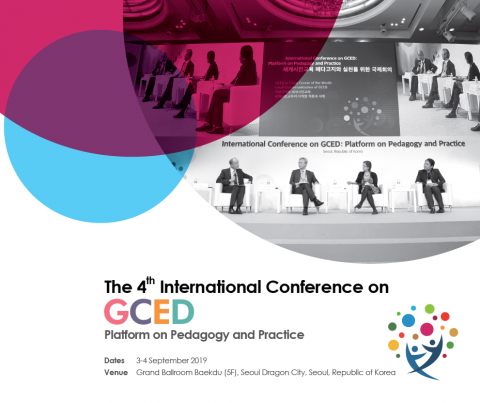 The 4th International Conference on GCED: Platform on Pedagogy and Practice 2019-08-03 Co-organized by the Asia-Pacific Centre of Education for International Understanding under the auspices of UNESCO (APCEIU), the Ministry of Education, and the Ministry of Foreign Affairs of the Republic of Korea, and in partnership with UNESCO, the 4th International Conference on GCED: Platform on Pedagogy and Practice will be held on 3-4 September 2019 at Seoul Dragon City Hotel Complex (Yongsan) in Seoul, Republic of Korea. Global Citizenship Education (GCED) aims to equip learners of all ages with knowledge, values, skills, and attitudes so that they can live together peacefully and become active and responsible citizens who will work together to tackle today’s pressing challenges. Through GCED, learners nurture respect for diversity and foster solidarity on the basis of a sense of belonging to a common humanity. With its incorporation under target 4.7 of Sustainable Development Goals (SDGs), it has been given fresh impetus as one of the key topics to be mainstreamed in education at all levels by 2030. As a result, APCEIU has organized an International Conference to promote GCED global implementation network, an educational goal adopted by the UN and UNESCO. APCEIU has organized annual international conferences on GCED since 2016. The conferences have dealt with topics ‘GCED for SDGs: From Commitment to Action,’ ‘In Pursuit of GCED in a Challenging Environment,’ and ‘GCED in Every Corner of the World: Local-Contextualization of GCED.’ The 4th International Conference on GCED in 2019 will focus on ‘Reconciliation, Peace, and Global Citizenship Education.’ This conference aims to demonstrate GCED’s unique potential in relation to reconciliation and solidarity, and that this potential can be fully harnessed first through promoting the use of transformative pedagogy, and second, by systematically mainstreaming GCED in terms of policy, curriculum and teacher training. Approximately more than 600 people policy makers, teachers, and experts from academia, international organizations, and NGOs are expected to participate. URL:The 4th International Conference on GCED: Platform on Pedagogy and Practice > APCEIU News - APCEIU (unescoapceiu.org)
 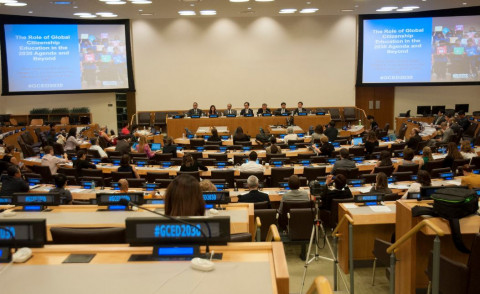 Engaging Stakeholders on GCED at the UN High-Level Political Forum 2019-07-18 This July, APCEIU is co-organizing and co-sponsoring four UN High-Level Political Forum Side Events on Global Citizenship Education with various institutions and government organizations at the UN Headquarters in New York. They are as follows: 1) Education for Global Citizenship: Empowering Our Interconnected World On 9 July, an event was held at the Permanent Mission of the Republic of Korea to the UN, entitled, "Education for Global Citizenship: Empowering Our Interconnected World". The objective of this side event was to highlight best practices and to share effective strategies for the advancement of Sustainable Development Goals. The event was co-organized by the NGO Steering Committee for an International Day of Education for Global Citizenship, UN DPI NGO Executive Committee and IVECA International Virtual Schooling. APCEIU co-sponsored this side event with other organizations, such as Permanent Mission of Austria to the United Nations, Permanent Mission of the Republic of Korea to the United Nations, Permanent Mission of Tunisia to the United Nations, Bridge 47 and more. 2) The Role of Transformative Education in Dealing with the Challenges of Our Times On 16 July, with the Permanent Mission of the Republic of Korea to the United Nations, Permanent Mission of the State of Qatar to the United Nations, United Nations Development Programme (UNDP) and other UN organizations, APCEIU will co-organize this side event regarding transformative education. It is expected that this side event will highlight various dimensions of transformative education, and will explore best practices and learn how to benchmark them in this globalized world. 3) Global Citizenship Education - Why is it important? Insights and cross cutting practices On 18 July, APCEIU, along with Finland, Fiji, Bridge 47 and Fingo will co-organize this event to explore GCED as a key to transforming societies in a meaningful and sustainable way. Speakers will be invited to discuss on how different dimensions of GCED will all connect to achieving Agenda 2030 and how it will be integrated as a fundamental part of formal and non-formal education practices and policies. Its aim is also to exchange best practices, consider challenges, and forge new partnerships for the implementation of Global Citizenship Education and Target 4.7. 4) 2019 Annual Celebration for International Day of Education for Global Citizenship On the evening of 18 July, APCEIU, along with many stakeholders at the UN, will co-sponsor the Annual Celebration for International Day of Education for Global Citizenship. This annual event provides a strong platform for global citizens around the world to assemble and share progress made in the previous years. This year’s event will spotlight SDG 4-Quality Education, in particular, SDG 4.7, and reaffirm the collective commitment for establishing International Day of Education for Global Citizenship at the United Nations. URL: Engaging Stakeholders on GCED at the UN High-Level Political Forum > APCEIU News - APCEIU (unescoapceiu.org)
 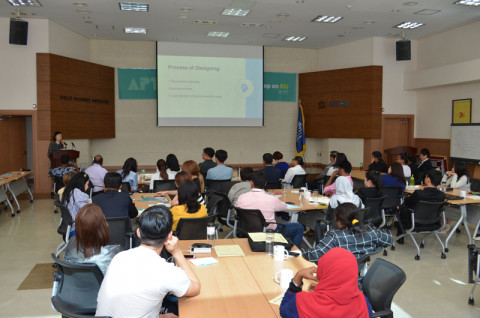 The 19th APTW: GCED in the 21 Century 2019-07-11 29 teachers, educators and policy-makers from 21 countries in the Asia-Pacific region attended the 19th Asia-Pacific Training Workshop on EIU in Seoul and Inje, from 20 June to 28 June 2019. The Workshop focused on deepening the participants’ knowledge of key concepts and pedagogies of GCED so that they can design and implement GCED projects in their local contexts. Recognizing the closely interconnected and interdependent society with the complicated challenges we face as global community such as inequality, violence, intolerance and environmental crises that are being exacerbated by the unsustainable development and ways of life, the Workshop aimed to deepen the participants’ knowledge on the issues and to empower them to realize their roles as agents of change to bring transformation in the society through education for the betterment of all. To do so, the 9-day-long workshop consisted of three main sessions - lectures, hands-on activities, discussion and interactive workshops - in order to encourage the participants to share ideas about how to deal with common challenges of the global and local community: sustainable future and education, the 21 century competency and teachers’ roles, global/glocal justice, human rights, intercultural dialogue, gender equality, as well as pedagogies of GCED. Along with those sessions, a joint seminar with Korean GCED Lead Teachers deepened the participants’ knowledge on GCED, by sharing innovative cases of GCED in the Republic of Korea. Another portion of the workshop was held in Inje in order for the participants to further explore issues of sustainability and peaceful co-existence. The attendees visited the Eul-ji Observatory Tower, the 4th Tunnel and Seo-hwa-ri village, witnessing how the local community in Inje has contributed to establishing sustainable and inclusive communities in the local area, as part of overcoming historical division in the Korean peninsula. The last session in Inje enabled the participants to lead inter-cultural classes with students of Shin-Nam High School, thus enhancing their skills at implementing EIU with people from different countries. On the last day of the Workshop, the participants synthesized what they have learned from the lectures, discussion and visits and crafted action plans that they could hypothetically implement in their organizations. Their action plans had a wide range of target groups - including local communities, teachers, universities - in order to develop and tailor teacher training courses, GCED curriculum and community-engagement programmes by their national or regional contexts. All in all, the 19th APTW was filled with the participants’ increased motivation and competency to carry out their own initiatives on GCED and further disseminate global citizenship education in the Asia-Pacific region. URL:The 19th APTW: GCED in the 21 Century > APCEIU News - APCEIU (unescoapceiu.org)
 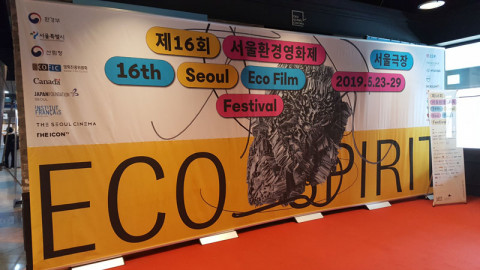 2019년 세계시민교육 중앙연구회: 제2회 세계시민교육 아카데미 ‘2019년 서울환경영화제 연계세미나’ 개최 2019-06-12 유네스코 아시아태평양 국제이해교육원 (이하 아태교육원)은 5월 26일 ‘2019년 서울환경영화제 연계세미나’를 개최하였다. 지난 4월 회복적 생활교육을 주제로 한 제1회 세계시민교육 아카데미에 이어 2회째를 맞이하는 본 아카데미에서는 지속가능발전목표 이슈 중 하나인 전지구적 환경문제를 세계시민교육에 녹여 실천할 수 있는 방안을 모색하는 자리를 마련하였다. 서울환경영화제 상영작 ‘블루 (카리나 홀든 作, 2017)’를 관람한 후 자원순환사회경제연구소 홍수열 소장의 그린토크와 청주교육대학교 과학교육과 이선경 교수의 심화 세미나가 진행되었다. 영화 ‘블루’는 우리 생활에서 자연스레 사용하고 있는 플라스틱이 해양생물과 주변 지역에 서식하는 동물들에게 미치는 영향을 밀착된 관점에서 보여주고 있다. 특히, 이전 세대에서 볼 수 있었던 수많은 생물들이 환경오염으로 인해 후세에 전달되지 못하고 있는 현실을 지적하면서 환경 지식의 지속가능성을 위해서는 개개인의 사소한 노력이 중요함을 일깨워주었다. 이에 홍수열 소장은 환경을 위해 노력할 수 있는 방안을 강구하기 위해서는 으레 떠올리는 보편적인 방식보다는 개개인의 독창적인 생각을 반영한 자유로운 실천 방식을 추구할 것을 강조하였다. 이와 같은 맥락에서, 이선경 교수는 학생들의 의미 있는 환경 문제 학습을 위해서는 학생 스스로 자신의 일상과 SSI (Scientific Social Issue)의 연관성을 자율적으로 발굴할 수 있는 힘을 길러주는 것이 필요함에 주목하였다. 이에 참가 교사들은 환경 문제에 진정으로 공감할 수 있는 의미 있는 질문 (authentic questions)을 통해 학생들이 교내 혹은 가정에서 실제 행동할 수 있는 세계시민교육적 페다고지에 대해 논의하였다. 유네스코 아태교육원은 선도교사들의 세계시민교육 역량강화를 통한 더 나은 교내 환경교육을 위해 참가 교사들에게 후속 자료 공유 등과 같은 지속적인 지원을 해나갈 예정이다.