
News
Catch up on what’s happening in the world of global citizenship education.
316 results found
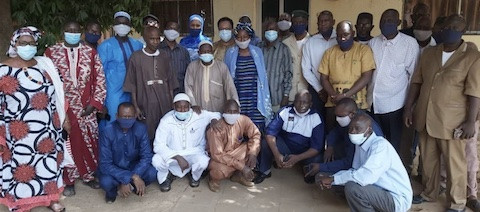 42 acteurs engagés dans l’élaboration d’un module de formation des enseignants du fondamental (1 & 2) à la Prévention et à la lutte contre les changements climatiques 2021-05-02 L’UNESCO s’engage auprès des autorités maliennes dans la formation d’une nouvelle génération d’enfants porteuse des valeurs de culture, de résilience et de lutte contre les effets des changements climatiques à travers la promotion de l’éducation environnementale. Du 14 au 22 avril 2021, s’est tenu dans les locaux de l’Hôtel Résidence de Ségou, l’atelier d’élaboration du module de formation des enseignants du fondamental (1 & 2) à la Prévention et à la lutte contre les changements climatiques.» Cet atelier a été organisé par le Ministère de l’Education Nationale à travers la Direction Nationale de la Pédagogie dans le cadre de la mise en œuvre du Projet de « Renforcement de la résilience du système éducatif comme alternative de prévention et de lutte contre les changements climatiques » sur financement du Fonds Climat Mali/MPTF à travers l’UNESCO. Ce projet constitue une contribution du secteur de l’éducation à la prévention et à la lutte contre le changement climatique au Mali. Les participants ont à travers des travaux de groupes et des séances de plénières donné du contenu aux différentes thématiques que composent ce module de formation. Les travaux de l’atelier se sont bien déroulés avec une participation active de tous les acteurs dont l’engagement a permis d’atteindre les résultats suivants à l’issue des 9 jours d’atelier : Les éléments du contenu du module (thèmes et sous-thèmes) ont été identifiés ; Les thématiques liées au module aux changements climatiques sont développées ; L’outil pédagogique (module) pour la formation des enseignants du fondamental (1 & 2) à la prévention et à la lutte contre les changements climatiques a été conçu. URL:https://en.unesco.org/news/42-acteurs-engages-lelaboration-dun-module-formation-enseignants-du-fondamental-1-2-prevention
 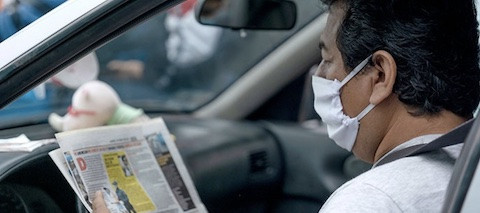 2021 World Press Freedom to promote Information as a Public Good in a severely challenged media landscape 2021-04-28 UNESCO and the Government of Namibia will host the World Press Freedom Day Global Conference in Windhoek from 29 April through 3 May, World Press Freedom Day. The laureate of the 2021 UNESCO/Guillermo Cano Press Freedom Prize will be honoured during the conference, on 2 May. Professional journalists and other media stakeholders at the Conference will call for urgent measures to counter the threats that are weakening independent and local news media around the world, a crisis worsened by the COVID-19 pandemic. They will put forward solutions to bolster media viability, push for greater transparency from social media companies, and measures to improve the safety of journalists and support independent media. Participants are also expected to urge governments to invest in media and information literacy training to help people recognize, value, and defend fact-based journalism as an essential part of information as a public good. Some 40 sessions will be held during the 5-day conference including three thematic discussions on issues currently affecting media viability, the transparency of online platforms, and ways to strengthen media and information literacy. Hage Geingob, the President of Namibia, and UNESCO Director-General Audrey Azoulay will address the conference on 2 May, alongside senior African government officials and UN Secretary-General Antonio Guterres (through a video message). Keynotes and interviews with over 250 world-renowned journalists, media and tech leaders, experts, policy makers, and activists will be held during the event which be an opportunity for registered participants to network, and interact with speakers, and access an offering of podcasts, films, and artistic contributions on a conference online platform. Notable speakers will include: Joseph Stiglitz (USA), Nobel Memorial Prize in Economic Sciences Irene Khan, UN Special Rapporteur on the Promotion and Protection of the Right to Freedom of Opinion and Expression Agnès Callamard, Secretary General, Amnesty International Maria Ressa (Philippines), CEO of Rappler Swe Win, Editor in Chief of Myanmar Now, recognized media outlet for its collaborative and investigative reporting on human rights abuses. Julie Owono, Member of Facebook’s Oversight Board. Executive Director of Internet sans Frontiers Miranda Johnson, The Economist, Deputy Executive Editor Stephen Dunbar-Johnson (USA), President, International of The New York Times Sir Nicholas Clegg, Vice-President for Global Affairs and Communications at Facebook Notable programme highlights will include: Six Regional Forums on specific, regional aspects of press freedom and ways to tackle current trends and challenges. The Forums build on the regional seminars that followed the UNESCO’s first African press freedom seminar in Windhoek in 1991. A one-on-one dialogue about information as a public good with Joseph Stiglitz, Nobel Memorial Prize in Economic Sciences and Miranda Johnson, Deputy Executive Editor of The Economist. 30 April: Presentation of key findings from UNESCO’s global study on online violence against women journalists, a trailblazing research project that assesses the scope and impact of the new frontline of media safety through big data analyses and an in-depth literature review. Link for registration here The digital revolution has weakened business models of most independent media and damaged their viability. The loss in revenue in 2020 is estimated to total US$30 billion. Local news 'deserts' are becoming ever more common as media outlets close, merge, or downsize in many parts of the Global North and South, and political interest groups take control of struggling media outlets. Due to the COVID-19 disruption, two-thirds of staff and freelance journalists worldwide have also suffered pay cuts, lost revenue, job losses, cancelled commissions or worsening working conditions, according to a survey carried out by the International Federation of Journalists IFJ. A survey by the International Center for Journalists and the Tow Center at Columbia University found that over 40% of surveyed journalists reported losing more than half their income. The COVID-19 pandemic has seen a steep rise in the in attacks on journalists and a weakening in regulations protecting freedom of expression. UNESCO’s forthcoming study on online violence against women journalists shows that 73% of the women journalists surveyed had experienced online violence relating to their work. Online violence, often in the form of coordinated misogynistic attacks, goes from hateful language to threats of sexual or physical violence. According to the International Press Institute, countries have reported more than 400 media freedom violations linked to the COVID-19 crisis, including restrictions on access to information and excessive regulations against alleged fake news, ostensibly meant to address COVID-19 related disinformation. The role of journalists in producing and sharing factual information is essential to all members of society. Whether exposing corruption, alerting us to conflicts or debunking disinformation on COVID-19, the information they provide must be recognized as a public good. This year’s celebration of World Press Freedom also marks the 30th anniversary of the Windhoek Declaration, developed by African journalists pressing for a free, independent, and pluralistic African press at a seminar organized by the UN and UNESCO in Windhoek in 1991. The declaration which triggered the proclamation of the 3rd May as World Press Freedom Day by the UN General Assembly. The Award Ceremony of the UNESCO/Guillermo Cano World Press Freedom Prize will take place on 2 May. The Prize, unique in the UN system, honours a person, organization or institution that has made an outstanding contribution to the defence and, or promotion of press freedom anywhere in the world, especially in the face of danger. Related links Programme Read our FAQs Read the concept note Visit World Press Freedom Day website UNESCO/Guillermo Cano World Press Freedom Prize Register your World Press Freedom Day event URL:https://en.unesco.org/news/2021-world-press-freedom-promote-information-public-good-severely-challenged-media-landscape
  Inspirando a las niñas a aprender: Cuatro historias para celebrar a las niñas en las TIC 2021-04-24 Girls around the world are using innovation and technology to solve problems, to unite communities and as a force for good and equality. And yet, women and girls are still under-represented in STEM fields. In an increasingly digitized world economy, the gender digital divide has severe repercussion for girls’ and women’s rights. To bridge this gap, at least three things need to happen: facilitate equal access to digital technologies and the internet for girls and women; encourage and invest in girls and women to build their ICT skills; and enable women and girls to take up leadership roles in tech. On International Girls in ICT Day, 22 April, join us to celebrate girls in tech, support technology education and skills training, and encourage more girls and young women to pursue STEM careers. From creating open-source ventilators in Afghanistan to unifying and amplifying the voices of young activists in Chile, and working to end child marriage in Georgia, here are some girls and young women changemakers who inspire us. Building a low-cost ventilator prototype in Afghanistan Somaya Faruqi. Photo: Digital Citizen Fund When ventilators were becoming scarce due to the COVID-19 pandemic, Somaya Faruqi and Afghanistan’s Girl’s Robotics Team developed a prototype ventilator to support the country’s health care system. “The former Governor of Herat requested our team join the challenge to build up an open-source ventilator. We had limited access to the market didn’t have the right materials, there were travel restrictions and we didn’t even have a budget. Still, we participated with the help of our coaches, experts and mentors,” Somaya says. “We designed an open-source ventilator based on the MIT design. And, we proved that if there is opportunity for young women, they can change their lives and their community” For Somaya, supporting other girls in STEM and paving the way for equality in the industry is a top priority. And that means supporting and encouraging the dreams and ambitions of girls and young women like herself. “It’s important to have the input of the younger generation, as they are the future and they have a lot of creative ideas that can benefit everyone. It can change their lives if someone believes in their dreams,” she says. Standing up against online violence in Kenya Kathy Gitau, 22, was elected as Vice President of Maseno University, Kisumu Kenya, in 2019. Photo: UN Women/Luke Horswell Kathy Gitau, 22, witnessed violence in her home growing up, and was told only certain jobs and roles are right for women. When she wanted to become Vice-President of the Student Union at her University, she was discouraged by others who believed that to reach decision-making roles, women had to offer sexual favours. “It makes you lose focus. It makes you think ‘let’s call it quits,”, Kathy says. “I don’t want anyone to suffer the same things I have.” After learning about the global and growing problem of cyber-bullying and technology-based violence against women, she decided to speak up and make her university a safer space. “Technology based violence is violence and discrimination propagated through technology, such as cyber bullying and cyber-attacks. People can hide behind pseudo accounts and names,” she says. “This problem has become global because everyone is connected by technology and the audience is everywhere.” Now, Kathy and her university have created support groups for those who’ve experienced online abuse, and continue to raise awareness on their campus, and in high schools across Western Kenya. Uniting activists across Chile Julieta Martinez. Photo: UN Women/Lupita Valdés As a speaker for youth festivals and a member of UN Women’s Beijing+25 Youth Task Force, Julieta Martinez, 17, connected with girls from across Chile and the world to learn from their experiences. She heard from many that the lack of safe spaces for girls to network and work towards their dreams was holding them back. Julieta took action. She founded the Tremendas platform to create spaces and opportunities for girls and young women to connect and combine their talents and knowledge to support social causes. Julieta believes that the unity and togetherness of activist communities is an incredible force for good. “To facilitate equality and inclusion, we need above anything else patience, respect and tolerance,” she says. “We need to listen to each other, first of all, to understand that there are different opinions and perspectives and that everyone's scope of action is different.” Julieta and the many Chilean girls she collaborates with recognize that young people need to be the driving force of solutions to global problems. “Just as we are part of the problem, we are part of the solution and we are certain that the time to act is now,” she says. “We cannot continue wasting time because if the future is truly ours, the decisions are up to us. This has to be an intergenerational dialogue (...) We, the youth, are not only the future, we are also the present.” Using tech and data to combat child marriage in Georgia Mariam Lomtadze. Photo courtesy of Mariam Lomtadze At a young age, Mariam Lomtadze was told science and technology were inappropriate for a girl. Rather than dissuading her interest in STEM, the criticisms sparked Mariam’s activism for gender equality. Now, she uses her skills in science and technology to address gender inequalities. At 17, Mariam participated in a Hackathon hosted by UN Women to visualize gender data. She and her team focused on early and forced marriages, because it happens to so many girls in their country, Georgia. “Presenting gender data in an innovative, easily understood manner helps us raise people’s awareness of important issues like gender inequality,” Mariam says. “As more people are exposed to gender equality problems, it makes it easier to find lasting solutions.” Mariam’s team created an app to show how early marriage creates obstacles for girls’ career prospects. In the app, which featured characters who represented young girls from all different regions of Georgia, users played as fairy tale heroines and answered scenario questions to play out their futures, which in many cases were not “happily ever after”. Through the game, users could see different scenarios for girls lives, and how they would be better off without early and forced marriage. “Talking about early and forced marriage is the starting point for resolving it,” Mariam says. “It is also important to show the affected girls – those who either married early or are facing the threat of [forced marriage] – that they are not alone.” URL:https://www.unwomen.org/en/news/stories/2021/4/compilation-stories-to-celebrate-girls-in-ict
 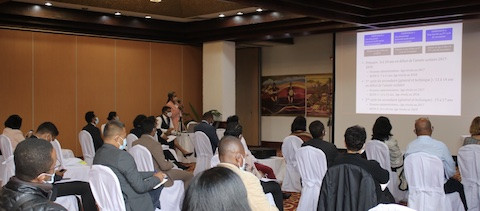 School exclusion in Madagascar during COVID-19 2021-04-15 On March 4th, UNESCO Madagascar presented the results of the study "Analysis of Out-of-School Children Data and the Impact of the COVID-19 Pandemic in Madagascar," conducted within the framework of the Global Out-of-School Children Initiative (OOSCI), for the UNESCO Institute for Statistics (UIS). With 258 million children, adolescents and youth out of school worldwide, according to the UNESCO Institute for Statistics (UIS), many countries are still struggling with the lack of education. In response to this situation, UIS has launched five country studies, including one in Madagascar - a country where legislation emphasizes compulsory school attendance from age 6. Results of the study in Madagascar:The percentage of children not in school by level:- Preschool (under 5 years old): 40% representing between 285,000 and 316,000 children- Primary: 22% to 27% representing between 751,000 and 921,000 children- Lower secondary: 30% to 40% representing between 741,000 and 1 million children- Upper secondary: more than 60%, or nearly 1.4 million adolescents The issues related to late entry, high school re-sits and dropouts at the primary level are among the most important problems of the Malagasy education system. Children enrolled in primary school are at greater risk of dropping out, where they have only a 33% chance of reaching the final grade. However, once students reach lower secondary school, they have a 73% chance of reaching the last grade, and those who reach upper secondary school have an 87% chance of reaching the last grade. The proportions of out-of-school boys remain higher than those of girls in the 5-14 age groups, but girls are more likely to be out of school once they are older than 15. Across all dimensions of exclusion, out-of-school children are more likely to come from the poorest households, to be orphans, to have disabilities, and to live in rural areas or in certain regions in the south and southwest of the country. Several demand and supply factors may explain school exclusion. At the household level, economic difficulties in the household, the low perception of the direct benefits of education combined with the need for labor in agricultural activities or herding, particularly for boys, explain a large part of the phenomenon of children not attending school. Early marriages, on the other hand, are a source of school dropout for young girls. As for schools, the cost of education, the distance from the school and the existence of incomplete schools with a discontinuity in educational offerings, the low qualification of teachers, and the existence of community teachers paid by parents have a significant influence on non-enrollment and dropout. These data were collected in close partnership with the Malagasy Ministry of National Education, the Ministry of Technical and Professional Education and the National Statistics Institute in Madagascar, and will be taken into consideration for policy and planning purposes and to facilitate synergies between the different stakeholders involved. URL:https://en.unesco.org/news/school-exclusion-madagascar-during-covid-19
 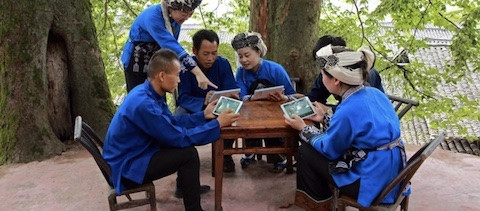 The Open University of China awarded UNESCO Prize for its use of AI to empower rural learners 2021-04-13 The “One College Student Per Village” programme at the Open University of China (OUC) is one of the laureates of the 2020 UNESCO King Hamad Bin Isa Al-Khalifa Prize for the Use of ICT in Education. The innovative programme provides an example of how Artificial Intelligence (AI) and associated technologies can create quality education opportunities for learners from remote areas and improve social and economic development in rural communities. The programme was established in 2004 with the support of the Chinese Ministry of Education in response to the shortage of higher education resources and slow economic development in China’s rural and remote areas. Since then, it has not only improved local educational infrastructure and put in place distance learning programmes, but also integrated AI and Virtual Reality (VR) techniques, which significantly enhanced learners’ experiences and engagement. Mobile learning and smart classrooms In its efforts to provide quality learning experiences, the OUC set up over 500 cloud-based classrooms and smart classrooms in poorer areas in 31 provinces, municipalities and autonomous regions. Online and offline learning environments have been created for local learners and the content adapted to their needs. “As local residents are mainly engaged in agriculture, forestry, animal husbandry and fishery, the University developed learning resources, which can be easily accessed via mobile applications from anywhere, including while working in the field or on the farm,” says Hou Songyan, associate researcher at the OUC. Huang Haiyang, a student from Tiandong County in the Guangxi Autonomous Region, shared his experience of how the tools are making a difference in his work. “Since I can look through the information and related knowledge from my smartphone, it makes it easier for me to know how to control insects before they do harm on my fruit trees,” he says. “And when I get confused with how to use the pesticide, I can go to the smart classrooms to ask for help from my online tutor.” Since the beginning of the COVID-19 pandemic, these classrooms have conducted over 2,000 live teaching sessions for more than 270,000 participants. 300 additional online courses and 100,000 “mini-lectures” were also opened to the general public. The series of lectures have generated nearly 100,000 views to date. Using AI to create adaptive learning environments The Smart Learning Platform enables teachers to create customized learning plans for students based on the profile of each learner and analyze their progress using big data. Using AI, the platform guides students along different learning paths. It can distinguish learners’ intentions using voice and semantic analysis and can text learners and give feedback to their questions to help with their study. It also lightens the workload of teachers by completing more routine tasks. Automatic assessments and automated essay scoring (AES) give students instant feedback and provide them with relevant learning resources. “This saves me a lot of time so that I can spend more time on preparing and reflecting the lectures and conducting academic research, etc.,” says Li Ganged, a teacher at the OUC. “Automated essay scoring is efficient in that I don’t have to mark these assignments myself but I can get a clear picture of where learners need help.” In addition, Virtual Reality (VR) is being integrated into the programmes. Not only does it enable to illustrate and visualize abstract course content, but it also increases learners’ engagement and motivation. “In the Forestry programme, the VR can supply vivid virtual experiment just like in the real world on how to prune fruit trees,” says Hou Songyan. “The VR experience makes learning easier and more fun.” Bridging the gap between rural and urban areas To date, 29 programmes have been implemented using AI, covering over 1,500 OUC study centers nationwide. A total of 825,827 learners have been enrolled, 529,321 of whom have graduated. For Hou Songyan, the impact of students who graduated from the OUC on the local economy of rural and remote areas is already visible. “More contributions are made to the local economic and social development by those who have graduated from the programmes and been using their knowledge and skills in the local rural poverty alleviation and rural revitalization effort.” Moving forward, the OUC will expand its potential target audience beyond the disadvantaged groups in rural and remote areas to include all members of society in the rural revitalization strategy. At the same time, the university plans to offer a wider range of programmes, degrees and diplomas, including short-term vocational training, and use AI techniques for knowledge mapping, automatic content generation, and smart answering chatbot technology to ensure round-the-clock online learner support. “We do believe that AI will become an integral part of the future of education,”, says Hou Songyan. “It is a great honor for the Open University of China to receive this Prize. With this encouragement, the Open University of China will pay more attention to the use of digital technologies, especially cutting-edge technologies like big data, cloud computing, blockchain, AI, 5G, etc., in our future educational delivery, continue providing quality education programmes to people in remote and rural areas, and strive for the UN 2030 Agenda for Sustainable Development.” UNESCO’s ICT in Education Prize UNESCO’s work in ICT in education URL:https://en.unesco.org/news/open-university-china-awarded-unesco-prize-its-use-ai-empower-rural-learners
 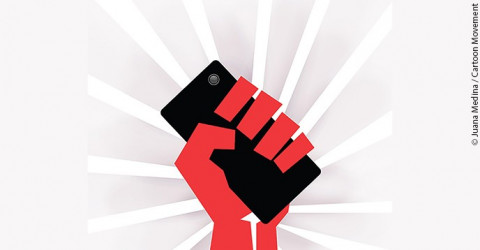 Grandir à l’heure des fake news 2021-04-12 Hopping from one social network to another, young people in the Middle East and North Africa (MENA) region now get their information from YouTube, Instagram and Facebook. To be able to distinguish between reliable information and fake news while navigating this flood of information, it is urgent to develop critical thinking. Hadil AbuhmaidA doctoral candidate at the School of Journalism and Communication, University of Oregon, United States, she is co-author of How The Middle East Used Social Media in 2020 an annual review. Some days ago, my nephew asked me who my favourite YouTuber was. Without hesitation, I said “no one”, because I rarely watch YouTube. He gasped and asked, “Then what do you do on your laptop all day?” Well, I am a 34-year-old Ph.D. student, not an 11-year-old. But his reaction reflects the power and influence that platforms like YouTube have on many young people around the world – including the Middle East, the region where I am from and which I continue to study. In one of the most youthful regions in the world – where over twenty-eight per cent of the population is between 15 and 29 – it should come as no surprise that nine out ten young adults use at least one social media platform to converse, access information, and share content, according to the 2019 Arab Youth Survey. Juggling between multiple platforms “I check my Facebook and Instagram about fifty times a day,” Tabarek Raad, 28, a translator from Basra, Iraq, said. “I use these two social media accounts to connect with friends and keep myself in the loop of what’s going on in the world,” she added. Using social media platforms to check the latest news, watch and interact with friends’ stories, share something, or just passively browse through the newsfeed, is universal among youth everywhere today. But what is interesting about internet users in the Middle East is that they have an average of 8.4 social media accounts, according to GlobalWebIndex (GWI), the market research firm. Mohammed Haraba, 28, who works for a large oil company in Al-Ahsa, Saudi Arabia, has nine social media accounts – including WhatsApp, Snapchat, Instagram, and Facebook. “I check WhatsApp every hour, unless I am too busy. It is the only platform on which family and friends gather. I don’t know anyone who doesn’t have an account,” he said. Facebook, which used to be Haraba’s main platform for socializing four years ago, now ranks low on his list. With over seven out of ten Arabs using Facebook and WhatsApp, the platform still has a big presence in the region, with 45 million Facebook users only in Egypt, Statista reports. Social media platforms are now the dominant source of news for young Arabs. Statistics from the Arab Youth Survey show that in 2020, seventy-nine per cent of young Arabs receive their news from social media, compared to only twenty-five per cent in 2015. “Facebook is one of my main sources of news and communication with friends. I check it more than ten times a day,” Pamella Hadawar, 24, from Palestine said. “And depending where the news comes from, I check with other news agencies and sources to make sure it is accurate.” This trend has resulted in a decline in news consumption through newspapers and television. Saudi Arabian youth, for example, reported an almost thirty per cent decline in TV news watching in the past four years. An infodemic The widespread use of social media in the region is both fascinating and scary – with information bombarding us constantly, it has become harder to filter the content. Fake news and misinformation have become especially prevalent during the pandemic. False and inaccurate news has spread even more rapidly on social media, resulting in an infodemic. The deluge of information has been overwhelming for some. “I used to get most of my news from Twitter, but I deactivated my account when the pandemic started,” says Tala Zabalawi, 31, a digital marketing specialist in Amman, Jordan. “It was so stressful to read about the pandemic, that I decided to focus on happy thoughts instead.” The growth of media consumption and the increasing affordability of new technologies point to an even further expansion in the use of social media in the MENA region. Big tech companies have been quick to take advantage of this emerging market. This has initiated an important discussion around media literacy. Realizing the value of media education for young adults, several organizations in the region have been offering training and workshops to increase awareness. Other initiatives – like Jordan’s Fatabayyano platform in Arabic – offer fact-checking services. This is a start. In order to develop critical thinking that allows us to distinguish between truth and lies, between facts and opinions, we need the widespread introduction of media education, particularly in schools. UNESCO combats the disinfodemic Read more: Zoomers, in their own words, The UNESCO Courier, July-September, 2020The health crisis: Fertile ground for disinformation, The UNESCO Courier, July-September 2020Developing a critical mind against fake news, The UNESCO Courier, July-September 2017 Subscribe to The UNESCO Courier for thought-provoking articles on contemporary issues. The digital version is completely free.Follow The UNESCO Courier on: Twitter, Facebook, Instagram URL:https://en.unesco.org/courier/2021-2/growing-age-fake-news
  Données ouvertes sur les écoles : mode d’emploi 2021-04-12 Open school data is a powerful tool. When used properly, open data can promote citizen control over the transfer and use of financial, material, and human resources. Open data can hold local and school authorities to account, improve service delivery, and detect malpractice at the school level – and most importantly, enable citizens to stand up for their right to a quality education. There are a variety of open school data initiatives operating around the world. IIEP-UNESCO, as part of its long-standing research in this area, has explored many of them in-depth. Now, a new guide for educational decision-makers, planners, and managers goes behind the scenes to illustrate – in concrete, applicable terms – how to foster effective and usable open school data. “The publication is designed to be a key resource for education actors seeking to confront corruption head-on, and remove it as a barrier to the attainment of equitable and inclusive quality education for all,” says author Muriel Poisson and IIEP expert on ethics and corruption in education. Open School Data: What planners need to know addresses five key questions: from how to choose the content and format of data, to how to link them with accountability, while also understanding inherent risks. Covering Australia to Zambia, these questions are brought to life with real-world examples and lessons from 50 countries and several hundred interviews with school-level actors. The book also argues that education authorities have much to learn from the experience of civil society in the area, emphasizing the need to shift from an administrative approach to a more citizen-centred perspective. Voices of impact The book features a number of interesting voices and testimonies, which highlight the impact of open school data: “With the Dapodik system in place, it is much more difficult for schools to inflate their student numbers. For each student, schools have to submit many variables including their demographic background, family background, academic progress, and even the distance between the student’s home and her/his school. It is much more difficult to manipulate students’ data now.” -- A provincial district representative in Indonesia. “Previously, school management decisions had been taken by a handful of school staff without really involving parents or the community, even though everyone in Malawi knew this type of arrangement was conducive to corruption.” -- A project manager from the non-governmental organization LINK in Malawi, which decided to use open school data to encourage collaborative planning approaches. “We became more conscious because we are being checked. We managed the resources better based on needs, pursued the right strategy, and improved governance of resources. If you don’t do that, the collected data will show it.” -- A secondary school teacher in Bangladesh. At the same time, the book does not ignore the risks that sometimes accompany the disclosure of school data. This can include misinterpretation or over-simplification of complex issues, possible stigmatization or school competition, and issues around data privacy and overall security, among other issues. One policy officer in Australia also raised the issue of the inherent shortcomings of data: “Schools are complex places that are hard to ‘capture’ through any data sets. Our principals tend to be passionate educators who know that what schools deliver is not solely based on a list of data. They change lives and My School can’t accurately represent all that is done.” -- A policy officer in Australia. Seven steps to design and implement open school data initiatives Making school data public is an important step in itself – but it is not enough to provoke significant changes in education systems. A number of other steps must be taken – both before and after publication – to bring open school data to the attention of citizens. As this can raise many questions for planners, the book proposes practical guidelines on how to design and implement open school data policies. It also includes a useful checklist, outlining what needs to be done and by whom. Design a clear open data policy framework: Review motivations for an open school data policy, clarify roles and responsibilities, and set expectations building on a theory of change. Prioritize data that can lead to positive change: Select meaningful data highlighting the current situation of schools and consider indicators that are comparable over time and between schools. Set up a strong information management system: Introduce open school data initiatives as part of existing educational management information systems (EMIS), organize technical trainings to teach school staff how to monitor data, and disseminate information in a timely manner. Present data attractively: Make sure data are accessible both online and offline in public areas where they are easy for all to view. Provide explanations to avoid misinterpretation, use simple language and incorporate tables and graphics. Make sure data are accessible to all: Send school report cards to all school principals, adopt legal provisions regarding the disclosure of data, and conduct advocacy campaigns in local languages to alert citizens. Strengthen stakeholder capacities to act on information: Enhance awareness among school administrators and teachers of the core principles of open school data, inform citizens about their rights and entitlements about education, and organize information sessions for pupils. Support efforts to improve accountability and fight corruption: Select data that can shed light on areas most vulnerable to corrupt practices, clarify the consequences of corrupt practices, and make the objectives of an open school data initiative evolve over time, from an information and communication tool to one of accountability. By taking these recommendations into consideration, open school data policies and initiatives can have greater success and impact in the education sector. And once the initial foundation is laid for open school data, its architects can find ways to evolve and further engage with users over time. For example, the publication suggests incorporating private schools into databases, designing data presentations for different formats (e.g. mobile, tablets, and computers), developing interactive tools that allow users to engage in more complex data presentations, or creating a dedicated space for students to discuss issues related to open school data. URL:http://www.iiep.unesco.org/en/open-school-data-heres-your-go-guide-13721
  Du discours de haine au génocide, les leçons à tirer du génocide de 1994 contre les Tutsis au Rwanda 2021-04-08 On the International Day of Reflection on the Genocide in Rwanda, 7 April, UNESCO will hold an online panel discussion from 15:00 to 16:30 CEST, which can be viewed here. It was on 7 April 1994 that the Hutu extremist-led government in Rwanda launched a systematic attack that within 100 days killed more than 1 million members of the Tutsi minority. The day is both a time to honor the victims and survivors, and to extract from this senseless slaughter the lessons that can still be learned to prevent genocide in the future. The online event will begin with introductory remarks from UNESCO Director-General Audrey Azoulay and Ambassador François Xavier Ngarambe, Permanent Representative of the Republic of Rwanda to UNESCO, to be followed by a conversation between Mr. Freddy Mutanguha, a survivor of the Genocide, and Dr. Tali Nates, Director of the Johannesburg Holocaust and Genocide Centre. Participants in the panel discussion are: Ms. Susan Benesch (USA), Director of the Dangerous Speech project, Mr. Marcel Kabanda (France), Historian and former President of Ibuka France, Mr. Paul Rutayisire (Rwanda), Historian. Ambassador Silvia Fernandez de Gurmendi (Argentina), Chair of Global Action Against Mass Atrocity Crimes and former President of the International Criminal Court, will deliver a video message. Closing remarks will be delivered by Ms. Alice Wairimu Nderitu, United Nations Special Adviser on the Prevention of Genocide. Dr. Stephen Smith, UNESCO Chair on Genocide Education and Finci-Viterbi Executive Director of the University of Southern California Shoah Foundation, will moderate the event. Hate speech and hate propaganda were identified as catalysts of the genocidal violence in Rwanda. The United Nations Strategy and Plan of Action on Hate Speech (2019) seeks to strengthen the UN response to the global phenomenon of hate speech and placing specific emphasis on the role of education as a tool for addressing and countering hate speech, while at the same time upholding legitimate freedom of expression and access to information. The commemoration is being organized by UNESCO and the University of Southern California Shoah Foundation UNESCO Chair on Genocide Education, with the Permanent Delegation of Rwanda to UNESCO, in partnership with Global Action Against Mass Atrocity Crimes (GAAMAC). As the only UN agency with a mandate to promote the prevention of genocide through education, UNESCO is committed to promoting genocide remembrance and education to sensitize learners about the causes, dynamics and consequences of such crimes and to strengthen their resilience against all forms of discrimination. URL:https://en.unesco.org/news/hate-speech-genocide-lessons-1994-genocide-against-tutsi-rwanda
 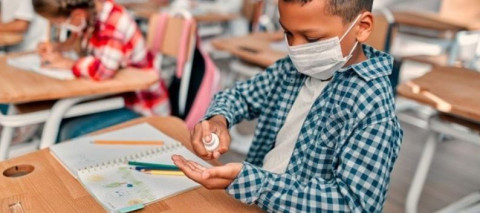 Connectivity, gender and teachers: How the Global Education Coalition is supporting COVID-19 learning recovery 2021-04-05 The COVID-19 pandemic hit the education sector with full force, disrupting schools globally and threatening to strip off decades of progress made towards learning. A year into the crisis, the situation remains bleak: Half of the world’s student population is still affected by full or partial school closures; nearly one-third cannot access remote learning; more than 11 million girls may never return to the classroom; and over 100 million children will fall below the minimum proficiency level in reading due to the impact of school closures. Unless urgent action is taken today, over 24 million children and youth are at risk of dropping out of school. As the pandemic revealed and amplified inequalities in education, UNESCO quickly mobilized support to ensure the continuity of learning around the world by establishing the Global Education Coalition in March 2020. This multi-sector Coalition brings together 175 institutional partners from the UN family, civil society, academia and the private sector currently working in 112 countries around three central themes: Connectivity, gender and teachers. A new report, published ahead of a high-level ministerial meeting, is showcasing the innovative responses that have been achieved through this unique partnership in the past year. How is the Global Education Coalition operating and what are its achievements? The Global Education Coalition has become an essential platform to support Member States to respond to the unprecedented challenges facing the education sector. Coalition contributions do not replace national responses, but rather engage new actors that would not have been obvious partners, such as technology and media organizations, to complement and support national efforts to ensure the continuity of learning. Coalition members are currently engaged in 233 projects across 112 countries. At least 400 million learners and 12 million teachers are benefitting directly or indirectly from the actions of the Coalition. Here are a few global, regional and country-specific examples of actions that have been achieved so far. In West Africa, the Francophone African regional online learning platform Imaginécole was launched as a key component of a Global Partnership for Education project to improve the quality of distance education in 10 countries: Benin, Burkina Faso, Cameroon, Côte d'Ivoire, Guinea, Mali, Niger, Senegal, Chad and Togo. The platform offers a large-scale experience in distance education for 6.6 million students and 200,000 teachers with over 600 educational resources. More than 5 million girls in the 20 countries with the greatest gender disparities in education will be supported to fulfil their right to education, with a focus on bringing back to school the most marginalized girls through wide range of actions. This includes information and awareness raising, skills acquisition and providing evidence-based recommendations to decision-makers. The Global Skills Academy, established to help equip 1 million youth with digital skills to adapt to changes in the workplace, reaching to date 142,000 beneficiaries. Since its launch, the Academy has mobilized more than 150 TVET institutions across 56 countries and is actively working with 15 partners to enroll 75,000 additional students and teachers in the coming days. In response to the explosion that rocked Beirut, Lebanon in August 2020, Coalition members mobilized financial commitments, technical assistance and capacity building support to rehabilitate damaged schools, provide technical assistance to teachers, ensure access to distance learning with content and support higher education. UNESCO and partners are supporting the rehabilitation of 55 public schools, 20 public Technical and Vocational Education and Training institutions, and 3 universities. In South Africa, a phone app-based support service for teachers developed with a partner was launched to provide a real-time chat-based learning and mentorship platform, along with a wellness and safety feature. It currently has over 67,200 users and plans to reach 400,000 more teachers in the upcoming months. UNESCO is supporting an open source platform for home-based distance learning and a regional repository of curriculum aligned resources for learners and teachers in Kiribati, Marshall Islands (Republic of), Samoa, Solomon Islands, Tonga and Tuvalu. With GIZ’s support, UNESCO is launching a teachers’ training programme for 20 Caribbean countries and a digital and social emotional skills training for migrants and refugees in Peru. Read and explore the Global Education Coalition’s latest progress report.Access the first progress report from September 2020. UNESCO is convening a high-level ministerial event on 29 March to take stock of lessons learnt, the greatest risks facing education today and strategies to leave no learner behind. It will show how the Global Education Coalition has mobilized partners to support learners, teachers and policy-makers with new tools and knowledge. URL:https://en.unesco.org/news/connectivity-gender-and-teachers-how-global-education-coalition-supporting-covid-19-learning
 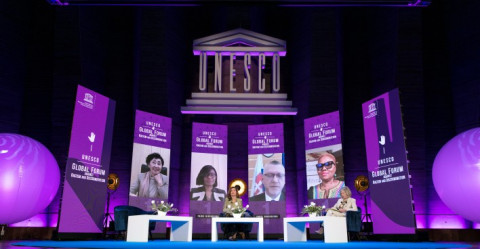 #كافحوا_العنصرية: اليونسكو تدعو إلى اتخاذ إجراءات حازمة لمكافحة العنصرية والتمييز 2021-04-04 "Fighting racism is part of UNESCO's DNA. It's history. We are working to erect effective bulwarks against racism in people’s minds." -- Audrey Azoulay, Director-General of UNESCO With these words, Audrey Azoulay, Director-General of UNESCO, opened the first Global Forum against Racism and Discrimination, co-hosted with the Republic of Korea, mobilizing a powerful global effort to step up UNESCO’s actions to tackle the alarming increase in racism and discrimination in all regions of the world. Organized on 22 March 2021, in the context of the International Day for the Elimination of Racial Discrimination, the Forum was a direct response to the strong ‘Global Call against Racism’ adopted by UNESCO Members States. © UNESCO Bringing together Ministers from several countries – including France, Mexico, Republic of Korea, Slovakia, South Africa, and the United Arab Emirates – experts, practitioners, and champions, the Forum built concrete insights and solid commitments through which UNESCO will construct an ambitious new Roadmap against racism and discrimination. The Roadmap aims to mobilize UNESCO’s crosscutting expertise, based on solid evidence-based social and human science research, to tackle the legal and institutional foundations which continue to perpetuate discrimination, and change mindsets to favour inclusion and mutual respect. It will position UNESCO to effectively combat racism and discrimination within the post-COVID context, building on its more than 70 years of moral and intellectual leadership on the issue, and leveraging its strong capacity to find intersectoral solutions through existing work on global citizenship education, the promotion of cultural diversity, the fight against hate speech, the combatting of mis and dis-information, and the mobilization of the social and human sciences to understand the problem. "We need to look deeper than just the individual racist attack. We need to focus on racism at the institutional level. We need to get the laws right" -- Denise Yvonne Aki-Sawyerr, Mayor of Freetown, Sierra Leone The discussions at the Forum underscored that whilst racial discrimination remains prevalent and pervasive in contemporary societies, strong and independent national institutions can help to provide solid legal and regulatory protections to counter discrimination. The importance of practical approaches to support such efforts, such as UNESCO’s forthcoming scanning exercise and integrated anti-discrimination toolkit, was repeatedly underlined. "Racism and discrimination are a clear challenge, and it is a challenge that requires an immediate response. To this end, there is a need more than ever for international cooperation and the support of multilateral institutions, including UNESCO." -- H.E. Choi Jongmoon, Vice Minister of Foreign Affairs, Republic of Korea "We need to develop an official mechanism and enact legislation for banning discrimination and realizing equality." -- H.E. Young-ae Choi, Chairperson of the National Human Rights Commission of the Republic of Korea Panelists addressed the mutability of racism, and the need for policymakers to understand emerging forms of discrimination that require innovative responses to be effectively tackled. COVID-19 has exposed many of these new manifestations of racism, not least those related to inequities in the access to, and benefits from, digital technologies. Calls were made for a strong ethical foundation to ensure technological progress is inclusive and absent of bias, and the work UNESCO is advancing to prepare a new normative standard on the ethics of artificial intelligence was strongly welcomed in this regard. "It goes back to human decency and respect. We need to treat people as we want to be treated. If we start off with that notion "Treat my human fellow being as I want to be treated" we'll be halfway towards winning the battle." -- Martin Luther King III The importance of forging partnerships and coalitions across different sectors and levels of government was also highlighted. Broad recognition was made to the critical nature of such collaboration for tackling the compounding effects of racism with other forms of discrimination, particularly that leveled on the grounds of gender. Additionally, the importance of providing support to local decision makers as those who are on the frontline of tackling racism and discrimination was stressed, and the essential role that networks such as UNESCO’s International Coalition of Inclusive and Sustainable Cities provide in this regard was recognized. Martin Luther King III, emphasized the importance of strong collaboration in his intervention, saying ‘we must create a partnership. For it is when you bring all the stakeholders together that it becomes possible to develop strategic plans and effect change.’ "Racism does not only hurt those directly affected; it challenges the trust and cohesion that holds our societies together." -- Gabriela Ramos, UNESCO Assistant Director-General for Social and Human Sciences Closing the Forum, Gabriela Ramos affirmed that the Forum had equipped UNESCO with the strong insights and ideas needed to take forward this critical agenda through the new UNESCO Roadmap against Racism and Discrimination. She committed to continue the process of inclusive partnership to ensure the Roadmap represents an ambitious, intersectoral vision and practical strategy, echoing the words of Stefania Giannini, UNESCO Assistant Director-General for Education, and Firmin Edouard Matoko, UNESCO Assistant Director-General for Priority Africa and External Relations, who also participated in the Forum. Accompanying the Forum, the Republic of Korea launched a social media campaign using the Forum’s hashtags #FulfillTheDream #FightRacism, bringing together a significant number of Ambassadors of the Group of Friends for Solidarity and Inclusion with Global Citizenship Education in UNESCO to reaffirm their commitment to this important issue. UNESCO intends to make the Global Forum against Racism and Discrimination an annual occurrence, providing an opportunity for the organization and its partners to take stock of progress at the same time next year. Watch the Forum on YouTube Programme Concept Note More on UNESCO’s work to foster inclusion and non-discrimination More on the International Day for the Elimination of Racial Discrimination URL:https://en.unesco.org/news/fightracism-fulfillthedream-unesco-calls-strong-action-against-racism-and-discrimination