
News
Catch up on what’s happening in the world of global citizenship education.
1,668 results found
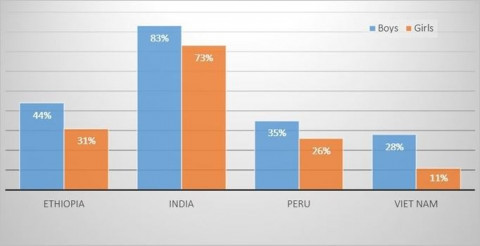 New data on violence in schools and effective preventative measures 2017-11-06 A special issue of the Journal of Psychology, Health and Medicine (January 2017), commissioned by the Global Learning Initiative: Know Violence in Childhood, offers data on school violence and effective preventative measures. Six articles in the journal describe the nature of school violence and bullying, and provide information on effective interventions in several countries, including Uganda and Viet Nam. Types of school violence and bullying Bullying is one of the most common expressions of school violence committed by peers. Large-scale surveys carried out in Western countries suggest that 9-25% of school age children are bullied (Menesini & Salmivalli, 2017 (link is external)).Another prevalent type of school violence is corporal punishment, which is perpetrated by teachers on students. It continues to be a legal means of disciplining children in 69 countries. Boys were found more likely than girls to experience school corporal punishment: the prevalence between boys vs. girls was 44% vs. 31% in Ethiopia; 83% vs. 73% in India; 35% vs. 26% in Peru; and 28% vs. 11% in Vietnam (See Figure 1). In both Singapore and Zimbabwe, this type of gender discrimination is written into law; only boys can be subject to school corporal punishment in these countries (Gershoff, 2017 (link is external)).Violence has a tendency to ‘spill’ from one environment to the other - also referred to as poly-victimization. For instance, according to a study in Uganda, girls who experience sexual abuse in schools are likely to also experience such violence in the streets (Kumar et al., 2017 (link is external)). Preventing violence and bullyingCognitive behavioural, social-emotional and peer mentoring/mediation programmes have been found to be some of the most promising approaches in reducing the levels of perpetration of peer aggression (Lester et al., 2017 (link is external)).Various school-based initiatives such as the Good School Toolkit in Uganda involve activities that focus on creating safe school environments for children, such as hanging codes of conduct in visible places and facilitating conversations. For instance, after an 18-month intervention, Ugandan students reported a decrease in physical violence against children by school staff by 42% in primary schools (Lilleston et al., 2017 (link is external)). A study in Viet Nam revealed that bullying is strongly correlated with the quality of the school environment. Students who experience less teacher support were more likely to be victims and bullies (Le et al., 2017 (link is external)). Bullying, along with all other forms of child violence, is also highly influenced by social norms (Lilleston et al., 2017 (link is external)). Corporal punishment in schools should be addressed through legislative reform and advocacy (Gershoff, 2017 (link is external)). URL:https://en.unesco.org/news/new-data-violence-schools-and-effective-preventative-measures
 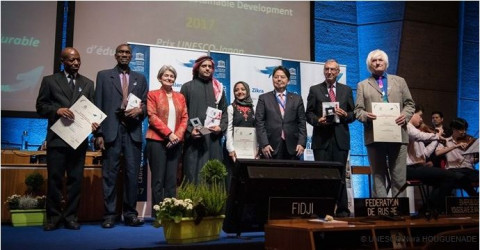 Education for Sustainable Development Prizewinners awarded by UNESCO and Japan 2017-11-03 The three winners of the 2017 UNESCO-Japan Prize on Education for Sustainable Development (ESD) received their awards at a ceremony at UNESCO Headquarters in Paris, on 3 November. They were awarded the prize in recognition of their innovative projects at the local, regional and international level. This was the third edition of the prize, funded by the Government of Japan and created in 2014 to honour outstanding projects and programmes in the field of ESD. The three laureates for 2017 are: the social enterprise Zikra from the Hashemite Kingdom of Jordan; the Hard Rain Project from the United Kingdom of Great Britain and Northern Ireland; and Sihlengeni Primary School from the Republic of Zimbabwe. The Director-General of UNESCO, Irina Bokova, presented the award, saying “The Sustainable Development Goals mark strong recognition by the international community that countries need ESD to make the transition to green societies” Each laureate received a diploma, an award and US $50,000. Japanese Minister of Education, Culture, Sports, Science and Technology, Yoshimasa Hayashi congratulated the winners, and encouraged their future efforts: “Receiving the award is the start of a journey rather than the finish line. I look forward to the varied efforts by laureates leading to further progress on ESD and greater quality of education around the world.” The future is bright! Sihlengeni Primary School in Zimbabwe won its award for its “Permaculture” programme which implements ESD through a whole-institution approach, providing learners with life skills while reducing land degradation and deforestation. “The future is bright for our Green Oasis of Zimbabwe!” exclaimed Headteacher Sibanga Ncube accepting the prize on behalf of the school. He added that winning the prize had boosted motivation for the future ESD work of his school as well as adjacent communities, Zikra won the prize for its “Popular Learning Programme” which promotes equity between rural and urban communities though ‘exchange tourism’. Representing the social enterprise, co-founder Lama Kathieb said: “Our work has been dedicated to rediscovering local knowledge and employ it in fabricating solutions to community’s current struggles. We thank the UNESCO and the government of Japan for awarding us with this great prize.” The Hard Rain Project was rewarded for its international exhibition projects “Hard Rain” and “Whole Earth?” which bring arts and science together to reach a large audience of citizens and leaders. Founder Mark Edwards said: “Education is a key element in the transition to a sustainable society, yet it’s often these projects that are hardest to fund. Thanks to the prize we can start work on our next exhibition that will showcase the Sustainable Development Goals.” In addition to the award, the three winning organizations will be invited to become key partners of the Global Action Programme on ESD (GAP), driving the GAP implementation forward in close collaboration with UNESCO. The call for nominations for the fourth edition of the prize will be launched in January 2018. URL:https://en.unesco.org/news/education-sustainable-development-prizewinners-awarded-unesco-and-japan
 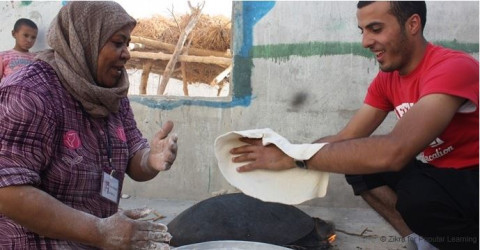 UNESCO sustainability education prizewinner Zikra builds the future on the past 2017-11-02 “We have so much to learn about sustainability from local knowledge ” says Lama Khatieb, co-founder of the social enterprise Zikra which has won the 2017 UNESCO-Japan Prize on Education for Sustainable Development (ESD) for its “Popular Learning Program”. The prize, which is funded by the Government of Japan, consists of three annual awards of USD 50,000 for each recipient.Jordan-based Zikra for Popular Learning (‘zikra’ is Arabic for ‘memory’) was founded by Lama, along with Rabee Zureikat, in 2011 and empowers community members to revalue their identity and culture, through the cultivation and sharing of their local knowledge in relation to sustainable solutions.Zikra has created several programmes to communicate its vision, one of which is Exchange Tourism which bridges the gap between urban and rural communitites. Alongside that it conducts capacity-building workshops and trainings in schools, universities and institutions working with youth, educators and community members in different Arab regions. It works closely with the marginalized village of Ghor Al-Mazra'a in one of the poorest areas of southern Jordan.“The villagers have a rich knowledge that has enabled them to live sustainable lives for decades, where they grow their food, weave clothes, build houses and all within a strong community support system,” said Lama.“We quickly saw that traditional charity was an imbalanced approach. We didn’t want to be the saviours of the people simply offloading things and leaving. We gradually found that we were the ones that were learning from them, that we were so poor in the knowledge that they had at their fingertips.” said Lama. Now, under the Exchange Tourism programme, a typical visitor will pay a nominal sum to spend a day experiencing village life including learning how to harvest crops and care for livestock.“It is a revelation for people from the city who may know a lot about consumption but no longer know about simple sustainable skills and the villagers are more than proud to share their own culture and traditions and earn an income,” said Lama.Individual village activities include making toy cars from wire, a food value chain project and a Musical Identity project based around the reed instrument, the ney.“The dominant culture in Jordan promotes instruments like the guitar and piano and marginalizes local instruments, music, songs and dances, along with their social and cultural stories that were part of people’s lives in the region for hundreds of years." said Lama. As a result the Musical Identity project, along with Zikra’s other learning programmes and tools, are being adopted as student activities in several schools and universities .On winning the prize Lama said: “We feel proudest of all that this prize is an affirmation that we need to start learning from, and not just about, our community. It’s an affirmation that people are the solution not the problem.”Future plans are focused on promoting and creating new learning tools.“We are proud to say that we are perfectly sustainable as our work depends on what resources we have around us. The prize money will help us to promote the programme further by building a new website, developing more learning tools and reaching out to other marginalized communities,” said Lama.UNESCO’s Director-General and the Japanese Minister of Education will award the prize in a ceremony at UNESCO Headquarters in Paris on 3 November 2017. As with all winners prize, UNESCO will invite Zikra for Popular Learning to join its Partner Networks of the Global Action Programme on ESD (GAP) and foster close, long-term collaboration. URL:https://en.unesco.org/news/unesco-sustainability-education-prizewinner-zikra-builds-future-past
 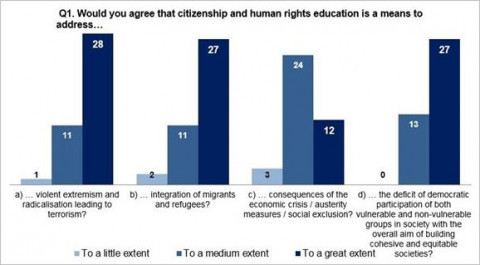 Council of Europe report calls for consistent implementation of Education for democratic citizenship and Human rights education policies 2017-10-19 The 2017 Council of Europe Report: “Learning to Live Together” highlights the great importance of democratic citizenship and human rights education in all European countries.The report highlights that 66% of the government respondents reported inconsistencies between Education for Democratic Citizenship and Human Rights Education policies and their implementation. The report also underlines the need for further support to civil society and improved cooperation with public authorities to achieve more effective results.The growing awareness of the essential role education plays in promoting values of democracy, human rights and the rule of law is reflected in the adoption of the Charter on Education for Democratic Citizenship and Human Rights Education (EDC/HRE) by the Organization’s 47 Member States. Improving the effectiveness of such education has become an imperative for the Council of Europe member states, and is the main focus of the 2017 Report on the State of Citizenship and Human Rights Education in Europe.The 2017 report, launched during a conference on the future of citizenship and human rights education in Europe in Strasbourg in June 2017, forms part of the implementation of the Charter and draws on the lessons from the first review in 2012. Data analysis is based on responses to questionnaires for a) governments and b) civil society organizations.Between 2012 and 2016, substantial progress was made in the 40 countries that responded to the survey. EDC/HRE gained in importance in European countries. At the same time, feedback from civil society shows that relevant policies need to be supported more effectively, that co-operation between public authorities and civil society should be further developed, and that the work done by civil society needs to be better recognized. The report also elaborates on key topics including extremism, migrants and refugees, social cohesion and equity.Education systems as well as stakeholders in non-formal education need to commit to carrying out EDC/HRE in a manner that is accessible, sustainable and of high quality, which is consistent with the aim of the Charter. In this respect, the Charter review is also part of the Council of Europe’s contribution towards the United Nations World Programme for Human Rights Education and the United Nations’ 2030 Education Agenda (Target 4.7).As presented in the above figure, the report also highlights key topics of extremism, migration and refugees, social cohesion and equity together with an elaboration on how EDC/HRE positively contributes to address these challenges of today societies.As the world moves forward on the implementation of the Education 2030 Agenda, UNESCO is committed to monitoring the progress towards the achievement of Target 4.7, with a focus on Education for Sustainable Development and Global Citizenship. Regular reports, news, analyses, publications and links to data sets produced by UNESCO and its partner provide evidence that indicate how the world is progressing towards the achievement of the Target.
 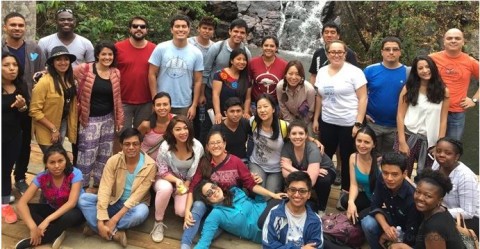 Training youth in Latin America and Caribbean to be key players in sustainability education 2017-10-16 A youth-oriented workshop on Education for Sustainable Development (ESD) for Latin American and the Caribbean region took place from 26 to 28 September in Brasilia, Brazil, with the support of the UNESCO Brasilia Office. The gathering brought together 44 young leaders from 13 countries: Argentina, Barbados, Brazil, Chile, Colombia, Costa Rica, El Salvador, Guatemala, Mexico, Peru, Santa Lucia, Saint Vincent and the Grenadines, and Trinidad and Tobago.The youth from Latin America and the Caribbean island countries actively engaged in interactive discussions -in Spanish, Portuguese and English - on varied topics concerning the Sustainable Development Goals. Among the skills learnt such as systems thinking, leadership, conflict solving, communication and networking, a session on the management and community visioning inspired to ensure the implementation of the participants’ project in the countries after their return. “The workshop gave me the tools, skills and the knowledge to ensure that I can facilitate the transformation of all these movements for sustainable development to the members of the community,” said Elon Ishmael Cadogan, a youth participant from Barbados. “Especially the vulnerable villages and communities in Barbados heavily impacted by tourism.”Following the intensive two-day session at the venue with presentations, discussions, group works and physical activities, the youth participants were invited to join an excursion to learn from the nature conservation activity in the ecological reserve “Chapada Imperial”. It facilitated the participants to understand the abundant diversity as well as increasing deforestation that causes crisis in natural resources in the region.After the workshop, a common youth network is expected to help the participants stay tuned and keep learning from their past and ongoing experiences. “I’m very happy to be here to learn and having been injected with all those ideas and knowledge, which we are going to implement in our daily life, in our culture and in our mother tongue,” said Glenda Marisol Xulu Perez from Guatemala. “I think that knowing about ESD or the SDGs is a big thing”. In terms of the most important outcome, she s “the connections we have created today, the network we are going to create, which I am sure will let us learn from each other. Also, we are going to keep on reinforcing our knowledge, as it is the key to maintain this Latin American and the Caribbean network and even at a global level”.The workshop was facilitated jointly by GAP key partners of two different priority action areas; the Earth Charter International, Costa Rica (priority action area of Youth), and Kerstin Forsberg from Planeta Oceano, Peru, (priority action area of Educators and Trainers). “The workshop went incredible,” said Ms Forsberg. “The Youth participating from Latin America and Caribbean region were extremely energetic, and you could clearly see that they will implement what we have learned throughout these days into their work back at home.”The workshop was one in a series of training activities under the flagship project of Youth Priority Action Area (Partner Network 4) of Global Action Programme (GAP) on ESD. Target groups are youth aged 18 to 35 who have demonstrated active engagement in ESD as an educator, trainer, and member of a non-governmental organization, private sector professional, policy-maker, researcher, or in any other relevant capacity in their communities.“Youth are critical players in ESD,” said Ms Forsberg “We talk a lot about Youth as the future, but Youth are actually the present as they are already developing a series of solutions to sustainable development worldwide. They bring a lot of creativity, they think outside of the box, and they are willing to work together.” Together with regional workshops held in New Delhi, Nairobi, Dublin and Beirut since the beginning of 2017, around 250 ESD youth leaders have been trained and are committed to conducting their own workshops, reaching out to over 1500 youth to multiplying the capacity building. These workshops are implemented with the financial support from the Ministry of Education, Culture, Sports, Science and Technology of Japan through the UNESCO Japanese Funds-in-Trust for ESD.
 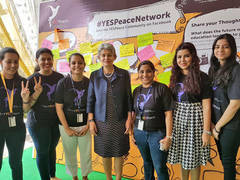 Empowering Teachers and Youth to Prevent Violent Extremism 2017-09-04 Critical inquiry, mindfulness, empathy and compassion: these are the four competencies that the UNESCO Mahatma Gandhi Institute of Education for Peace and Sustainable Development in New Delhi, India has identified as the key to empower youth to address 21st century challenges, including violent extremism, based on recent advances in brain research.Empowering educators and teachers to build these competencies and prevent violent extremism through education brought together participants from 10 countries for a three-day workshop organized by MGIEP in New Delhi.Addressing the closing session of the event, Director-General Irina Bokova higlighted the leading role of MGIEP in building the capacity for educators across the globe, online and offline. Drawing on existing research in neuroscience, MGIEP has started work with pilot schools to integrate socio-emotional skills, empathy training and values-based education into curricula.“I believe what you are doing here in fostering a culture of tolerance and non-violence, expresses the core mission of UNESCO, to build peace in the minds of men and women,” said the Director-General.“Violent extremism seeks to destroy the foundation of humanity,” continued Irina Bokova. “’Hard power’ is not enough to counter a threat that draws on exclusive visions of the world and builds on false interpretations of faith, hatred and intolerance, we need ‘soft power’ to win this battle. We need to educate a new generation of peace fighters […] with the skills and knowledge they need to respond to those who distort history, culture and religion.”In this context, the Director-General called for new political will, new partnerships, new policies and concrete pedagogical tools to take this forward.On the same day, the Director-General participated in a “Talking Across Generations” dialogue, organized by MGIEP and India’s YESPeace Network which focused on ‘Harnessing the Indian youth demographic bulge for a true dividend: Vision to Action for 21st Century’.Both through social media and on site, students exchanged with the Director-General and Dr Karan Singh, Chair of the MGIEP Board, on skills to navigate rapid change driven by technology and create more just, peaceful and sustainable societies.“We need a broad perspective, an integral education encompassing body, mind and emotions,” said Dr Karan Singh. Recalling his participation in the Delors Commission on Education for the 21st Century, he emphasized “learning to live together” as the bedrock of human and social development. The Director-General discussed evolving approaches to education promoted by UNESCO, centred on changing mindsets and developing new skills not only for jobs in growth areas, from cultural industries to the green economy, but also for intercultural dialogue, tolerance and understanding. This calls for sustained investment in teachers, in relevant online content, and in broad community and social mobilization to make education a priority. She praised the youth present for championing peace and for their sensitivity to advancing social justice and education for all.
  International Youth Day 2017- Celebrating young people contributions to conflict prevention and transformation 2017-08-28 This year the global theme for International Youth Day is "Youth Building Peace" and is dedicated to celebrating young people’s contributions to conflict prevention and transformation as well as inclusion, social justice, and sustainable peace.The current generation of youth are the largest in history and in South Sudan represent at least 70% of the population. Considering the needs and aspirations of youth in matters of peace and security is therefore a demographic imperative. The #Anataban Campaign was founded by a community of young South Sudanese creatives who are tired of war and bloodshed in their country. The founding members include musicians, actors, comedians, scriptwriters, fashion designers, visual artists, graphic designers, among others, with a goal of being positive influencers. The campaign was established a few weeks after the conflict in Juba in July 2016, and thus out of frustration and anger the artists established the campaign #Anataban which in Arabic simply means “I am Tired”. #AnaTaban’s event on Saturday 12 August was held on stage at the Youth Centre in Nimra Talata in Juba and, in spite of the rain and cold weather, drew a crowd of several hundred, mostly young people. It featured the performances of South Sudanese artists including singers, rappers, comedians and actors. The performers showcased their talents and expressed their feelings of frustration with the current challenges facing South Sudan and their desire for change. Students from a selection of secondary schools in Juba made up much of the audience at the event, and also participated in some of the performances including showcasing their acting and singing talents. The involvement of school students was a crucial part of the event and the artists directed their words to the young people concerning their hopes for a positive future for South Sudan. As a follow up to this public event, #AnaTaban will be holding focus group discussions with youth in secondary schools in Juba at #AnaTaban school clubs to promote the active involvement of youth in matters of peace and security in South Sudan.#AnaTaban are also planning more public events under the #BloodShedFree2017 this year and UNESCO will be pleased to further showcase their activities in the coming months.Secondary school students join in the performance during #AnaTaban’s International Youth Day event
  UNESCO, DepEd, KOICA launch ALS project to help improve lives of out-of-school girls in the Philippines 2017-08-18 More young Filipinas now have a better chance at quality education and improved opportunities as the United Nations Educational, Scientific and Cultural Organization (UNESCO), the Department of Education (DepEd), and the Korea International Cooperation Agency (KOICA) launch the “Better Life for Out-of-School Girls to Fight Against Poverty and Injustice in the Philippines” project on July 14 at the Southeast Asian Ministers of Education Organization Regional Center for Educational Innovation and Technology (SEAMEO INNOTECH) in Quezon City.The project aims to help improve the quality of life for girls living in poverty through the establishment and operation of a Girls Education Center. Furthermore, it endeavors to increase the passing rate among out-of-school girls who took the Accreditation and Equivalency (A&E) Test after completing the DepEd’s Alternative Learning System (ALS). The project also seeks to improve the quality of instructional knowledge and skills of ALS mobile teachers and implement the use of K to 12 ALS teaching and learning materials for out-of-school girls.The pilot locations of the project will be in Tacloban City and the municipality of Palo in the province of Leyte.“Education is a basic human right enshrined, protected, and promoted by the Philippine Constitution, but gender-based disadvantage is a reality that Filipinas, especially the youth, still encounter. As we continue expanding and intensifying the delivery of education for all through K to 12 and ALS, we are thankful to partner organizations in helping us reach learners who are isolated by their varying personal circumstances,” Education Secretary Leonor Magtolis Briones emphasized.The project is anchored on a study that identified a multitude of challenges faced by learners, especially girls, resulting in dropping out of schools. These setbacks include economic, health, and social factors, among others. The generous support of the Government of the Republic of Korea, through KOICA, made the $6 million-dollar project possible.Korean Ambassador Kim Jae-Shin shared that, “The Government of the Republic of Korea, through the Korea International Cooperation Agency, is committed to quality education and health for all. This Better Life for Girls aims to promote girls’ right to education, health, and profession with the support from family, school and community. With the right support, education and resources, girls can be empowered to change their lives and become better equipped with the life skills, attitudes and social intelligence needed to live full, productive, and meaningful lives.”The project responds to current reforms being implemented in the Philippine educational system. This year, the roll out of Grade 12 in Senior High School (SHS) saw the full implementation of the K to 12 curriculum. UNESCO, with its experiences, expertise, and network of experts in education, extends its support to DepEd.UNESCO Jakarta Office Director and Representative, Dr. Shahbaz Khan, in his remarks, expressed his appreciation and recognition to DepEd and KOICA for the continued cooperation and partnership, “UNESCO is committed in supporting the Government of the Philippines, through the Department of Education, in its efforts towards the attainment of Sustainable Development Goal 4-Quality Education. And most especially in its efforts to bring quality, accessible, relevant, and liberating basic education for all with focus for those children who are the lost, last, and least.”
  Arab youth participate in the “Education for Sustainable Development Leadership Training” 2017-08-18 “I came from Somalia to attend this training workshop; I work in an NGO that helps students affected by conflict in Somalia to enroll in schools and pursue their education in normal conditions. While attending this training, I am learning a lot about Education for Sustainable Development and the means to teach students about the need to safeguard our planet and guarantee the rights of future generations. As soon as I am back to Somalia, I will advocate with my NGO to introduce education on sustainable development into school curricula”. With these words, Abdallah, a youth activist from Somalia, expressed his joy in participating in the “Education for Sustainable Development Leadership Training” jointly organized by UNESCO and UNESCO Beirut office, in partnership with Organisation de Developpement Durable (ODDD), on 1-3 August 2017 in Beirut.The “Education for Sustainable Development (ESD) Leadership Training” is a project of the Global Action Programme on ESD. As a follow-up to the UN Decade on ESD (2005-2014), UNESCO launched the Global Action Programme (GAP) on ESD which focuses on generating and scaling up ESD action at all levels, in all areas of education, and in all sustainable development sectors. The GAP has five Action Areas, one of which (GAP 4) is dedicated to mobilizing and engaging youth who are recognized as key to the success of the GAP.41 out of 450 applicants from the Arab world were selected to participate in the ESD Leadership Training in Beirut. The participants, aged 18 to 35, and coming from 17 Arab countries, are all active leaders in sustainable development in their communities. They work in different fields, including: youth NGOs, Education, Communication, Advertising, Business.The two-day training programme has a double objective. It aims to empower youth leaders to inspire and mobilize others to take action towards building more sustainable, just and resilient communities; and to build a youth-led ESD network for exchange and collaboration. Mona, a participant from Morocco, noted that: “This training offers us a unique opportunity to connect with youth like us, from different Arab countries, who are active leaders in sustainable development. The synergies created here can help us build a strong network of young Arab activists who will promote sustainable development at different levels”. She added: “I work for Unilever in Casablanca. When I am back to my country, I will seek to implement the notions of sustainable development in my company’s business. For, economic growth is inseparable from sustainable development. Being the Communications officer at Unilever, I will also try to raise awareness of our partners on sustainable development. People need to be aware that they are part of the environment, and therefore any degradation of the environment will directly harm them”.In the opening ceremony, following an introduction by Salim Shehadeh, Programme Specialist at UNESCO Beirut, the director of UNESCO Beirut Dr Hamed Al Hammami addressed the participants, highlighting UNESCO’s role in promoting ESD. Al Hammami noted that “supporting young men and women is one the main priorities of the UN who seeks to empower youth and build their capacities so that they become agents of positive change in their societies”. He added that “UNESCO in particular seeks to facilitate and support youth participation in the policymaking process, governance, and design and implementation of laws.” Al Hammami noted that “building partnerships with youth is one of the key long-term priorities of UNESCO, as stated in UNESCO Operational Strategy on Youth (2014-2021). In this context, the ESD training offers a platform to connect youth with UNESCO and to build the capacities of the participants so that they play a leading role in promoting ESD in Arab countries”.Julie Saito, Programme Specialist in the Section of Education for Sustainable Development in UNESCO Paris, stressed that “ESD is a hard and long process as it seeks to promote a balance between human welfare, economic growth and prosperity, local cultural traditions, and scarcity of natural resources, with the aim to guarantee sustainable development and a better life for present and future generations”. “This is why – she added –this ESD Leadership Training is important, as it engages the youth and helps them acquire the skills and tools to promote ESD at the level of their community, country, and region”.The training programme is based on a participatory and collective learning approach where participants engaged with the theory and practice on the following themes: sustainability, ESD, Systems Thinking, Conflict Transformation, Leadership, Visioning, Communication, Facilitation, Networking, Monitoring and Evaluation. It also included a trip to Taanayel and Shouf regions in Lebanon, where participants visited eco-friendly businesses (Ecolodge), and Water, energy and agriculture infrastructure projects. According to Mohammad, a participant from Yemen, “through the workshops and the field trips we learnt a lot and we acquired new tools on Education for Sustainable Development. This will allow us to be the ambassadors of ESD in our own countries; we now have the tools to implement training sessions and workshops on ESD in our countries to sensitize people on this highly important topic. Yemen is a poor, conflict-ridden country. ESD could be a way to lift people out of poverty and war, and achieve peace, prosperity, and an equal distribution of resources”.In order to guarantee the sustainability of this initiative, alumni of the ESD Leadership Training will be invited to become part of the ESD Young Leaders Network coordinated by UNESCO.
 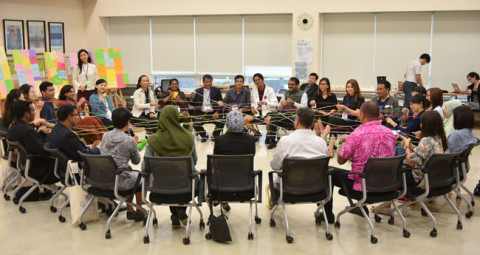 17th APTW: Successful and Continuous Commitment to GCED 2017-08-08 As the oldest and longest running training workshop in APCEIU’s history, the 17th Asia Pacific Training Workshop on Education for International Understanding (APTW) was held from 20 to 28 in Seoul and Inje, Republic of Korea. This year, the workshop was organized in partnership with UNESCO Bangkok Office. Twenty-seven participants representing twenty-one countries gathered together to dive into the concept of global citizenship education (GCED) under SDG 4.7. As educators with backgrounds in teaching and training, policymaking, and curriculum development, it was a vibrant time of learning from one another’s ideas and practices. The nine-day workshop consisted of informative and interactive sessions with activities facilitated by GCED experts in the fields of the arts, human rights, sustainable development, and peace education. By learning the content, pedagogy, tools and skills of GCED application in their local educational settings, the participants were prepared to craft their own actions plans of implementation when they return back home. Through many engaging discussions and debates within the global paradigm, they committed once again to foster a culture of peace with their teachers and youth through education. > In addition, three days were dedicated to a field visit in Inje, Gangwon Province. Participants spent time at the DMZ Peace-Life Valley, which is only about nine kilometers from the most heavily militarized zone in the world - the DMZ. Many topics and themes were centered on non-violence, sustainability, and conflict resolution, especially in the context of the Korean War and division, including current inter-Korean relations. Most participants claimed that visiting the 4th Tunnel (a poignant remnant of a divided Korea) left a lasting impression on them of the impact of war on both national and international peace. Towards the end of the workshop, Ms. Lea Espallardo, one of the facilitators of the workshop, stressed that GCED is not learned through just a worksheet or presentation, but is a transformative process and a vision worth fighting for. One participant stated that despite having read about GCED in the past, the workshop has brought the ideal, but broad concept to life. He now feels more empowered and supported to be an effective facilitator when he returns back home. The final discussion among the participants was filled with encouragement to continue their roles as global citizens to create more global citizens for a peaceful world. URL:17th APTW: Successful and Continuous Commitment to GCED > APCEIU News - APCEIU (unescoapceiu.org)