
News
Catch up on what’s happening in the world of global citizenship education.
229 results found
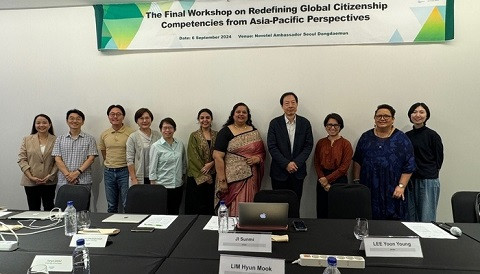 The Final Workshop on Redefining Global Citizenship Competencies Asia-Pacific Perspectives 2024-10-09 The Asia-Pacific Centre of Education for International Understanding (APCEIU) held its final workshop on Redefining Global Citizenship Competencies Asia-Pacific Perspectives on 6 September. The workshop was organised ahead of the publication of an academic book introducing new approaches to reconceptualising global citizenship competencies that reflect the Asia-Pacific context. Researchers from Pakistan, India, Thailand, Singapore, China, Japan, South Korea, New Zealand, and Kazakhstan gathered in Seoul to share the contents of their draft manuscripts and to discuss the finalisation of the project. The researchers also participated as moderators, speakers, and attendees in the 9th International Conference on Pedagogy and Practice for Global Citizenship Education, held on 4-5 September. They shared their experiences and research on global citizenship education contributing to the revitalisation of multilateralism and peace in various regions of Asia and the Pacific. The workshop began with opening remarks from Director LIM Hyun Mook of the APCEIU, followed by participant introductions, presentations, and discussions. The researchers proposed new possibilities for defining global citizenship based on traditional Asian religions and cultures such as Confucianism, Buddhism, and Islam, as well as Pacific wisdom and the philosophy of Tagore. They presented specific examples of how Global Citizenship Education (GCED) has been interpreted and implemented in East Asia (China, Japan, and Korea) and Central Asia, exploring the potential for fostering global citizenship through national policies and educational reforms. They also discussed methods for integrating local and universal perspectives and the role of national citizenship in global citizenship education. The researchers delivered presentations on the following topics: - Professor Aigul KULNAZAROVA (Tama University, Japan) presented on “Global Citizenship in Central Asia: Contested, Transformed, and Challenged”, addressing the historical context and current trends of GCED in the region;- Professor Kyujoo SEOL (Gyeongin National University of Education, Korea) introduced the direction of global citizenship education using the example of Korea's "Statue of Peace", reflecting local history and universal values;- Professor Mousumi MUKHERJEE (O.P. Jindal Global University, India) introduced her chapter, which explores Tagore’s philosophy of education and pedagogic praxis, as well as three dimensions of GCED competencies relating to his ideas;- Dr. Sicong CHEN (Kyushu University, Japan) presented on “The Direction of Global Citizenship Education in Asia: Beginning with Locality and Expanding to Universality”, defining global citizenship as “taking actions based on an ethical concern for humanity and a political consciousness of criticality”;- Dr. Suzanne CHOO (Nanyang Technological University, Singapore) emphasised the significance of Confucian cosmopolitanism as a virtue in global citizenship competencies, particularly in response to political wokism, post-truth, and postmodernism of the 21st century;- Dr. Tania SAEED (Lahore University of Management Sciences, Pakistan) illuminated the relationship between Sufism and global citizenship education in her presentation titled "Identity, Rituals, and Religion: Reflections on Sufism and the Quest for Global Citizenship Education from a South Asian Perspective.";- Dr. Tanya SAMU (University of Auckland, New Zealand) introduced her manuscript "Global Citizenship Competencies and Indigenous Pacific Ways of Being, Knowing, and Doing: Exploring the Possibility of New Starpaths," focusing on Tapasā cultural competencies for teachers in New Zealand;- Dr. Thippapan CHUOSAVASDI (Chulalongkorn University, Thailand) proposed a redefinition of GCED based on Buddhist concepts in her presentation titled "Tolerance, Interdependence, and GCED". In the discussion that followed the presentations, the researchers continued their dialogue on the overall tone and direction of the book. They emphasised the need to critically review and clearly define the meanings of terms that are repeatedly used throughout the research in the introduction. They also decided to clarify that the study is not intended to reinforce the “East-West” binary or promote self-orientalisation, but rather to equally address the Asia-Pacific perspectives on Global Citizenship Education (GCED). APCEIU plans to publish the research findings on the redefinition of global citizenship competencies from Asia-Pacific perspectives in November. In connection with this, a webinar will be held to introduce the results of the research and explore original ways to define global citizenship competencies that reflect the diverse histories, cultures, and contexts of the Asia-Pacific region. URL: https://www.unescoapceiu.org/post/5175
 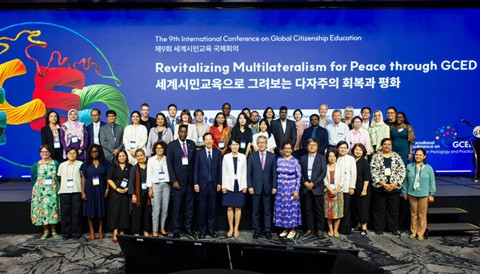 제9회 세계시민교육 국제회의, 세계시민교육으로 다자주의 회복과 평화의 가능성을 그려보다 2024-09-21 The Asia-Pacific Centre of International Understanding under the auspices of UNESCO (hereafter APCEIU) co-organized the 9th International Conference on Global Citizenship Education (IConGCED) with the Ministry of Education and the Ministry of Foreign Affairs of the Republic of Korea, in collaboration with UNESCO and Chungnam National University BK21 Four Center for GCER. Held from September 4th (Wednesday) to 5th (Thursday), 2024, the Conference was centred around the theme "Revitalizing Multilateralism for Peace through GCED". Over these two days, approximately 300 policymakers, educators, researchers, and practitioners gathered to engage in diverse and insightful discussions. The opening ceremony on September 4 began with opening remarks by OH Seok Hwan, Vice-Minister of Education of the Republic of Korea, and HONG Seok-in, Ambassador and Deputy Minister for Public Diplomacy of the Ministry of Foreign Affairs of the Republic of Korea. This was followed by congratulatory remarks from Stefania GIANNINI, UNESCO Assistant Director-General for Education, and a welcoming speech by LIM Hyun Mook, Director of APCEIU. The keynote speech was delivered by Professor Audrey OSLER, Professor Emerita at the University of Leeds, UK, on the topic “Hope, Justice, and Compassion in a Fractured World: Reviewing Our Role as Global Citizenship Educators.” The first plenary session focused on "Navigating Current Challenges Where Multilateral Efforts Are Most Required." Panelists included Assistant Professor Rawan ARAR from the University of Washington, Ambassador Extraordinary and Plenipotentiary Peter NGURUE of the Republic of Kenya to UNESCO representing the ‘Group of Friends for Solidarity and Inclusion with Global Citizenship Education’ initiated by the Republic of Korea, Professor Kihara AI from the University of Tokyo, and Professor LEE Sang-wook from Hanyang University. They presented and discussed the intersection of emerging topics such as ‘Humanitarian Crisis Focusing on Refugees and Forced Migration,’ ‘Racism and Hate Speech,’ "Sustainable Peace and Human Security,’ and ‘Ethical Dilemmas of Generative AI’ and their implications in the educational field. The second plenary session was facilitated by Dylan WRAY, High Resolves Learning, at the Human Responsibility Accelerator, South Africa. In this session, Associate Professor Ludivina BORJA-DEKIT from Western Mindanao State University, Philippines, and Associate Professor Tania SAEED from Lahore University of Management Sciences, Pakistan, engaged in an interactive dialogue on “Storytelling for Peace”. On the second day, the plenary session featured youth activists from diverse fields and regional backgrounds discussing the changes they are creating for peace. Noora ELKENAWI, a GCED Activist; Oshani GUNATHILAKE, an Education, Sustainability and Development Practitioner; and KIMHAN Minyoung, Manager of the Peace Momo Action Research team, shared their challenges as youth activists and their hopes for stakeholders in global citizenship education, receiving much encouragement and support. Additionally, various breakout sessions such as “Transformative Learning for Collaboration: From ME to WE,” “GCED in Action across Borders,” and “All Hands on Deck: Unlocking the Potentials of Multilateral Efforts” drew the attention of participants and stakeholders alike. The 9th IConGCED was successfully concluded, providing a platform to reflect on the importance and necessity of multilateral cooperation for peace. Related content can be accessed on the official conference website (icongced.unescoapceiu.org) and the YouTube channel (@International Conference on GCED). URL: https://www.unescoapceiu.org/post/5171
 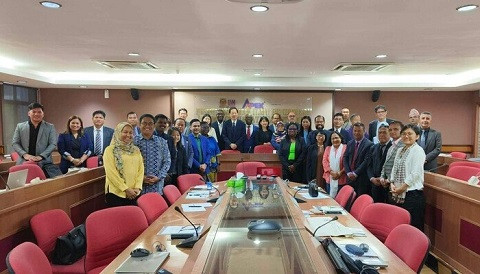 2024년도 세계시민교육 협력센터 센터장 회의, 제 2회 세계시민교육 협력센터 국제 컨퍼런스와 함께 말레이시아 페낭에서 동시 개최 2024-08-27 From 6 to 8 August, 2024, the Global Citizenship Education Cooperation Centre (GCC) Malaysia at Universiti Sains Malaysia (USM) hosted the 2nd GCC International Conference on Global Citizenship Education (GCED) alongside the GCC Directors’ Meeting 2024, in Penang, Malaysia. The event was co-organised with the Asia-Pacific Centre of Education for International Understanding (APCEIU) and drew over 200 participants from around the world, the GCC Programme and the GCED Curriculum Development & Integration Project (CDI) Partners. GCC-Malaysia, established at USM in 2021 through a MOU with APCEIU, began as one of APCEIU’s first GCC Programme partners and has been playing an active role since its establishment. This year is particularly special for GCC-Malaysia, as they were hosting the GCC Directors’ Meeting 2024, the 2nd GCC International Conference on GCED, and the GCED CDI Partners’ Meeting 2024 all together right here in Penang. The first day of the event kicked off with the GCC Directors’ Meeting 2024. Despite the early morning start, the atmosphere was vibrant as participants from around the world eagerly shared their GCC’s activities and engaged in meaningful discussions. The meeting began with welcoming remarks from Dr. Hyun Mook Lim, Director of APCEIU, followed by congratulatory remarks from Dr. Rohizani Yaakub, Director of GCC-Malaysia. In the first session, representatives from GCCs in Thailand, Cambodia, the Philippines, and Lao PDR presented their achievements and challenges from the past year. Dr. Athapol Anunthavorasakul, Director of GCC-Thailand at Chulalongkorn University, shared insights on their GCED Teacher Educator Training workshops, which involved 270 teachers across 90 schools. Dr. Neau Vira, Vice-Director of GCC-Cambodia at the National Institute of Education, discussed their capacity building workshops and the ongoing monitoring and onsite visits at teacher training centres. And Dr. Rowena Hibanada, Director of GCC-Philippines at Philippine Normal University, highlighted the establishment of GCC Regional Hubs in 23 higher education institutions, while Dr. Kiengkay Ounmany, Director of GCC-Lao PDR and Dr. Soubin Sisavath, Visiting Lecturer, Faculty of Language Education, National University of Laos, presented their activities including the result of the GCED Need Assessment at teacher training centres in Laos PDR they conducted in 2023. The second session featured presentations from GCC representatives in Indonesia, Malaysia, Nepal and Bangladesh. Dr. Ace Suryadi, Deputy Director of GCC-Indonesia at Universitas Pendidikan Indonesia, shared their activities including the online learning platform and webinar series. Dr. Rohizani Yaakub, Director of GCC-Malaysia shared their activities including face-to-face workshops for teachers, school principals, and counsellors in Malaysia. Representing GCC-Nepal, a new member of the GCC Programme, Mr. Jayaram Adhikari, Deputy Director General of the Center for Education and Human Resource Development (CEHRD), outlined GCC-Nepal’s future goals and strategies. And lastly, on behalf of representatives from GCC-Bangladesh at National Academy for Educational Management (NAEM) who could not attend the meeting due to the recent national unrest in Bangladesh, Mr. Raju Das, National Programme officer at UNESCO Dhaka Office, delivered a presentation on GCC-Bangladesh’s expected outcomes and key strategies for this year. Following the GCC Directors’ Meeting, representatives from across the globe had the opportunity to visit GCC-Malaysia, situated on the campus of USM. During the visit, Dr. Rohizani Yaakub, Director of GCC-Malaysia, led a tour of the centre. As part of the tour, she also took the time to introduce APCEIU’s GCED materials, which were thoughtfully displayed for the participants. In the afternoon of the same day, the 2nd GCC International Conference on GCED commenced with an official Opening Ceremony. The event began with an inspiring speech by Professor Dato’ Seri Ir. Dr. Abdul Rahman Mohamed, Vice-Chancellor of USM, followed by congratulatory remarks from Dr. Hyun Mook Lim. The ceremony was graced by the presence of distinguished guests, including Associate Professor Dr. Rahimi Che Aman, Dean of the School of Educational Studies and Dr. Rohizani Yaakub, Director of GCC-Malaysia, along with other esteemed academicians, research officers, and representatives from GCCs and the GCED CDI Project. Concurrently, multiple poster presentations showcasing GCCs from various countries were on display outside the ceremony hall. The first day concluded with a delightful conference dinner organised by GCC-Malaysia, where participants had the opportunity to experience Malaysia’s traditional cuisine and enjoy cultural performances, deepening their appreciation of Penang's rich history and culture. On the second day of the Conference, the first keynote session, titled "Focus of GCED in Today’s World," was delivered by Dr. Hyun Mook Lim. This was followed by the second keynote session, "The Need for Global Citizenship Education to Address Current Global Challenges," presented by Professor Dato’ Dr. Sivamurugan Pandian from USM's School of Social Sciences. After the keynote addresses, a series of paper presentations on GCED were held across various lecture rooms at USM, featuring contributions from academics from Malaysia and around the globe. Representatives from GCC-Thailand, GCC-Philippines, GCC-Indonesia, Arts-ED (GCED CDI Project in Malaysia), and NaCCA (GCED CDI Project in Ghana) also shared their project experiences and research findings. This provided participants with a rich opportunity to present their insights and exchange knowledge on GCED with fellow passionate attendees. In the afternoon, Arts-ED, APCEIU’s GCED CDI Project partner in Malaysia, based in Penang, conducted a community-based learning workshop for all GCC and GCED CDI Project partners. Renowned for its approach to GCED through community-based learning, Arts-ED has been a key promoter of cultural sustainability in the region. They began with an introduction to the concept of community-based learning, followed by hands-on activities typically conducted with students, enabling participants to gain a deeper understanding of the concept. The day concluded with a guided walk through George Town, the capital of Penang and a UNESCO World Heritage site, where diverse cultures coexist in harmony. There, participants engaged in real-life community-based learning activities while experiencing the vibrant streets of George Town. On the last day of the Conference, participants had another opportunity to present their findings across multiple lecture rooms. The Conference concluded with a Closing Ceremony, present were Dr. Hyun Mook Lim, Director of APCEIU, Associate Professor Dr. Rahimi Che Aman, Dean of the School of Educational Studies, Dr. Rohizani Yaakub, Director of GCC-Malaysia, along with other academicians, research officers, and representatives of GCCs and GCED CDI Project. During the entire Conference, more than 80 papers were presented by participants. It offered a vibrant platform for individuals passionate about GCED to connect, exchange ideas, and share their latest research. As highlighted during the event, the Conference served as a gathering place for GCED advocates from different countries to learn from one another and recognise that they are part of a larger, supportive community. URL: https://www.unescoapceiu.org/post/5151
 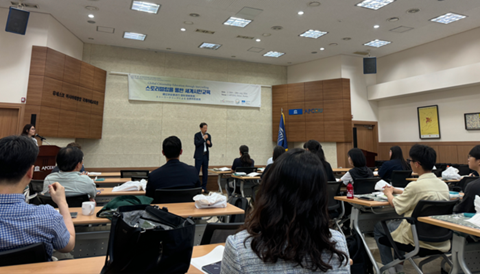 2024 Korea-Japan-China EIU Storytelling Project Workshop in collaboration with the Japanese Association for International Education (JAIE) and Beijing Normal University 2024-08-07 The Asia Pacific Centre of Education for International Understanding (APCEIU) and the Korea Society of Education for International understanding (KOSEIU) co-organised a workshop for 2024 Korea-Japan-China EIU Storytelling Project on July 26-27, 2024, at APCEU in Seoul, Republic of Korea, in collaboration with the Japanese Association for International Education (JAIE) and Beijing Normal University. The Storytelling Project, a collaborative initiative among APCEIU, KOSEIU and Beijing Normal University since 2021, aims to promote EIU/GCED in Northeast Asia by encouraging (pre-service) teachers from China, Japan and Republic of Korea to develop and share GCED lesson plans using storytelling. Last year, the outcome sharing meeting/roundtable was held as part of the special session of the research conference of JAIE. This year, the participants were given the opportunity to share their outcomes and experiences through the Storytelling Project workshop. The workshop began with KOSEIU’s presentation on the background, purpose, and outcomes of the Storytelling Project, which was followed by the presentations of the pre-service teachers from China, Japan and Republic of Korea on their experiences of implementing storytelling-based lessons on the topic of peace, cultural diversity and sustainable development (ESD). They utilized stories written by authors from each country, such as Syria’s tears, Maira’s Eagle, Walking with Sea Cucumbers: Biodiversity and Cultural Diversity Considered from the Field, with some participants building on these activities through Metaverse (ZEP) games. Followed by a Q&A session, the participants shared positive feedback they received from their students and discussed the perceived impact of storytelling on promoting GCED in the classroom and school context. In so doing, mutual understanding and cooperation were facilitated among the pre-service teachers from the three countries in Northeast Asia. The participants indicated that they gained valuable learning experiences beyond curriculum offered by universities and shared how the participation in this project helped them to grow as an educator. They also showed their willingness to further engage in and promote GCED lessons using storytelling within the school setting. The workshop provided the opportunity for the participants to share project outcomes and discussed effective ways to improve the project, including strengthening the networks of those participating in the Storytelling Project. Through this project workshop, APCEIU obtained valuable takeaways for the EIU Storytelling Project and other programmes offered by the centre. URL: https://www.unescoapceiu.org/post/5140
  제23차 아태지역 교원연수: 세계시민교육을 통한 평화의 비전 확장 2024-08-05 The 23rd Asia-Pacific Training Workshop on EIU/GCED was held online from 19 to 28 June 2024. This year’s theme, “Expanding the Vision of Peace through GCED,” emphasized the need for comprehensive understanding of peace and transformative potential of Global Citizenship Education (GCED) in promoting a culture of peace and sustainable development. This was designed in line with UNESCO's "Recommendation on Education for Peace and Human Rights, International Understanding, Cooperation, Fundamental Freedoms, Global Citizenship and Sustainable Development (2023)," which updates the 1974 Recommendation. Under this theme, 42 educators from 16 UNESCO member states in the Asia-Pacific region successfully completed the workshop and empowered to become catalysts for positive change in their communities and beyond. Throughout the workshop, participants engaged in dynamic group discussions and interactive activities, and attended a series of lectures by renowned experts on pivotal topics related to GCED and global issues of the 21st century. Moreover, the APTW introduced transformative pedagogies and practical methods for incorporating GCED into teaching practices and curricula, equipping educators with the tools needed to implement contextualized educational programs that promote a holistic culture of peace. In specific, the workshop addressed key thematic issues on GCED and fostered critical thinking about global issues. Guest speakers and alumni delivered lectures on essential topics, including glocal justice, respect for cultural diversity, human rights, critical medial information literacy and climate crises. Additionally, as a vital component of the workshop, a lecture on the 2023 UNESCO Recommendation provided a comprehensive overview and highlighted core principles and approaches to peacebuilding and the role of GCED. Then, the workshop touched upon ‘how’ to implement GCED by introducing innovative approaches and methodologies of GCED. This was designed to support participants’ follow-up activities in their own contexts. Participants gained insights from live sessions on transformative pedagogies for GCED, the evolving role of teachers, community-based learning for responsible citizenship, and socio-emotional learning. They also benefited from dialogues with APTW alumni, who shared their experiences in implementing GCED projects in their own educational settings. Breakout group discussions held during each session facilitated intensive brainstorming and knowledge exchange. These discussions allowed participants to reflect on their learnings, collaborate, and share diverse perspectives. The interactive activities and dialogues encouraged active engagement, fostered creativity, and enhanced problem-solving skills by leveraging the collective expertise of each group. Moreover, these sessions served as a platform to build a strong network within the Asia-Pacific region. At the end of the workshop, participants presented GCED projects they plan to implement at their respective institutions and communities. As a culmination, they received constructive feedback aimed at enhancing quality and building support, ensuring their initiatives are well-prepared for successful implementation. Through the workshop, participants were empowered to creatively address the multifaceted challenges of today's world as global citizens. APCEIU will continue to support their endeavors by providing additional learning opportunities, including a mentorship and grant program, enabling participants to implement GCED projects in their educational settings later this year. URL: https://www.unescoapceiu.org/post/5133
 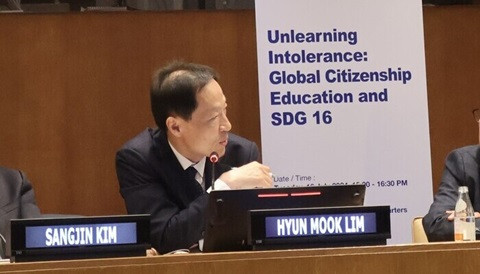 "Unlearning Intolerance: GCED and SDG 16" event at UN Headquarters 2024-08-05 On 16 July 2024 – The Asia-Pacific Centre of Education for International Understanding (APCEIU) and its partners co-organized a distinguished event titled "Unlearning Intolerance: Global Citizenship Education and SDG 16" at the United Nations Headquarters. This event was organized in collaboration with the Permanent Missions of Costa Rica and the Republic of Korea to the United Nations, the University for Peace, and co-sponsored by the Ban Ki-moon Foundation. The proceedings opened with a welcoming address by Hyun Mook Lim, Director of APCEIU. Director Lim detailed APCEIU’s initiatives and emphasized the pivotal role of Global Citizenship Education (GCED) in achieving Sustainable Development Goal 16 (SDG 16), which focuses on promoting peaceful and inclusive societies. Following Director Lim's remarks, Ambassador Sang Jin Kim, Deputy Permanent Representative of the Republic of Korea to the United Nations, expressed his gratitude to the event organizers and participants. Ambassador Kim addressed pressing global challenges, including the refugee crisis and climate change, stressing the essential role of GCED in fostering compassion, empathy, and understanding to create a safer and better world. He reaffirmed the Republic of Korea's commitment to advancing GCED as a tool for building peaceful and sustainable societies. Further acknowledgments were offered by Kate Landon, Executive Director of the Ban Ki-moon Foundation, and Ramu Damodaran, Permanent Observer of the University for Peace to the United Nations. In celebration of the 20th anniversary of the 'Unlearning Intolerance' series, Mr. Damodaran underscored the critical role of education in promoting global citizenship and tolerance, highlighting historical milestones and advocating for intergenerational learning to combat intolerance and advance peace. Notably, Mr. Damodaran remarked that replacing apathy with empathy is significant because apathy itself constitutes a form of intolerance. The interactive panel discussion centered on three key questions:1. What is the current global situation regarding intolerance and violence?2. How does GCED relate to SDG 16, particularly its specific targets in the present context?3. What priority actions should various stakeholders—including governments, schools, academia, civil society, communities, and the media—undertake to strengthen the role of GCED in achieving SDG 16? Moderated by Mr. Liberato C. Bautista, President of the Conference of Non-Governmental Organizations (CoNGO), the panel featured distinguished speakers: Ms. Annemarie Hou, Executive Director of the UN Office for Partnerships; Ms. Felisa Tibbitts, Chair in Human Rights Education at Utrecht University and UNESCO Chair in Human Rights and Higher Education; and Ms. Laura Engel, Professor of International Education and International Affairs and UNESCO Co-Chair in International Education for Development at George Washington University. The event underscored the importance of collaborative efforts in promoting GCED and highlighted the need for educational initiatives to foster tolerance, empathy, and global understanding as integral components of sustainable development.The full video of the event is available here. URL: https://www.unescoapceiu.org/post/5131
 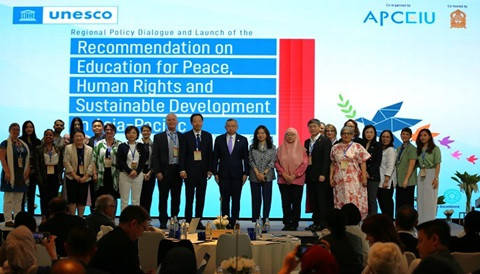 유네스코-아태교육원, 2023 권고 이행을 위한 아태지역 정책회의 공동 개최 2024-07-01 Regional Policy Dialogue and Launch of the Recommendation on Education for Peace, Human Rights and Sustainable Development in Asia-Pacific was held from 5 to 7 June 2024 in Bangkok, Thailand. This landmark event was co-organized by UNESCO and APCEIU, with support from the Centres of Asia-Pacific Excellence (CAPEs), the New Zealand Centre for Global Studies, and Sophia University, Japan, and hosted by the Ministry of Education of Thailand. The overarching goal of the event was to raise awareness on The Recommendation on Education for Peace and Human Rights, International Understanding, Cooperation, Fundamental Freedoms, Global Citizenship and Sustainable Development (hereafter referred to as the Recommendation) and facilitate discussions on implementation priorities at the regional level. On Day One, the event began with opening remarks from Soo Hyun Kim, Director of the UNESCO Regional Office in Bangkok, and welcoming remarks from Hyun Mook Lim, Director of APCEIU, and Police General Permpoon Chidchob, Minister of Education, Thailand. They expressed hope that the regional roadmap, to be developed at the event, will inspire policymakers, educators, and communities to implement impactful initiatives that enhance education's role in shaping a more just, peaceful and sustainable future. In the first session, Christopher Castle, Director of the Division for Peace and Sustainable Development at UNESCO, emphasised the comprehensive nature of the Recommendation and the necessity for a holistic approach. He also outlined upcoming milestones aimed at supporting its effective implementation, including the launch of the Global Implementation Guide. Following this, Miki Sugimura, Professor at Sophia University, presented research findings to enable participants to grasp the current landscape of education for peace, human rights, and sustainable development in the region, including its challenges and opportunities. In the second session, youth representatives engaged in gender, mother tongue education, environmental, and peace initiatives illuminated the room by sharing diverse proposals on the future direction of education as they envision it. The parallel sessions facilitated in-depth discussions on key action areas outlined in the Recommendation, such as Policy, Capacity Development, and Monitoring; Curriculum, Pedagogy, and Assessment; Teacher Development, Teaching and Learning Materials; and Life-wide Learning and the Learning Ecosystem. These sessions inspired participants to connect current issues with their own contexts, forming the basis for the development process of a draft regional roadmap. On the second day, all participants were grouped for field visits into three themes: 1) Health and Wellbeing, 2) ESD, and 3)GCED. Participants observed how these topics are applied and practiced in real-life settings. With all the insights and information gathered, participants convened around the table to identify priorities for each action area in the Recommendation and to explore existing resources to support its implementation. They discussed crucial issues within their respective contexts and shared ideas on how to compose the draft regional roadmap. On the last day, all participants reviewed the collated draft regional roadmap and provided feedback. Faryal Khan, Programme Specialist for Education at UNESCO Bangkok, concluded the event by highlighting the importance of upcoming global and regional platforms, emphasising the need for local and national-level actions to advance these critical dialogues. Developed collaboratively through the wisdom and participatory process of over 100 participants from 27 countries in the Asia-Pacific region, the draft regional roadmap will be further reviewed and agreed upon by UNESCO and the Asia-Pacific Member States, with the final version scheduled for future sharing. While anticipating regional launches in Africa, MENA, and LAC, alongside the launch of the Global Implementation Guide in November this year, this inaugural regional roadmap will set an example as a powerful tool for policymakers, educators, and grassroots activists to implement the new Recommendation. APCEIU remains committed to continuing support for the implementation of the Recommendation, the sole global standard-setting instrument outlining how education can promote lasting peace and advance human development at national, sub-regional, regional, and international levels. URL: https://www.unescoapceiu.org/post/5101
 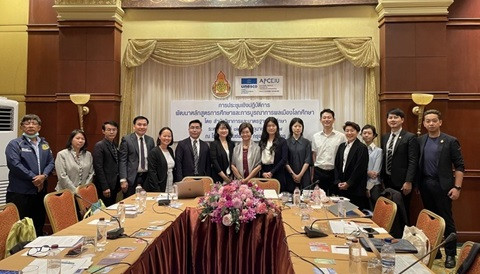 GCED Curriculum Development and Integration in Thailand (2024-2026) - Moving Forward with the Capacity Building Workshop 2024-07-01 In partnership with APCEIU, the Office of the Basic Education Commission of Thailand (OBEC) has taken their first step in the 3-year project of Global Citizenship Education Curriculum Development and Integration (GCED CDI), following up on its official launch in May, by organizing the Capacity Building Workshop on GCED for the Curriculum Development Committee (CDC) members from 13 to 14 June 2024 in Bangkok, Thailand. Launched in 2016, the Global Citizenship Education Curriculum Development and Integration (GCED CDI) project is one of the APCEIU’s flagship projects, and in 2024, Thailand, alongside Morocco, Pakistan and Nepal, is participating in the 5th Round (2024-2026) of the GCED Curriculum Development and Integration project. This workshop was organized by the Office of the Basic Education of Thailand, the implementing agency of the project, in support of APCEIU, for providing the overview of the conceptual framework of GCED, its application to Thai context, and the orientation of the GCED CDI project, including the practical resources to the Curriculum Development Committee members who will be the main bodies of implementing this project. Around 24 participants from the various Bureau and departments at the Office of the Basic Education, stakeholders from universities and schools, GCC-ESD at Chulalongkorn University (Thailand), UNESCO Bangkok Office, and APCEIU participated in the workshop. The first day of the workshop consisted of two main themes: Introductory sessions on GCED and the GCED CDI Project provided by APCEIU and Contextualization of GCED in Thai Education and its application for the curriculum mapping by the GCC-ESD at Chulalongkorn University, the 1st Round partner of APCEIU’s GCED Cooperation Centres (GCC) programme. Following the introductory sessions, active discussions including the QnA went on among the participants for the efficient and successful implementation of the project in Thailand. As Thailand is currently preparing the competence-based curriculum, strategies to link the Project to this process and make mutual contributions were also discussed. The second day of the workshop started with the introduction of the useful GCED resources and materials on GCED by APCEIU and sharing of the examples and publications in Thailand by various stakeholders from GCC-ESD at Chulalongkorn University, UNESCO Bangkok Office and OBEC. Then, the sessions further introducing and discussing the details of the GCED CDI Project in Thailand, followed, discussing strategies, human resources, and practical issues. The workshop concluded with practical suggestions for the next steps while identifying a number of broader challenges to be further discussed and resolved throughout the project implementation process. URL: https://www.unescoapceiu.org/post/5090
 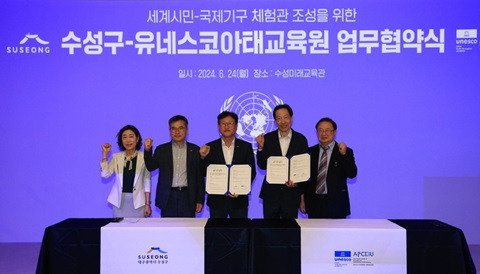 세계시민-국제기구체험관 대구관 설치 업무협약 체결 2024-06-30 유네스코 아태교육원은 지난 6월 24일 대구광역시 수성구청과 '세계시민-국제기구 체험관' 설치를 위한 업무협약을 체결하였다.아태교육원과 수성구청은 업무협약식을 통해서 다음과 같이 상호 협력을 하기로 했다.▲세계시민교육 및 체험관 홍보 활성화를 위한 상호 협력 ▲체험관 컨텐츠 제공 및 활용 ▲청소년 및 시민을 위한 세계시민교육 프로그램 운영 ▲세계시민 교육 관련 인적, 물적 교류 또한 협약식 이후 ‘수성미래교육관’ 개관식에서도 수성구는 대구의 세계시민교육 기반 조성과 확산을 향한 비전을 제시했다. 수성구는 아태교육원으로부터 지정을 받아 수성미래교육관 3층을 '세계시민-국제기구체험관'으로 운영할 예정이다. 이에 따라 아태교육원은 부산관(유엔평화기념관)에 이어 대구시 수성구에 분관을 개관하여 체험관 프로그램의 공간적, 물리적 제약을 완화하고 수요에 비해 부족했던 교육의 기회를 확대함으로써 대구 및 인근지역 학생 및 시민들도 세계시민교육에 쉽게 접근할 수 있게 되었다.한편 수성구의 '세계시민-국제기구체험관 대구관'은 온라인 예약을 통해 방문할 수 있으며 무료로 진행된다. 평일에는 학교, 기관 대상의 단체 프로그램, 주말에는 시민 누구나 이용할 수 있는 개인 프로그램으로 나눠 운영하게 되고 9월에 프로그램을 런칭할 예정이다. URL: https://www.unescoapceiu.org/post/5095
 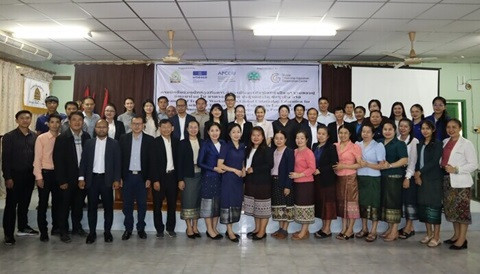 2024년도 라오스 세계시민교육 협력센터 활동 착수 - 교사교육가들의 세계시민교육 역량 강화를 향한 여정 2024-06-10 라오스 세계시민교육 협력센터가 5월 15일부터 17일 3일간 라오스 루앙프라방 교사양성대학 대상 세계시민교육 역량강화 연수 워크숍을 시작으로 2024년도 협력센터의 역량강화 사업 활동을 시작했다. 세계시민교육 협력센터 사업은 유네스코 아태교육원의 주력 사업 중 하나로 현재 6개국에서 운영되고 있으며 올해 2개국에서 협력센터가 새로이 합류할 예정이다. 라오스 협력센터는 2023년 동남아교육장관기구 지역교육발전센터(SEAMEO CED)에 개소하여 활동을 시작하였다. 라오스 협력센터는 이번 루앙프라방 교사양성대학 워크숍을 시작으로 올해 라오스 전국 8개 교사양성대학 대상 세계시민교육 역량강화를 위한 교사교육자 연수 워크숍을 진행할 예정이다. 유네스코 아태교육원의 협력과 지원으로 라오스 협력센터와 루앙프라방 교사양성대학이 공동 주최한 이번 워크숍은 연수 참가자인 루앙프라방 교사양성대학 교사교육가들을 비롯하여 유네스코 아태교육원과 라오스 국립대학교, 라오스 교육과학연구소, 유네스코 라오스 위원회, 그리고 라오스 교육부 전문가 총 48명이 참석하였다. 워크숍 첫날에는 이번 워크숍에 참석한 루앙프라방 교사교육가들이 생각하는 세계시민교육이 무엇인지, 그리고 이번 워크숍을 통해 기대하는 바가 무엇인지 나누는 시간을 시작으로 연결성 및 다양성을 몸소 배울 수 있는 다양한 활동들과 세계시민교육 프레임워크 및 글로벌 의제로서의 세계시민교육 등 세계시민교육에 대한 전반적인 교육 세션들이 진행되었다. 둘째날은 유네스코 아태교육원을 비롯하여 라오스 국립대학교와 라오스 교육과학연구소, 유네스코 라오스 위원회 및 교육부에서 참석한 발표자들이 한국 사례를 포함하여 라오스 고등학교 교육과 고등교육, 그리고 교사 교육 등 여러 방면에서 세계시민교육을 접목 시킨 사례들을 소개하고, 다양한 활동과 교훈 등을 나누는 시간을 가졌다. 워크숍 마지막날에는 지난 이틀간 진행된 다양한 활동들과 교육 세션을 바탕으로 그룹 활동을 진행하였다. 5개의 그룹으로 나뉘어 세계유산, 기후변화, 지속가능한 관광업 등 루앙프라방 지역과 관련된 주제들을 선정하여 활동 계획을 작성하고 발표하는 시간을 가졌다. 이번 워크숍을 통해 루앙프라방 교사교육가들의 세계시민교육에 대한 이해를 높이고, 학교 교육 내 세계시민교육 접목 사례들을 공유함으로써 세계시민교육을 지역적 특성과 환경에 맞게 풀어낼 수 있도록 교사교육가들로 하여금 다양한 방법들을 생각하고 실천할 수 있는 기회를 마련하였다.