
News
Catch up on what’s happening in the world of global citizenship education.
1,668 results found
 Mapping girls’ right to an education 2019-10-14 UNESCO’s Her Education Rights Atlas (HER Atlas) is designed to measure the degree of protection of girls’ and women’s education rights in national legal frameworks. Her Atlas was launched at the G7 France/UNESCO international conference on girls’ education in July and is part of UNESCO’s ‘Her education, our future’ Initiative. We feature some of its findings today on International Day of the Girl Child. The Atlas provides the latest information on the status of girls’ and women’s right to education in countries’ constitutions, legislation and regulations, serving as a strong monitoring and advocacy tool. More than 70 years after the adoption of the Universal Declaration of Human Rights, the right to education is still not realized for many girls and women worldwide. Finding 1: Only 44% of all States enshrine the right to education within their constitution without discrimination based on sex or gender Despite numerous reaffirmations by the international community of its strong commitment to achieve gender equality in education and the considerable progress in recent decades, poverty, pregnancy, early marriage, gender-based violence and traditional attitudes are among the many obstacles that stand in the way of girls and women fully exercising their right to participate in, complete and benefit from education. Findings 2- 3 from the 35 States fully analysed for the pilot phase 29% set the minimum age of marriage at 18 for girls Only 9% protect from all forms of violence in educational institutions, including corporal punishment and psychological, physical and sexual violence Normative instruments such as international declarations or conventions should not just be ratified but also implemented. This cannot be achieved without solid national legal frameworks that are rights-based, gender responsive and inclusive. Finding 4: 22% of the 35 States fully analysed by the team enshrine the right to education within their legislation without discrimination based on sex or gender for the first phase The UNESCO Convention against Discrimination in Education lays down core elements of the right to education. It prohibits any form of discrimination in education based on sex, in law and in fact, and provides for equal opportunities and chances to succeed in education, regardless of gender. The UN Convention on the Elimination of all forms of Discrimination against Women is the only legally-binding text focusing on the specific needs and circumstances of girls’ and women’s education and adopts an explicit gender perspective, ensuring to all an equal right of access to education, equal rights within education and equal rights through education. This commitment has been further reaffirmed by SDG 4, notably target 4.5, which requires States to “eliminate gender disparities in education and ensure equal access to all levels of education and vocational training for the vulnerable” by 2030. Findings 5-8 from the 35 States fully analysed for the first phase: 32% guarantee at least 9 years of compulsory education in the legal framework 46% do not guarantee free education, or guarantee only progressively free education in the legal framework 17% have aligned the minimum age of employment with the end of compulsory education, and that age does not fall below 15 years 20% of legal frameworks contain a provision that restricts the right to education of pregnant or parenting girls Strong and comprehensive constitutional, legislative and regulatory frameworks are the scaffolding to ensure the right for all to free and compulsory education. They are essential to advance girls’ education and gender equality, and to dismantle barriers to education, including child marriage, child labour and early and unintended pregnancy. How was Her Atlas developed? The Interactive Atlas has been developed by a multidisciplinary team in the Education Sector of UNESCO to support advocacy and monitoring of national normative frameworks that regulate girls’ and women’s right to education and to foster sharing of knowledge, experience and practices at country level. The first iteration is using 12 indicators to measure the status of national legal frameworks on girls’ and women’s right to education and includes information and data: on all States for the first three indicators, and on 35 countries for the other 9, with the ultimate aim to cover all States. This tool is in progress and is being developed. It will be further expanded and updated periodically to measure changes in the lead up to 2030, the deadline set for SDG 4. UNESCO collected and analyzed constitutions, laws, regulations, circulars and decrees available in national legal frameworks. The 12 indicators identified for the first phase of the project capture factors that have been shown to either strengthen, or act as a barrier to, the right to education of girls and women. The mapping builds upon the Observatory on the Right to Education, among other sources, and is informed by research carried out on the legal and regulatory provisions using all available sources. Each of the indicators has been assigned a score, from 1 (lowest) to 5 (highest). These scores were based on the analysis of existing legal provisions found in the first phase of the research and the confirmed existence of legal provisions that have achieved score 5. On the basis of these scores, Her Atlas aims to provide the information in a quantitative, visual and readily understood format. URL:https://gemreportunesco.wordpress.com/2019/10/11/mapping-girls-right-to-an-education/
 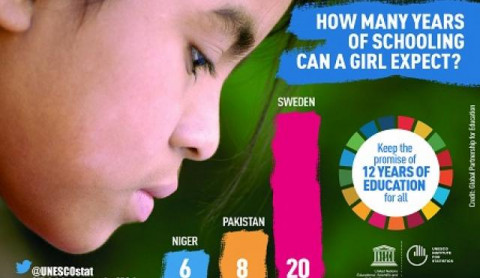 Data to Celebrate 50 Years of Progress on Girls’ Education 2019-10-14 On International Women’s Day, we can look back at 50 years of extraordinary efforts to get girls into the classroom. Thanks to these efforts, the gender gap in education is closing and has been closing for decades. And today, the majority of girls worldwide complete primary school. Girls are also in school for longer than ever before. As 50 years of data produced by the UNESCO Institute for Statistics (UIS) show, girls’ school life expectancy is on the rise. School life expectancy is the number of years of education a child can expect to receive. Overall the trends look good, even though school life expectancy also includes the years that girls repeat grades. Back in 1970, the global average for girls’ school life expectancy, spanning primary, secondary and tertiary education, was around 6.7 years. Today, it tops 12 years. Greatest progress in the least developed countries The world’s high-income countries started with a clear advantage: girls attaining an already impressive 11.5 years of education in 1970. But they have pushed this up still further to just over 17 years today. Nonetheless, we have seen the greatest progress in the world’s Least Developed Countries, even though they began from a far lower starting point, with school life expectancy for girls jumping from 2.8 years to 8.9 today. When we cast an eye across the regional data (see Table 1), we see that Southern Asia has managed to triple the years girls will spend in school since 1970 – from 3.8 to 12 – outpacing all other regions in terms of the scale of the increase. The average expected school duration for girls has more than doubled in Northern Africa and Western Asia (from 5.3 to 12.7 years) and in sub-Saharan Africa (from 3.3 to 8.8). While this is an impressive achievement, sub-Saharan Africa is still far from the goal of providing 12 years of universal primary and secondary education as part of SDG 4. Digging down into the country data, we find a mixed picture. Almost 50 years ago, a girl in Burkina Faso could expect to receive just one year of education, while the average today is 8.7. In Morocco, school life expectancy for girls has soared from about 2.2 to 13 years since 1971. The number of years girls spend in school has tripled in Guatemala (3.5 to 10.6), India (4.1 to 13) and Rwanda (3.5 to 11.2) and doubled in countries like Colombia (6.7 to 15) and Mexico (7.2 to 14.4) since about 1970. Although many countries can take pride in boosting school life expectancy for girls, they may still be far from the goal of ensuring 12 years of quality education by 2030. Girls are struggling to set foot in a primary classroom in countries such as Central African Republic, Chad, Mali and Niger, where more than one-third of girls of primary school age are out of school. Out-of-school rates for girls reach 72% in South Sudan and 64% in Liberia. Overall the progress that has been made for girls’ education has been a long and often difficult journey, with many obstacles to overcome along the way. Governments, educationalists and campaigners have had to enhance access to education for millions of children – boys as well as girls – who simply had no school to go to half a century ago. But they have also had to tackle entrenched social norms and hard-wired attitudes that have kept girls out of school, and that continue to exclude many of them today, including the low value sometimes placed on their education or more valid parental fears for their safety on the way to and from school, and even while they are there. Milestones in girls’ education The passage of millions of girls into and through education systems has been supported by helpful milestones along the way, including the 1989 Convention on the Rights of the Child, which turns 30 this year. The most ratified human rights treaty in history enshrined the right of every child to an education. The Education for All movement that grew out of the Dakar Framework for Action in 2000 added momentum to the push for universal education, leading many countries to abolish school fees. The Millennium Development Goals aimed to have every child completing primary school, and while that particular goal was not achieved in full, it helped to drive progress. And now we have the 2030 Agenda with its vision for education, and the Sustainable Development Goals that set the targets to be achieved. These trends chime, to some extent, with other development indicators for girls and women over recent decades. Although economic gender inequalities remain both common and large, recent research suggests that they are shrinking, with the gender pay gap falling in most countries and gender-equal inheritance systems that were once rare fast becoming the norm. Roser also points out that the global fertility rate has halved over the past 50 years and stands at just below 2.5 children per woman today. Average female life expectancy has also increased, from a global average of 60 years in 1970 to around 74 today, according to World Bank data. High-income countries had already achieved that level of life expectancy five decades ago and have manage to push average life expectancy still further, to almost 84 years today. But we see the greatest progress on female life expectancy in the Least Developed Countries. While they began from a very low starting point of just 45 years, they have managed to add an additional 20 years since 1970, with average life expectancy for females now standing at 66 years. It is hard to know whether greater education has helped to expand life expectancy or whether shrinking economic disparities have helped to get more girls into the classroom. Perhaps we are starting to see the impact of a decades-long virtuous circle, with success breeding success across a whole range of sectors for women and girls. My own personal view is that education has been at the very heart of the progress that has been made. By using data as a rallying call, we must show how much more can and must be done to support the most vulnerable women and girls during the discussions at the next High-Level Political Forum on Sustainable Development in July. URL:http://uis.unesco.org/en/blog/data-celebrate-50-years-progress-girls-education
 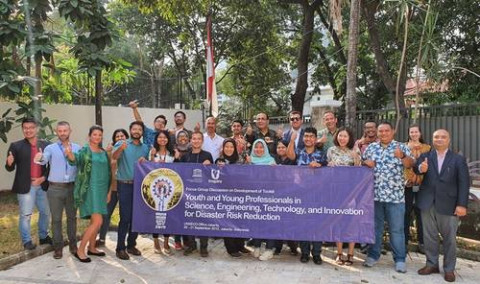 Young professionals take action to reduce disaster risks 2019-10-14 Youth and Young Professionals Declare Regional Alliance for Cooperation in Science, Engineering, Technology and Innovation for Disaster Risk Reduction and Climate Change UNESCO Jakarta organized a two-day workshop for Youth and Young Professionals in Science, Engineering, Technology, and Innovation (SETI) for Disaster Risk Reduction (DRR), on 20 & 21 September 2019. 20 participants representing U-Inspire and UNESCO offices in Jakarta, New Delhi, Islamabad and Almaty attended the workshop. As part of the workshop, youth and young professionals from U-Inspire India, Nepal, Afghanistan, Indonesia, Malaysia, Pakistan, Philippines, and U-Inspire Central Asia (Kazakhstan, Tajikistan and Uzbekistan), formally launched the Asia-Pacific Youth and Young Professionals Alliance in SETI for DRR and Climate Change. Some of the activities that were undertaken as part of the workshop were collaboration and discussion on the best practices and challenges faced in establishing platforms for engagements by youth and young professionals in this area. In addition, success stories and various initiatives of youth and young professionals in using their SETI expertise to support disaster risk reduction activities in their countries, were exchanged. While discussing the role of young people as potential agents of change, Neha Midha, UNESCO New Delhi National Programme Officer, emphasized the importance of establishing such platforms and forging partnerships for disaster risk reduction. Outcomes of the workshop will contribute to the development of a toolkit publication to showcase best practice examples and provide guidance around how youth and young professional in SETI for DRR can link with and contribute to regional, national and global DRR activities and frameworks. U-INSPIRE is a platform of youth and young professionals in science, engineering, technology and innovation (SETI), to accelerate the efforts towards disaster risk reduction (DRR) and support DRR policy and action at the local, national and international levels. As a signatory to the declaration, the UNESCO Regional Science Bureau for Asia and the Pacific is committed to professionally support the formal launch of the Asia-Pacific U-Inspire Alliance in 2020. URL:http://www.unesco.org/new/en/newdelhi/about-this-office/single-view/news/young_professionals_take_action_to_reduce_disaster_risks/
 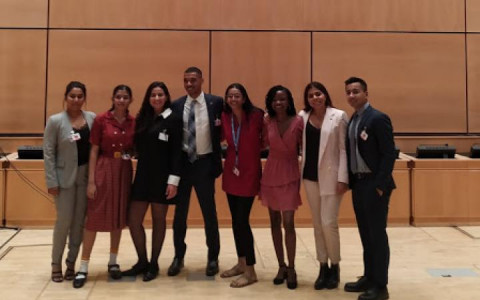 One Million Youth Leaders Beyond 2030 (1M2030) 2019-10-14 The United Nations Institute for Training and Research (UNITAR) and the Global Challenges Forum Foundation (GCF) are partnering to promote a new youth capacity-building initiative by creating an umbrella for fragmented, siloed, and left-behind efforts on youth empowerment. Additionally, they joined forces to host the launch of the One Million Youth Leaders Beyond 2030 (1M2030) initiative on the 27th of September, at the Palais des Nations in Geneva, Switzerland. The occasion was accentuated by Mr. Nikhil Seth, the UN Assistant Secretary General, Executive Director of UNITAR, who gave the opening remarks honoring the upcoming young leaders to empower themselves by taking the lead on attaining the Sustainable Development Goals. Through this statistical data, it becomes clear that the young among us must become present changemakers and not merely the futuristic hope of the elders. The most frequently quoted definition of sustainable development is from Our Common Future, known as the Brundtland Report and says: "Sustainable development is development that meets the needs of the present without compromising the ability of future generations to meet their own needs." 1M2030 is a social welfare initiative, which aspires to carry forward a global movement to empower youth to execute projects aligned to the UN SDGs. Via online and face to face training, mentorship, and access to micro-financing, youth are empowered to implement projects in their communities. The initiative primarily aims to target beneficiaries from Least Developed Countries, Small Island Developing States and Landlocked Developing Countries. Through this 1M2030 project, GCF is initiating to register and enlist 1 million youth by 2030 to overcome various challenges in different countries by undertaking small/medium sized projects aligned to the 17 SDGs. They already have made a conceptual start via the launch event, networking, and planned expansion. The event officially launched the Global Challenges Forum’s 1M2030 project and brought together international experts and inspiring youth speakers to assemble the latest thinking on how capacity-building can be leveraged to mobilize a new generation of young leaders for the Sustainable Development Goals (SDGs) and beyond. It included panel discussions, and TEDx-style youth talks, where nine selected spotlight speakers presented their aspiring projects in front of an influential crowd. Given the invaluable results of this partnership, UNITAR looks forward to future collaborations with GCF and the 1M2030 initiative and will continue enhancing the content and format of its training activities related to their common ambitions. URL:https://unitar.org/about/news-stories/news/one-million-youth-leaders-beyond-2030-1m2030
 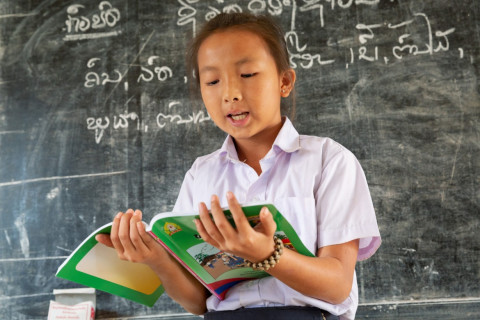 Reaching gender equality: Start with redesigning education systems for girls 2019-10-14 Time and time again, young women tell me that it was through education that they found their voice and the agency they needed to write their own futures. Education opens doors to knowledge, opportunity and empowerment. Yet the face of exclusion in education is still predominantly female and not a single country is on track to achieve the Sustainable Development Goal of gender equality by 2030. Surely the instrumental role of education needs to play a bigger part.We know that getting girls into school is not enough. There are many barriers to learning that are specific to girls and it is still extremely rare for the poorest girls to complete secondary school.While education can be life-changing, it can also reinforce deep-rooted gender inequalities. For this reason, we must take a system-wide approach to achieving gender equality in and through education. Girls’ experience of education needs to change The political momentum for gender equality in education is building, reflected in the recent G7 Declaration on Gender Equality and Women’s Empowerment, which calls for at least 12 years of safe and quality education for every girl and boy. While tackling the social norms and overlapping causes of exclusion is essential, also of critical importance is her learning experience, starting before she arrives in class.To achieve gender equality in school, girls must be safe from violence and harassment both on their way to school as well as in the classroom. Girls must have access to separate toilets so they don’t miss school during menstruation. Girls must receive the same levels of attention and expectation from their teachers as boys - that they will perform to their full potential in all subjects and lift their aspirations. And they need to see themselves in textbooks as doctors, scientists and Prime Ministers as much as nurses, primary school teachers and mothers.Only when education breaks down the deep structures that maintain gender inequality will the transformative potential of education be realized. URL:https://www.globalpartnership.org/blog/reaching-gender-equality-start-redesigning-education-systems-girls
 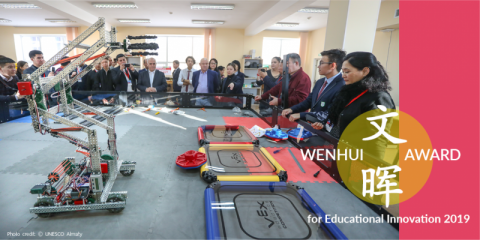 University-school partnerships leave no one behind 2019-10-14 From a lifelong-learning perspective, education should flow seamlessly from cradle to grave. The transition from early childhood education all the way to post-secondary and through non-formal education should support learning at all stages. The image of professors and students sitting in their ivory towers detached from the ‘real’ world is no longer valid in the 21st century, as universities are reaching out to schools and communities to improve the quality of education and make it more relevant. The 2019 Wenhui Award, Promoting University and School Partnerships in Advancing the Education 2030 Agenda, recognized successful university-school partnerships that have contributed to quality education and lifelong learning in preparing children and youth for life, work and global citizenship. The Wenhui Award organizers and Jury Members would like to commend all applicants for their contributions to meet this goal. Seven applications were shortlisted for the Wenhui Award this year, with two winners and two honourable commendations. Congratulations to all! Shortlisted applications Nauru Teacher Education Project School of Education, University of New England, Australia FABO College of Design and Innovation, Tongji University, China Building School-University Partnership for Students Benefit Nazarbayev Intellectual Schools, Kazakhstan Mentor-Mentee Outreach Program: Promoting University and School Partnerships in Revitalizing STEM Education in Rural Secondary Schools Nyet Moi Siew, Faculty of Psychology and Education, Universiti Malaysia Sabah, Malaysia University and School Partnership for ESD: Empowering Students and Teachers through Multi- faceted Informal Experiential Learning Regional Centre of Expertise on ESD Penang, Universiti Sains Malaysia, Malaysia Outreach Services Division of the Library, University of Moratuwa, Sri Lanka and its Activities Ruvini Kodikara, University of Moratuwa, Sri Lanka Service Learning as an Innovative Educational Initiative to Help Underprivileged Schools Carrier Guidance Unit, Faculty of Science, University of Colombo, Sri Lanka Winners Building School-University Partnership for Students Benefit Nazarbayev Intellectual Schools, Kazakhstan Service Learning as an Innovative Educational Initiative to Help Underprivileged Schools Career Guidance Unit, Faculty of Science, University of Colombo, Sri Lanka Honourable Commendations FABO College of Design and Innovation, Tongji University, China Mentor-Mentee Outreach Program: Promoting University and School Partnerships in Revitalizing STEM Education in Rural Secondary Schools Nyet Moi Siew, Faculty of Psychology and Education, Universiti Malaysia Sabah, Malaysia URL:https://bangkok.unesco.org/content/wenhui-award-educational-innovation-2019-results
 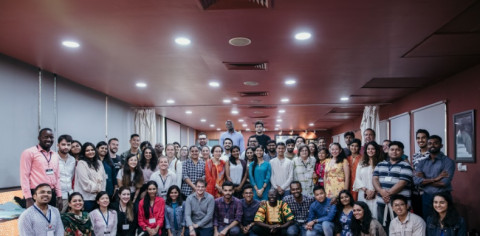 60 global youth receive Compassionate Integrity Training 2019-10-11 60 youth from 27 countries underwent Compassionate Integrity Training (CIT) to build their capacities on social and emotional learning at the 1st World Youth Conference on Kindness in New Delhi, India from 29 July to 22 August, 2019. The United Nations Educational, Scientific and Cultural Organization’s Mahatma Gandhi Institute of Education for Peace and Sustainable Development (UNESCO MGIEP) has partnered with Life University to build the capacities of youth organizations and universities on social and emotional learning and to develop a self-directed learning version of Compassionate Integrity Training which will be rolled out as a large scale training of youth across the globe. CIT is a multi-part training programme that cultivates basic human values as skills for increasing individual, social and environmental flourishing and was developed by the Life University’s Center for Compassion, Integrity and Secular Ethics. The sixty youth were trained through online classes and culminated in an intensive three-day face-to-face workshop at O.P. Jindal Global University, Sonipat, India by Marilyn Turkovich, Executive Director- Charter for Compassion, Thomas Flores- Fellow and Assistant Professor at Life University, and Shane O’Connor-Youth Trainer and consultant. The partnership between UNESCO MGIEP and Life University is expected to contribute to the United Nations Sustainable Development Goal 4.7 towards education for building peaceful and sustainable societies across the world by building capacities to comprehend the rising complexities through a deeper understanding of self, others, systems and interdependencies. The multi-part programme of Compassionate Integrity spreads across three modules and ten skills. It is a journey of progression from skills for self-cultivation to engaging in systems to understand the wicked and the complex problems plaguing the world community. The ten skills are: Calming Body and Mind Ethical Mindfulness Emotional Awareness Self-Compassion Impartiality and Common Humanity Forgiveness and Gratitude Empathic Concern Compassion Appreciating Interdependence Engaging with Discernment In addition to the 60 individual youth, UNESCO MGIEP supported the advanced training of 10 professional trainers as CIT Facilitators representing UNESCO MGIEP, O.P. Jindal Global University, and the Kalinga Institute of Social Sciences from 10 to 13 September 2019. Ms Deepika Joon, Youth Mobilizing Specialist at UNESCO MGIEP says that participants felt that compassionate integrity training happened to them at the right time in their life when they needed it the most. The repeated calls and reinforcements that CIT journey is a progress and not perfection creates a strong sense of hope and empowerment. She further elaborates that CIT is a unique learning programme due to two features. Firstly, it is based on the concept of secular approach to universal ethics and not based on any religion or culture and secondly it connects the skills of self-cultivation to appreciating interdependence to understand the systems. The secularized philosophy of ethics will develop the skills of youth to understand and comprehend inclusion and diversity from a unique perspective. The partnership between UNESCO MGIEP and Life University was facilitated by the International Charter for Compassion, an important strategic partner, which facilitates the establishment of initiatives of compassionate cities and communities, working with local groups to design sustainable action plans towards the achievement of the United Nations’ Sustainable Development Goals. It is hoped that the CIT skills will enable the youth delegates to implement community-wide activities to further train educators and mobilize their respective communities for long-lasting peace and sustainability leading to a stronger kindness movement across the globe. Compassionate Integrity Training will give big impetus to youth to achieve the humongous targets they have set out to achieve through the New Delhi Declaration of Kindness, one of the major conference outputs. URL:https://mgiep.unesco.org/article/60-global-youth-receive-compassionate-integrity-training
 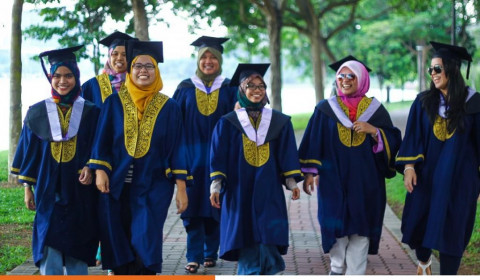 SDG 4: Planning for flexible learning pathways in higher education 2019-10-11 Higher education is expanding rapidly worldwide. Global enrolment in higher education more than doubled in less than two decades, reaching 221 million students in 2017. This number is expected to surpass 590 million by 2040. This expansion has led to a diversified sector, reflected in not only a wider variety of higher education institutions, programmes of study and delivery modes, but also a diversity of learners entering the system, including non- traditional groups. As a result, higher education is increasingly expected to adapt to different learning requirements, which means offering well-articulated and flexible learning pathways that can facilitate good outcomes for all. The need to adapt education systems to better support flexible learning pathways, with a view of strengthening equity and lifelong learning is well recognised in the international Education 2030 Agenda and the Sustainable Development Goal (SDG) 4. The Agenda encourages countries to develop well-integrated education systems that provide flexible learning pathways for all students in the form of entry points and re-entry points at all ages and all educational levels, strengthened links between formal and non-formal structures, and recognition, validation, and accreditation of the knowledge, skills and competencies acquired through non-formal and informal education. However, ensuring that higher education systems provide multiple entry and progression pathways tailored to different types of learners is easier said than done. This process requires adequate policies and steering instruments to create an enabling environment for flexible learning pathways and well-designed implementation strategies to ensure that these pathways are reflected into the practices of higher education institutions and are truly used for the benefit of the learners. New research project launches on planning for flexible learning pathways: In 2018, the UNESCO International Institute for Educational Planning (IIEP) launched the research project, ‘SDG4: Planning for flexible learning pathways in higher education’. The objective is to produce knowledge and provide evidence-based policy advice to ministries of (higher) education in different development contexts that are considering building or strengthening flexible learning pathways as an area of reform. The research comprises an international baseline survey and seven country case studies in different regions that are developing or have developed initiatives for flexible learning pathways. The case study approach envisages an in-depth analysis of how national policies are implemented and how they influence institutional practices. Furthermore, it also aims to capture more decentralized, institution-led measures for the development of flexible learning pathways in higher education. 7 countries come together: The selected countries and partner organizations for the project are Chile (Consejo Nacional de Educación), Finland (Finnish Education Evaluation Centre and the Finnish Institute for Educational Research), India (Centre for Policy Research in Higher Education, National University of Educational Planning Administration), Jamaica (The University Council of Jamaica), Malaysia (National Higher Education Research Institute, University Sains Malaysia), Morocco (University Hassan II), and South Africa (South African Qualifications Authority). URL:http://aspbae.org/userfiles/sep19/others/ASPBAE_Bulletin_June_2019.pdf
  Empowering students for just societies: A new resource for teachers 2019-10-11 In some societies, children are led to believe that the absence of the rule of law is not just common, but acceptable. Even in countries where the rule of law is well-established, frequent corruption scandals and spiraling social inequalities means that young people are losing trust in politicians and the institutions of justice and democracy. Education has a key role to play in empowering students to understand their fundamental rights, and to become champions for justice in society. Therefore, UNESCO in partnership with UNODC, has developed two handbooks, one aimed for primary and one for secondary schools to help teachers empower their students. “We piloted the handbooks in schools that are members of the UNESCO Associated Schools Network (ASPnet) in 10 countries (Spain, Brazil, Burkina Faso, Indonesia, Lebanon, Nigeria, the Philippines and Slovenia) and received positive feedback from both students and teachers,” says Cecilia Barbieri, chief of UNESCO’s Global Citizenship Education Section. Ayi Joseph, a 15–year-old student from Nigeria felt inspired by what he learnt: ‘The ideal future, devoid of crime, terrorism, violence is in our hands, we should make the change now.’ The exercises build students’ awareness of their rights, and break down misconceptions surrounding law and justice. One student involved in the piloting revealed: ‘I thought anyone in a leadership position could just make a law and force others to obey. I didn’t know that rules have processes.’ Interactive lessons The lessons in the handbooks are interactive: democracy is demonstrated, as students participate in mock elections or take on the roles of judges – jurors - local mayors and refugees. Games and story-telling help bring social issues to life, prompting students to take a moral stand. For some, this was their first experiences of interactive learning. Teachers instruct their classes to push the desks against the walls, to engage in role-play and to debate real-life issues. One primary-aged pupil said: ‘It’s almost like in the real world’ The handbooks are designed to help teachers develop students’ critical thinking and empathy – two important skills which are often not core learning objectives within school curricula. One secondary school teacher felt they succeeded in doing this: ‘This kind of activity helps students to think bigger. It helps them see they’re part of a wide community that’s working around the clock to establish a culture of peace.’ One of the main aims of the primary schools handbook.is to convey the message that one is never too young to start developing a moral compass. ‘Right is what you should do even if no one does it, while wrong is the act you should try to avoid’, as one child observed. Learning through games Diminishing Islands is a game young children love to play. It teaches them about common causes for conflict, and about the need to work together without resorting to violence. Children occupy ‘islands’ of newspaper on the classroom floor, but as the game develops their ‘islands’ disappear, and they find themselves crowded onto just a few islands, until at the end, most are ‘out’. Afterwards, the teacher leads the class in reflection on how the game made them feel, and on how it relates to real life challenges - war, migration, poverty, inequality. One primary aged child who played this game learnt a valuable lesson about working together: ‘We have to do our best to help one another to survive because I don’t want to be alone on an island’. Some of the lessons in the handbooks are rooted in history and local culture, building students’ understanding of how national laws evolve and societies learn to resolve conflict and live together. There are lessons on how the norms in the African Charter on Human and Peoples’ Rights were refined over time, or on the Charter of Manden, one of the earliest sources on fundamental human rights, which was passed down through Malian oral tradition. Historical sources like these help students understand that co-operation has always involved peaceful and inclusive dialogue: ‘Life is all about creating balance and space for yourself and others’, was the view of one secondary-school pupil. Other lessons equip students with the skills they need to navigate the digital age. Our partner, the UNODC worked with the government of El Salvador to develop a set of learning resources on cybersecurity, privacy, cyberbullying, grooming, sexting and sextortion. The activities in handbooks are rooted in Global Citizenship Education, an approach which can help foster young people's trust in public institutions, transforming them into agents of change instead of allowing feelings of disenfranchisement and victimhood to fester. UNESCO works with the UNODC to promote the rule of law, democracy and human rights through education. URL:https://en.unesco.org/news/empowering-students-just-societies-new-resource-teachers
 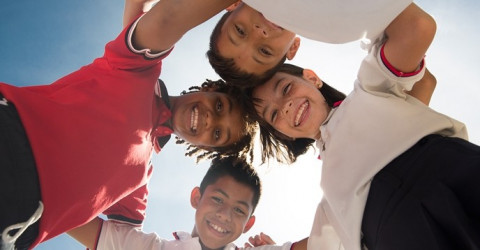 Every learner matters: A renewed drive for inclusion in education in Cali 2019-10-11 “To overcome inequality and injustice, we must widen the lens by acting on all factors that marginalize children and youth and hijack their educational journey.” In her opening remarks, Stefania Giannini, UNESCO Assistant Director-General for Education set the tone of the International Forum on Inclusion and Equity in Education that took place in Cali, Colombia from 11 to 13 September 2019 on the occasion of the 25th anniversary of the Salamanca World Conference. A call for renewed impetus Every learner matters equally, regardless of their specific needs, difference, status and gender. But 25 years after the adoption of the Salamanca Statement, ensuring each learner has an equal opportunity to receive and benefit from an education remains a major issue worldwide. Still today, 750 million adults around the world cannot read or write. And 262 million children and youth are out of school worldwide. A renewed impetus for action on inclusion in education by governments and partners, the Forum provided a unique platform for debate, experience-sharing and networking. It devised strategies needed to accelerate the progress started at Salamanca in fostering education systems that make inclusion a reality. The Forum stressed the urgency to build education systems that make diversity a strength, and where every learner matters equally. Every learner matters equally As underlined by the theme “Every learner matters”, the Forum was an opportunity to revive the broadened notion of inclusion as a general guiding principle to strengthen equal access to quality learning opportunities. It showcased the wide range of people who would benefit from inclusion in education. From people with disabilities, children and young people whose inclusion is jeopardized by their health status such as pregnant and parenting girls and people living with HIV , to indigenous populations, young LGBTI people and people on the move, inclusion in education is needed for all learners across different settings. The Forum enabled the voices of young people, directly affected by the shortcomings of education systems around the world, to be heard. “Our main goal should be that every child can grow up to be the person that they dream to be without facing any system of exclusion,” said youth representative Omar Didi. “This can only be achieved through inclusion in education.” They spoke to why inclusion in education matters to them, engaging the audience to partake in a live poll on this question. “To talk about quality education means approaching education from a point of view of inclusion. It means recognizing children, young people and adolescents as learners with rights,” said María Victoria Angulo, Minister of Education of Colombia. The fact that learners are in school does not mean that they are included’, said João Costa, State Secretary of the Ministry of Education of Portugal. The Forum recognized, as concluded in Salamanca, that schools integrating an inclusive curriculum and environment are the most effective means of reaching all learners and building an inclusive society. At school, teachers, head teachers and administrators should be empowered and supported with tools and knowledge to respond to the diverse learning needs of their students in an environment free from discriminatory attitudes and gender-based discrimination. Discussions highlighted the need for adequate legislative frameworks to address discrimination in education and more investments to build stronger national capacity for statistics and disaggregated data on the topic. The Forum resulted in the establishment of the “Cali Statement”, an outcome document stating the commitments of involved parties in accelerate action on inclusion in education. Read the outcome document. More than 450 delegates from over 55 countries came together over three days to attend the Forum organized by UNESCO, in cooperation with the Ministry of Education of Colombia and the City of Cali. In attendance were government officials, education practitioners and educators, researchers and experts, representatives of intergovernmental and non-governmental organizations, development partners, civil society representatives and private sector stakeholders, among others. A synthesis report documenting the main achievements and outcomes of the Forum is forthcoming. URL:https://en.unesco.org/news/every-learner-matters-renewed-drive-inclusion-education-cali