
News
Catch up on what’s happening in the world of global citizenship education.
1,668 results found
 New agreement to measure global citizenship and sustainable development education 2016-03-04 UNESCO and the International Association for the Evaluation of Educational Achievement (IEA) have established an official agreement to collaborate in the area of measuring Global Citizenship Education (GCED) and Education for Sustainable Development (ESD).The UNESCO – IEA collaboration will focus on measuring Target 4.7 of the 2030 Education Agenda which includes GCED and ESD, the aim of which is to “…ensure all learners acquire knowledge and skills needed to promote sustainable development, including among others through education for sustainable development and sustainable lifestyles, human rights, gender equality, promotion of a culture of peace and non-violence, global citizenship, and appreciation of cultural diversity and of culture’s contribution to sustainable development.”IEA administers the International Civic and Citizenship Education Study (ICCS), one of the major sources of data collection for Target 4.7. UNESCO and IEA have already collaborated in identifying a set of potential indicators for measuring Target 4.7, one of which is being considered as a potential global indicator for Target 4.7.The two organizations will continue their collaboration to further align future cycles of the ICCS study with the indicator for Target 4.7 and to develop at least one thematic report, relevant to GCED and ESD.More information about UNESCO’s work on:GCEDESDFor more information about IEA and the ICCS study
 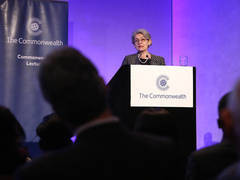 In Commonwealth Lecture, a call to educate for inclusion, dialogue and peace 2016-03-03 A community of 53 countries harbouring a quarter of the world’s population – of which 60% are under 25 – she affirmed that “UNESCO and the Commonwealth are guided by similar principles of dialogue, tolerance, respect and understanding, cooperation and joint action.” She noted the scope of UNESCO’s cooperation with the Commonwealth, spanning teachers, technical and vocational education and training, higher education, ICTs, as well as Open Educational Resources. From combating violent extremism to connecting the dots between the social, economic and environmental dimensions of sustainable development, Ms Bokova affirmed that there is no more powerful force than education, to advance social inclusion, break the vicious circle of poverty and hold up human rights.“Lasting peace and sustainable development are unthinkable while exclusion and deep inequality persist,” she warned.She opened on the Syria crisis and the risk of losing a generation to despair, poverty and violence, asserting that “education cannot wait – it must be a priority from the top, in disaster risk reduction, in humanitarian action, in peacebuilding – because there is no stronger foundation for reconstruction and recovery, for lasting peace.” This crisis, she said, highlights the wider challenge of building more just and inclusive societies, in what she described as a “global struggle for hearts and minds.”“Education is the way to disarm the processes that may lead to violent extremism, by undermining prejudice, by fighting ignorance and indifference,” she said, citing UNESCO’s actions to engage youth in strengthening the narrative of a single humanity and empowering them as agents of change.Noting that inclusion lies at the core of the 2030 Agenda for Sustainable Development, she outlined UNESCO’s leadership in shaping a comprehensive and holistic vision of education, and its work with Governments to build more inclusive education systems and schools that are “crucibles of tolerance and solidarity.” She emphasized that the promotion of gender equality, a global priority for UNESCO, is the foundation for dignity and the catalytic force for development, citing UNESCO’s cooperation in several Commonwealth countries, including Bangladesh and Pakistan.Today’s challenges call for new ways of seeing the world, of thinking and behaving – and this starts with education. “Given the depth of transformation affecting all societies, I am convinced we need to think big again today about education, to make the most of its transformational force for equity and inclusion, for global solidarity,” said the Director-General, stressing that global citizenship education is a priority for UNESCO.“This is about learning to live in a world under pressure, about new forms of cultural literacy, about sharing the wealth of cultural and linguistic diversity as a force for renewal, belonging and innovation.”She highlighted the work of the Mahatma Gandhi Institute of Education for Peace and Sustainable Development based in New Delhi, which promotes youth action for transformative learning and social change, including through its YESPeace Network.Irina Bokova also underlined the importance of Education for Sustainable Development, including to take forward the Paris Climate Change Agreement. Noting that the Commonwealth counts a large number of Small Island Developing States, she listed UNESCO’s work to strengthen disaster preparedness through teacher training, safe school facilities and climate change education.Reacting to the lecture, the Chair of the session, Lord John Alderdice, renown for his lifetime work on conflict resolution and peace building, praised the focus placed on values. “We tend to speak about education in instrumental terms. This brought us back to its fundamental purpose, which is about values, dialogue and peace – the human dimension. Concluding the event, the Secretary-General of the Commonwealth of Nations, Mr Kamalesh Sharma, affirmed that “investing in young people is essential for securing a peaceful future. UNESCO and the Commonwealth are committed to dialogue and knowledge sharing as the pathway to sustainable development and mutual understanding. ” He outlined plans to reinforce collaboration in the areas of education, youth, peace-building and dialogue, stating that this commitment takes on heightened importance in the context of violent extremism.
  Leading French network of rural vocational institutions puts Global Citizenship Education first 2015-12-21 What skills do young people need to face the complexities of a globalized world? More than 250 educators, learners and school administrators from across France gathered to discuss the theme at a seminar entitled “Education aux autres et aux mondes held at UNESCO Headquarters, Paris on December 16. The seminar, organized by the association Maisons familiales rurales (MFR), a leading education network offering alternative and vocational training in rural areas, also addressed concerns about a rise in youth radicalisation. Participants underlined the importance of offering holistic programmes that encompassed cognitive, socio-emotional and behavioural learning.“It is our collective responsibility as parents, educators and community members to respond to the questions of youth, and to value their future as young citizens,” said an MFR administrator. “Citizenship education should not be only taught in a classroom. It is a learning process that involves dialogue and interacting with others in and out of schools.“Young people experience citizenship in their daily lives, at school, in the work place and at home. Our challenge is to help them live by their values on a daily basis”.Global Citizenship Education (GCED) is a strategic area of work for UNESCO’s education programme and aims to equip learners of all ages with values, knowledge and skills that empower them to be responsible global citizens.During the seminar, MFR launched a pedagogical toolkit and video that provides assistance to educators and MFR administrators on how to integrate GCED into teaching and learning practices and the educational community at large. Learners benefiting from the MFR educational programmes presented a video they developed to promote respect for all and diversity.The recommendations made during the seminar will serve for the development of the future educational strategy of MFR that will reaffirm GECD as a priority and scale up its implementation.Speakers at the seminar included representatives of national youth organizations, the European Commission, Educasol and UNESCO’s Section for Health and Global Citizenship Education.MFR is comprised of 440 associations training 70,000 pupils, apprentices and trainees, and more than 600 rural family centres across 30 other countries.
 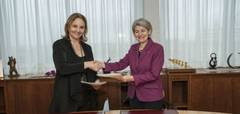 UNESCO signs new partnership with Asia Society to advance Global Citizenship Education 2015-12-15 Paris, December 11, 2015 - UNESCO Director-General Irina Bokova and Asia Society President and CEO Josette Sheeran, signed an agreement today to work together to implement Global Citizenship Education at global, regional, national and/or school levels.The two organizations share a history of collaboration and a common goal to work toward the objectives of Goal 4 of the 2030 United Nations Agenda for Sustainable Development regarding quality education and, in particular, Target 4.7 which focuses on global citizenship education. Welcoming the agreement, the Director-General stressed the heightened relevance of global citizenship education for countering violent extremism and promoting human rights, respect for diversity and a sense of solidarity and shared responsibility towards the future.“We must educate a generation of global citizens – versed in human rights, culturally literate, skilled for intercultural dialogue, compassionate and committed to building a better world for all. Our partnership with Asia Society will contribute to delivering on the promise of the 2030 Sustainable Development Agenda and prepare all students to succeed in a global era.”The partnership will mobilize Asia Society’s education frameworks and expertise – including teacher and principal training, curriculum materials, and international best practices sharing to support UNESCO Member States to implement global citizenship education.“Asia Society values our strong relationship with UNESCO, and we are pleased to form this partnership, which is particularly timely with the upcoming launch of the Asia Society Center for Global Education in 2016,” said Sheeran. “As we consider critical 21st century education challenges, we are glad to join forces with UNESCO to help nations meet their global citizenship education goals.”GCED aims to equip learners of all ages with values, knowledge and skills based on respect for human rights, social justice, diversity, gender equality and environmental sustainability and empowers them to be responsible global citizens, promote a better world and help prevent violent extremism.UNESCO has organized several international consultations on global citizenship education and developed the first pedagogical guidance outlining topics and learning objectives. It promotes GCED through policy dialogue, technical guidance and a clearinghouse which offers a rich resource of written and audiovisual materials.Asia Society has worked for more than 60 years to build bridges of understanding in policy, culture, and education between the US, Asia, and globally. Its education mission is to develop global competence in students, young leaders, and educators as the foundation for understanding between people in the Asia Pacific region and throughout the world.The Asia Society Center for Global Education brings together leaders and institutions to tackle one of the most critical education challenges today: how to educate all students for employability and citizenship in a global era.Over the past decade the Asia Society global education team, led by Dr Tony Jackson, has developed a global competence framework for teaching and learning, in partnership with education experts from the Harvard Graduate School of Education and Stanford University and with support from the Bill and Melinda Gates Foundation, Carnegie Corporation, and others.This framework, which defines what students need to succeed in a globalized job market and world, has now entered the first phase of implementation and is currently deployed in more than 30 primary and secondary schools in the United States. It provides a tested methodology for actualizing the UN targets regarding global citizenship education.
 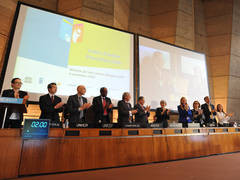 The global education community adopts and launches Education 2030 Framework for Action 2015-11-25 The Education 2030 Framework for Action (FFA) was adopted and launched at a high-level meeting, held alongside the 38th UNESCO General Conference at the Organization’s Headquarters on 4 November."Today, with the Education 2030 Framework for Action, Governments from across the world have agreed on how to translate a promise on paper to change on the ground,” said UNESCO Director-General Irina Bokova at the launch event.The Education 2030 Framework for Action was adopted by more than 70 Ministers, representatives of Member States, the United Nations, multilateral and bi-lateral agencies, civil society, regional organizations, the teaching profession, academia, youth and the private sector.Ministers and Heads of Delegation took the floor throughout a day-long meeting, which will end with closing addresses by Kishore Singh, Special Rapporteur on the Right to Education, and the Prime Minister of Cook Islands, Mr Henry Puna.The FFA, the result of an unprecedented consultative process, provides guidance to countries for the implementation of the Education 2030 agenda. It aims to mobilize all stakeholders around the new global education goal and targets, and proposes ways of implementing, coordinating, financing and reviewing the 2030 education agenda—globally, regionally and nationally—to guarantee equal educational opportunity for all.“Never before has the world consulted in such depth on a new goal in education, bringing all voices to the table. Never before has the world agreed on such a detailed road-map for the implementation of a new goal,” said the Director-General.Addressing the opening session of today’s event, Najat Vallaud-Belkacem, France’s Minister of Education, Higher Education and Research, said that her country endorsed the four principles of the Agenda: the right to free and compulsory quality education; the affirmation that education is a public responsibility; the need to give adults lifelong learning opportunities; and the priority given to gender equality. “The conviction guiding our policy is that inequality is not a matter of fate. We have the responsibility to act to ensure that students’ background does not determine their educational prospects and future opportunities.” She also emphasized the importance of education for global citizenship, referring to the fundamental role of schools in countering extremism and promoting values of freedom, tolerance and non-discrimination.The essential elements of the FFA were agreed upon at the World Education Forum in Incheon, Republic of Korea, in May this year. The resulting Incheon Declaration represents the firm commitment of countries and the global education community to a single, education agenda—Education 2030—that is holistic, ambitious, inclusive and aspirational. The Declaration entrusts UNESCO, as the United Nations’ specialized agency for education, to continue its mandated role to lead and coordinate the Education 2030 agenda.“The Education 2030 Framework sets bold benchmarks…This calls for new funding, to bridge the annual US$ 40 billion funding gap, to invest where needs are most acute. We need every country to meet the target of allotting six percent of Gross Domestic Product to education,” said Ms Bokova “We need to reach the overall goal of directing 0.7 per cent of all Official Development Assistance to education. To leave no one behind, we need more investment and smarter investment, backed by stronger policies.”The event is organized by UNESCO jointly with the co-convenors of Education 2030—the United Nations Development Programme, the United Nations Populations Fund, the United Nations High Commissioner for Refugees, the United Nations Children's Fund, the United Nations Entity for Gender Equality and the Empowerment of Women, and the World Bank. During the event, it was announced that the International Labour Organization would become the eighth convenor of Education 2030.
 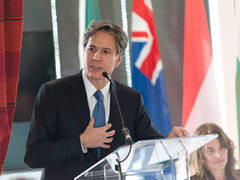 UNESCO and United States promote education to prevent violent extremism 2015-11-09 Paris, 6 November – Director-General Irina Bokova and United States Deputy Secretary of State Antony Blinken made a forceful appeal for respect, civic engagement and responsibility at a high-level event on Preventing Violent Extremism through Education, organized by UNESCO and the Permanent Mission of the United States during the 38th General Conference at UNESCO Headquarters on 6 November.The event was supported by the Permanent Delegations to UNESCO of Australia, Austria, Bulgaria, Canada, France, Kenya, Saudi Arabia, Turkey and the United Arab Emirates.“No one is born a violent extremist,” said the Director-General. “Violent extremists are made, they are nurtured, they are fuelled. Violent extremists offer destruction and hatred. We must respond with culture and knowledge. Violent extremists promote fear and division. We must respond with skills for critical thinking, with opportunities for civic engagement, with competences for dialogue across cultures."Mr Blinken stressed that UNESCO’s role as a guardian of shared humanity was more needed than ever. “By arming young minds with a world perspective rooted in respect, social justice, diversity and critical thinking, we can not only counter radicalization as it arises, but prevent its growth in the first place,” he said. “In the 21st century, what really defines the wealth of a nation is its human resource, and that ability to maximize the potential of that resource to be creative, to innovate, to think, to argue and to create.”He said that UNESCO’s Global Citizenship Education programme was helping to equip ministries with the latest in education policy, classroom curriculum, and internet guides in order to foster a learning environment based on the exchange of ideas.“We recently saw the great depth of support that exists for these kinds of partnerships when the resolution on UNESCO’s role in promoting education to prevent violent extremism received an exceptional response of 80 co-sponsors,” he said, noting that “UNESCO’s mandate remains a pillar of international security and prerequisite for sustainable development.”He said the United States would work with UNESCO to develop a dynamic digital education resource to help prevent and undermine the allure of violent extremism along with the United States Holocaust Memorial Museum, the University of Southern California Shoah Foundation and Facing History and Ourselves.During a bilateral meeting with the Director-General, Mr Blinken underlined that cooperation with UNESCO has a special significance for the U.S. given the fundamental role of the Organization in addressing issues such as countering violent extremism and radicalization, protecting journalists, enhancing scientific cooperation and protecting the Ocean. He asserted that the United States are and remain a vibrant partner of UNESCO.The event took place with 200 participants, including around 30 ministers of education and representatives of permanent delegations to UNESCO. It included a round table discussion moderated by Newsweek journalist Ms Janine de Giovanni with contributions from Mr Belio Kipsang, Principal Secretary, State Department for Education of the Republic of Kenya, Ms Fariha Peracha, Director of the Sabaoon Centre in Pakistan and Mr Ivo Veenkamp, Deputy Executive of Hedayah in Abu Dhabi. Topics included ways of promoting critical thinking, breeding grounds for and causes of radicalization among youth and how international cooperation could be strengthened in preventing and countering violent extremism.It follows the adoption of a resolution at UNESCO’s 197th Executive Board on education as a tool to prevent violent extremism, placing UNESCO in a leading role in this domain. UNESCO’s action was recognised as essential to prevent and counter violent extremism, during the Leaders’ Summit on Countering ISIL and Violent Extremism, hosted by President of the United States, Barack Obama at the United Nations in September 2015 The preventive approach in addressing violent extremism is also part of the UN Global Counter-Terrorism Strategy.
 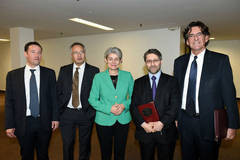 Education at the heart of the fight against anti-Semitism: The Director-General participates in the 6th National Convention of Representative Council of Jewish Organizations in France (CRIF) 2015-11-05 On 1 November 2015, UNESCO Director-General, Irina Bokova, attended the 6th National Convention of the Representative Council of Jewish Organizations in France (CRIF), within the framework of a round table on "Education, a defense against racism and anti-Semitism?"Throughout the day, the National Convention of CRIF brought together dozens of political personalities, community and religious leaders, journalists, intellectuals and academics to address the major issues affecting the life of Jewish communities in France and in the world, notably, in relation to minorities, the rise of racism and anti-Semitism, the rise of violence in Israel.Among participants at the round table "Education, a defense against racism and anti-Semitism?" there were Mr Alain Chouraqui, President of the Camp des Milles Foundation and Head of the UNESCO Chair on Citizenship Education, Human Sciences and Shared Memories", Pastor François Clavairoly, President of the Protestant Federation of France, Ms Emilie Freche, writer, Ms Valérie Pécresse, Member of Parliament of the Yvelines.Participants discussed the importance of developing education that promotes the civic engagement of young people as an essential ingredient of a society more able to resist extremist ideologies.The Director-General emphasized the gravity of the current situation in the face of the surge of anti-Semitism, especially in the European context, referring to the murders in Toulouse, Brussels, Paris and Copenhagen in recent years."It is possible, in France, 70 years after the Holocaust, to be murdered because of being Jewish," recalled the Director-General, adding that the crimes occur in a fragmenting social environment marked by increased mistrust between citizens, fear of the future and promoting the rise of racism.She called for increased vigilance to the changing forms of contemporary anti-Semitism, including its relativization or denial."This violence of words is all the more difficult to combat it sometimes appears in the form of stereotypes, it permeates culture and it asserts itself in the public debate by hiding behind the pretext of freedom of expression, or behind the anonymity of the Internet,” she said. "This is the sign of a considerable slump of our collective intellectual defenses, weakening our critical minds, the disappearance of our bearings and the most basic reflexes."Recalling UNESCO's actions in the field of education for global citizenship and in the teaching of the history of the Holocaust and other genocides, Irina Bokova recalled the recent nomination of Serge and Beate Klarsfeld as Honorary Ambassadors and UNESCO Special Envoys for teaching the history of the Holocaust and for the prevention of genocide.The Director-General underscored the importance of the commitment to quality education, based on human rights, providing young people with the skills of critical analysis and outlooks that will enable them to be engaged in the face the ideologies of hatred and reject radicalization.She recalled the important role that UNESCO plays today in the fight against violent extremism, through its education programmes and its action to protect cultural heritage in the Middle East. "We cannot reply to extremism solely by the force of arms," said Irina Bokova."There is no clash of civilizations. There is a conflict between those who think that we can live together in diversity and those who reject the idea," she concluded, highlighting the crucial role of culture and education in preventing extremist ideologies.On this occasion, the Director-General met Mr Jonathan Greenblatt, the new Director of the Anti-Defamation League (ADL), who recently succeeded Mr Abraham Foxman in this function. Ms Bokova and Mr Greenblatt discussed new educational projects that the ADL plans to carry out and possible avenues of cooperation with UNESCO, notably in the fight against racism and anti-Semitism on social networks.
  UNESCO's Role in UN’s Action to Counter and Prevent Violent Extremism 2015-10-20 On 30 September, at UNHQ in New York, UNESCO Director-General briefs US government officials on UNESCO’s role in the United Nations Counter-Terrorism Implementation Task Force (CTITF). On the margins of the high-level week of the 70th UN General Assembly, UNESCO Director-General Irina Bokova, joined other CTITF entities to address the joint work of the UN in countering and preventing violent extremism at a meeting with high-level officials from the US Government’s State Department. The delegation from the United States was led by Assistant Secretary of State Bathsheba Crocker, Bureau of International Organizations Affairs in the US State Department; Ambassador Jacob Walles, Special Advisor on Foreign Terrorist Fighters (FTFs) and Raffi Gregorian, Director, from the Bureau of Counterterrorism in the US State Department; as well as the Deputy Assistant Secretaries from the US State Department’s Bureau of Conflict and Stabilization Operations; Bureau of Democracy, Human Rights, and Labor; Bureau of South and Central Asia; and Bureau of African Affairs. The Directors of USAID and the National Counterterrorism Centre (NCTC) and a number of other officials were also part of the delegation.Irina Bokova outlined UNESCO’s commitment and action in educating youth to keep them away from radicalizing forces, underscoring the value of protecting cultural heritage from destruction and keeping cultural properties from trafficking. She reiterated the calls she had made the day before in President Obama’s Leaders’ Summit on countering ISIL and violent extremism, where she was the only UN Official to be given the floor along with UN Secretary-General Ban Ki-moon -- focusing on UNESCO's action to promote education as a force to prevent and counter violent extremism, through education for global citizenship, human rights and peace.The discussion covered the Plan of Action on Preventing Violent Extremism (PVE) that UN Secretary-General shall present to the UN General Assembly in November 2015, currently being finalized, in which UNESCO played a leading role as co-chair of the CTITF working group on “conditions conducive to the spread of terrorism” bringing its expertise in preventive education. In this regard, participants exchanged on ways to best implement the plan’s strategy and recommendations through a one-UN approach. Particular attention was given to ways to integrate countering violent extremism (CVE) and PVE into UN development programming and projects.Participants welcomed the initiative by the US delegation to UNESCO and other partners to hold a high-level meeting at UNESCO Headquarters in Paris with Ministers of Education from around the world on the margins of the ‘Education Commission’ of the upcoming General Conference of UNESCO (November 2015), dedicated to “Preventing Violent Extremism through Education”.Other than UNESCO, the UN entities represented in the meeting were UNODC, UN/DPA, UNDP, the UN Security Council’s Al-Qaida Monitoring Team and Counter-Terrorism Committee Executive Directorate (CTED), as well as the Executive Office of the UN Secretary-General and the UN Counter-Terrorism Implementation Task Force – UN Counter-Terrorism Centre (UN CTITF-UNCCT).
  Sub-Regional Workshop on Global Citizenship Education in Central Asia 2015-10-20 The workshop was held in Almaty from 14 to 16 October 2015. Global citizenship education (GCED) is one of the strategic areas of work for UNESCO’s Education Programme (2014-2017). The event was organized by UNESCO and Asia-Pacific Centre of Education for International Understanding under the auspices of UNESCO (APCEIU) on the occasion of its 70th Anniversary of UNESCO and UN. The sub-regional workshop brought together 80 participants from Kazakhstan, Kyrgyzstan, Tajikistan and Uzbekistan including representatives of Ministry of Education, In-service Teacher Training Institutes, National Associated School Coordinators, school directors and teachers. Mr. Segey Lazarev, Director of the UNESCO Cluster Office in Almaty opened the sub-regional meeting. Education specialists from UNESCO Cluster Office in Almaty, UNESCO offices in Moscow and Tashkent , UNESCO Headquarter in Paris, UNESCO Regional Office for Education in Asia and the Pacific, UNESCO Mahatma Gandhi Institute of Education for Peace and Sustainable Development (MGIEP) and APCEIU take part in the work of the workshop. International experts introduced to the GCED concept and goals, the ways of promotion through formal and non-formal educational settings as well as the first UNESCO pedagogical guidance “Global Citizenship Education: Topics and Learning Objectives “as well as the manual entitled “Prevention of Violence in Schools” were presented to the audience. Within the workshop framework two parallel sessions were organized – promotion of civic education through interactive teaching methods and violence prevention in schools. Country delegates had the opportunity to share existing experiences with all participants and discussed key priorities and steps forward at the national and Central Asian levels. Several key questions were raised during the meeting and all participants highlighted the importance of GCED as a tool for peacebuilding and emerging perspective of the GCED in the region. Country delegations also visited selected Almaty secondary schools. link to the workshop's programme: http://www.unesco.kz/education/2015/GCED_programme_en.pdf
 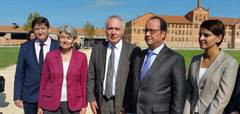 Launch of the UNESCO Chair "Education for Citizenship, Human Sciences and Shared Memories" at the Camp des Milles (France) 2015-10-20 On 8 October, UNESCO Director-General, Irina Bokova, inaugurated the UNESCO Chair at the Camp des Milles, in Aix-en-Provence (France), entitled "Education for Citizenship, Human Sciences and Shared Memories", in the Presence of the President of the French Republic, François Hollande, the Minister of Education, Higher Education and Research, Najat Vallaud-Belkacem and the Minister of Justice, Christiane Taubira."The will that drives us all is the same, we must teach and transmit, ignore nothing to be able to be and feel responsible," said President François Hollande, emphasizing the global historical approach to the site dedicated to the prevention of genocide.Welcoming the establishment of the UNESCO Chair, the President said: "I want to make this a national site for training and citizenship through memory. These places are intended to present the memory of all citizens, to unite us not divide us."The Director-General congratulated the Chairman and Founder of the Foundation Camp des Milles, Alain Chouraqui, for the creation of this new Chair."The effort of memory and education of this Chair is at the heart of UNESCO's work to convey the history of the Holocaust, as pillars of the fight against all forms of racism and anti-Semitism," said Ms Bokova. “Transmitting history is not turned to the past - it is an effort to warn the living, help everyone recognize the mechanisms of hatred and he warning signs of violence and discrimination."This new Chair will strengthen a network of over 250 UNESCO institutions dedicated to scientific research and international solidarity.It is the fourth Chair specialized in teaching the history of the Holocaust, citizenship and the prevention of genocide, with the Chairs of Krakow in Poland, of Rutgers University of New Jersey in the United States, and the University of Southern California. This network constitutes the framework of an international effort for education for global citizenship.During the event, the Director-General commended France for its efforts to protect cultural diversity in the Middle East, for the protection of heritage, and its work conducted in the country to combat racism and anti-semitism."The force of weapons alone will not defeat this fanaticism - we must also win the battle of ideas, and respond with more culture, more education," said the Director-General."Peace, to be sustainable, must be based on dialogue, on the sharing of cultures that allows mutual understanding. This new Chair embodies this vision, it resonates at the heart of UNESCO's mandate and inspires us to continue," she concluded.