
Resources
Search and filter resources to explore in-depth content on Global Citizenship Education.
0 Results found
 Global Reimagining Our Futures Together: A New Social Contract for Education 2021 International Commission on the Futures of Education UNESCO Our humanity and planet Earth are under threat. The pandemic has only served to prove our fragility and our interconnectedness. Now urgent action, taken together, is needed to change course and reimagine our futures. This report by the International Commission on the Futures of Education acknowledges the power of education to bring about profound change. We face a dual challenge of making good on the unfulfilled promise to ensure the right to quality education for every child, youth and adult and fully realizing the transformational potential of education as a route for sustainable collective futures. To do this, we need a new social contract for education that can repair injustices while transforming the future.This new social contract must be grounded in human rights and based on principles of non-discrimination, social justice, respect for life, human dignity and cultural diversity. It must encompass an ethic of care, reciprocity, and solidarity. It must strengthen education as a public endeavour and a common good.This report, two years in the making and informed by a global consultation process engaging around one million people, invites governments, institutions, organizations and citizens around the world to forge a new social contract for education that will help us build peaceful, just, and sustainable futures for all.The visions, principles, and proposals presented here are merely a starting point. Translating and contextualizing them is a collective effort. Many bright spots already exist. This report attempts to capture and build on them. It is neither a manual nor a blueprint but the opening up of a vital conversation.
 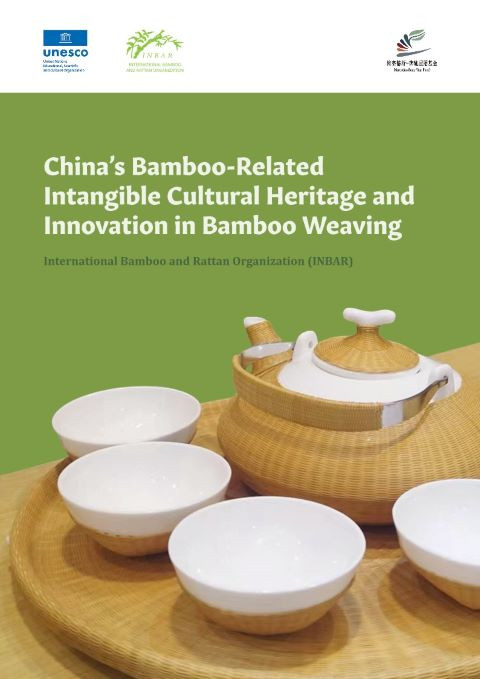 Asia and the Pacific Global China’s Bamboo-Related Intangible Cultural Heritage and Innovation in Bamboo Weaving 2024 Li Yanxia Liu Chenge Wang Renfei UNESCO Beijing International Bamboo and Rattan Organization (INBAR) In the writing and editing of China’s Bamboo-Related Intangible Cultural Heritage and Innovation in Bamboo Weaving (hereinafter called the “Booklet”), we have focused on introducing Chinese bamboo weaving to allow readers to comprehend relevant knowledge about the craft, fully appreciate its charm, and inspire the passing down and innovation of bamboo-weaving techniques.The Booklet includes six chapters focusing on intangible cultural heritage, China’s national bamboo related intangible cultural heritage elements, the development of Chinese bamboo weaving, analysis of bamboo-weaving patterns, modern designs and product innovations, and a tutorial series on bamboo-woven products. The first chapter introduces the definition of global and Chineseintangible cultural heritage. The second chapter systematically outlines the history, model for classification and contemporary development status of China’s traditional bamboo crafts. The third chapter presents an in-depth analysis of the development of bamboo-weaving skills. The fourth chapter features 12 flat weaving patterns recorded by the project team in Chishui City, Guizhou Province, where “China Danxia, a World Heritage Site, is located. It provides a detailed exploration of pattern characteristics and weaving methods, accompanied by picture and video tutorials for readers to practice by hands. The fifth chapter comprehensively elaborates on the innovative design system of bamboo-woven products and showcases real-world cases through personal involvement in designing and collecting innovative bamboo-woven products from both domestic and international sources. Finally, the sixth chapter explains the production methods of common bamboo-woven products to readers through video tutorials.
  Global Paris Agreement 2015 United Nations (UN) The Paris Agreement is a legally binding international treaty on climate change. It was adopted by 196 Parties at the UN Climate Change Conference (COP21) in Paris, France, on 12 December 2015. It entered into force on 4 November 2016.Its overarching goal is to hold “the increase in the global average temperature to well below 2°C above pre-industrial levels” and pursue efforts “to limit the temperature increase to 1.5°C above pre-industrial levels.”
 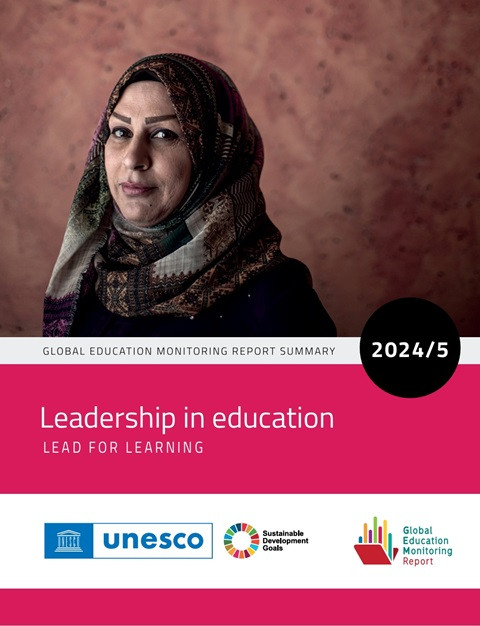 Global [Summary] Global Education Monitoring Report Summary 2024/5: Leadership in Education; Lead for Learning 2024 Global Education Monitoring Report Team The 2024/5 Global Education Monitoring Report assesses progress towards the 2030 targets and shows that, while more children are in school and completing secondary education than ever before, there is stagnation in many areas. Leadership is central to addressing this. There are no schools that improve student outcomes without a good leader showing the way. Building on a review of legislation and policies on the selection, preparation and working conditions of school principals in 211 education systems, the report discusses policy levers to attract and retain talented leaders.Leadership’s potential is not limited to school leaders: it extends to individuals in positions elsewhere in the education system as well as outside of it, from assistant principals, teachers and students, when leadership is shared, to political leaders, civil society, international organizations, unions and the media, who help shape education goals.The report calls for efforts to develop leaders in four key leadership dimensions so that they can set expectations, focus on learning, foster collaboration and develop people. For these dimensions to be realized, people in leadership positions should be trusted and empowered; recruited through fair hiring practices; supported to grow; and encouraged to develop collaborative cultures. The report also calls for investment in education officials’ capacity to serve as system leaders, with a particular emphasis on instructional leadership and quality assurance.
 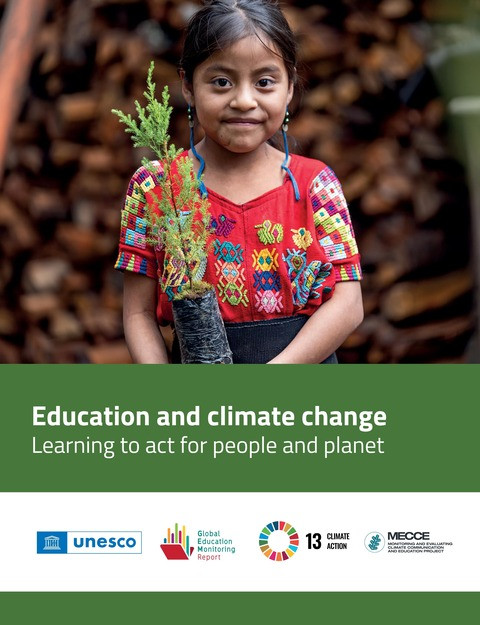 Global Education and Climate Change: Learning to Act for People and Planet 2024 Global Education Monitoring Report Team Monitoring and Evaluating Climate Communication and Education Project (MECCE) University of Sakatchewan How can education lead to climate change action?Despite strong evidence on the impact of education on other development outcomes and the role it plays in developing professional capacity for sustainable development transitions, education is often absent from other sectors’ strategic, policy, planning and financing considerations. The Global Education Monitoring Report is introducing a new series to advance dialogue on the interrelationship of education with the other Sustainable Development Goals.The first paper in the series focuses on climate change. It starts by reviewing the growing impact of climate change on education before turning to the role of education in climate action. Education has a somewhat underappreciated contribution to developing professional capacities for the transition to a green economy. Formal, non-formal and informal learning are also commonly believed to be playing a critical role in motivating actions on climate change mitigation and adaptation.Yet a positive association between education attainment and unsustainable consumption levels, as well as inconclusiveness of much research on the direct impact of education on climate change adaptation and mitigation actions has in part contributed to education receiving low priority in global and national climate change agendas.This paper argues that climate change education needs to adapt to fulfil its potential. The education paradigm cannot rely solely on knowledge transfer but needs to focus on social and emotional, and action-oriented learning.Much of the research has focused on the impact of education attainment and cognitive learning. More research is therefore needed to assess other drivers through which education can influence behaviours and motivate climate change action. Such research is needed to formulate viable education reform packages that improve the curriculum, strengthen climate-readiness of schools and education systems, engage learners and prepare educators accordingly.
 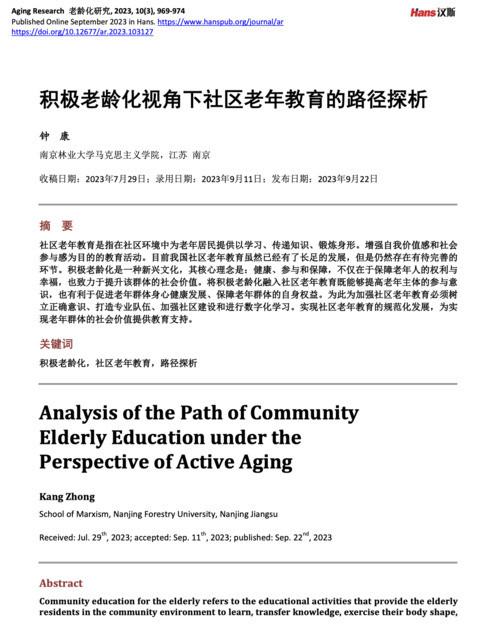 Asia and the Pacific 积极老龄化视角下社区老年教育的路径探析 (老龄化研究 第10卷 第3期) 2023 钟康 汉斯出版社 社区老年教育是指在社区环境中为老年居民提供以学习、传递知识、锻炼身形。增强自我价值感和社会 参与感为目的的教育活动。目前我国社区老年教育虽然已经有了长足的发展,但是仍然存在有待完善的 环节。积极老龄化是一种新兴文化,其核心理念是:健康、参与和保障,不仅在于保障老年人的权利与 幸福,也致力于提升该群体的社会价值。将积极老龄化融入社区老年教育既能够提高老年主体的参与意 识,也有利于促进老年群体身心健康发展、保障老年群体的自身权益。为此为加强社区老年教育必须树 立正确意识、打造专业队伍、加强社区建设和进行数字化学习。实现社区老年教育的规范化发展,为实 现老年群体的社会价值提供教育支持。
 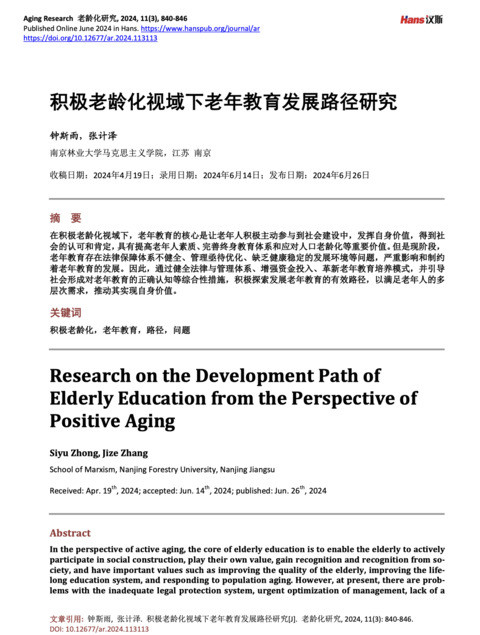 Asia and the Pacific 积极老龄化视域下老年教育发展路径研究 (老龄化研究 第11卷 第3期) 2024 钟斯雨 张计泽 汉斯出版社 在积极老龄化视域下,老年教育的核心是让老年人积极主动参与到社会建设中,发挥自身价值,得到社 会的认可和肯定,具有提高老年人素质、完善终身教育体系和应对人口老龄化等重要价值。但是现阶段, 老年教育存在法律保障体系不健全、管理亟待优化、缺乏健康稳定的发展环境等问题,严重影响和制约 着老年教育的发展。因此,通过健全法律与管理体系、增强资金投入、革新老年教育培养模式,并引导 社会形成对老年教育的正确认知等综合性措施,积极探索发展老年教育的有效路径,以满足老年人的多 层次需求,推动其实现自身价值。
 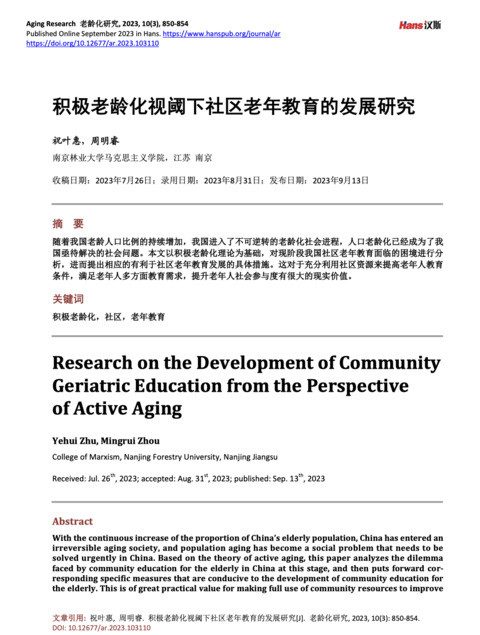 Asia and the Pacific 积极老龄化视阈下社区老年教育的发展研究 (老龄化研究 第10卷 第3期) 2023 祝叶惠 周明睿 汉斯出版社 随着我国老龄人口比例的持续增加,我国进入了不可逆转的老龄化社会进程,人口老龄化已经成为了我 国亟待解决的社会问题。本文以积极老龄化理论为基础,对现阶段我国社区老年教育面临的困境进行分 析,进而提出相应的有利于社区老年教育发展的具体措施。这对于充分利用社区资源来提高老年人教育 条件,满足老年人多方面教育需求,提升老年人社会参与度有很大的现实价值。
 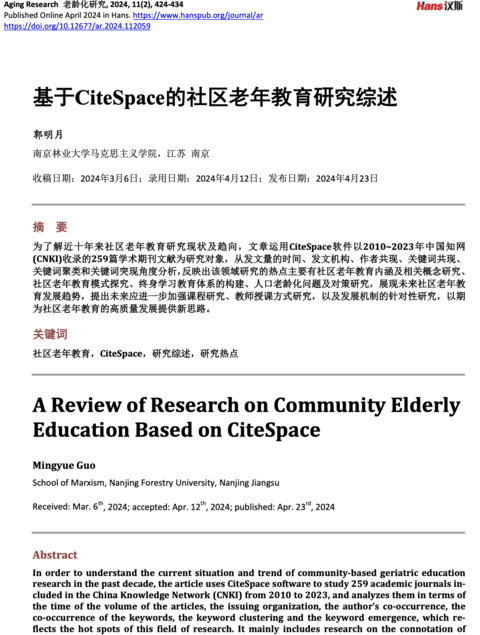 Asia and the Pacific 基于CiteSpace的社区老年教育研究综述 (老龄化研究 第11卷 第2期) 2024 郭明月 汉斯出版社 为了解近十年来社区老年教育研究现状及趋向, 文章运用CiteSpace软件以2010~2023年中国知网 (CNKI)收录的259篇学术期刊文献为研究对象,从发文量的时间、发文机构、作者共现、关键词共现、 关键词聚类和关键词突现角度分析,反映出该领域研究的热点主要有社区老年教育内涵及相关概念研究、 社区老年教育模式探究、终身学习教育体系的构建、人口老龄化问题及对策研究,展现未来社区老年教 育发展趋势,提出未来应进一步加强课程研究、教师授课方式研究,以及发展机制的针对性研究,以期 为社区老年教育的高质量发展提供新思路。
 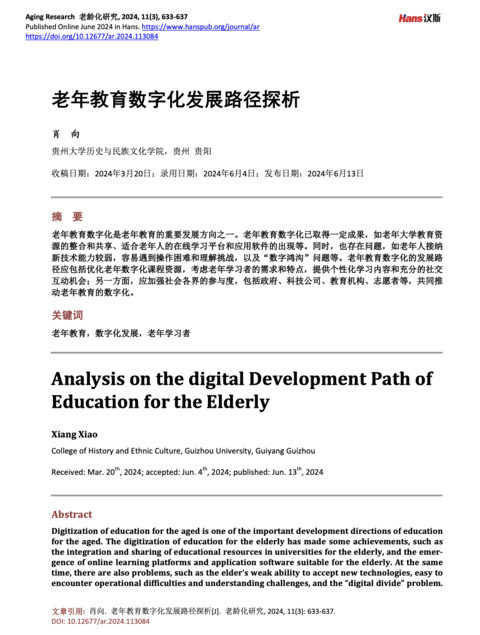 Asia and the Pacific 老年教育数字化发展路径探析 (老龄化研究 第11卷 第3期) 2024 肖向 汉斯出版社 老年教育数字化是老年教育的重要发展方向之一。老年教育数字化已取得一定成果,如老年大学教育资 源的整合和共享、适合老年人的在线学习平台和应用软件的出现等。同时,也存在问题,如老年人接纳 新技术能力较弱,容易遇到操作困难和理解挑战,以及“数字鸿沟”问题等。老年教育数字化的发展路 径应包括优化老年数字化课程资源,考虑老年学习者的需求和特点,提供个性化学习内容和充分的社交 互动机会;另一方面,应加强社会各界的参与度,包括政府、科技公司、教育机构、志愿者等,共同推 动老年教育的数字化。