
Global Citizenship Education: Topics and Learning Objectives
- Author
- Corporate Author
- UNESCO
- Topic
- Civic / Citizenship / DemocracyDiversity / Cultural literacy / InclusivenessHuman rightsGlobalisation and social justice / International understandingPeace / Culture of peaceSustainable development / SustainabilityTransformative initiatives / Transformative pedagogies
- Region
- Global
- Level of education
- Early childhood care and education (ECCE)Primary educationSecondary educationNon-formal education
- Keyword
- Civic educationGlobalizationInternational educationEducational objectivesCurriculumTeaching methodsAcademic achievement
- Place of publication
- Paris
- Year of publication
- 2015
- Resource Type
- International normative instruments / policy and advocacy documentsCurriculum, teaching-learning materials and guides
- ISBN
- ISBN 978-92-3-100102-4
- Collation
- 74 p.
- Format
- Type of file
This publication, titled Global Citizenship Education: Topics and learning objectives, is the first pedagogical guidance from UNESCO on global citizenship education. It is the result of an extensive research and consultation process with experts from different parts of the world. This guidance draws on the UNESCO publication Global Citizenship Education: Preparing learners for the challenges of the 21st century and the outcomes of three key UNESCO events on global citizenship education: the Technical Consultation on Global Citizenship Education (September 2013), as well as the First and Second UNESCO Fora on Global Citizenship Education, organized in December 2013 and January 2015 respectively. Before it was finalized, the guidance was field-tested by education stakeholders in selected countries in all regions to ensure its relevance in different geographical and socio-cultural contexts. Following the foundational work of UNESCO to clarify the conceptual underpinnings of global citizenship education and provide policy and programmatic directions, this document has been developed in response to the needs of Member States for overall guidance on integrating global citizenship education in their education systems. It presents suggestions for translating global citizenship education concepts into practical and age-specific topics and learning objectives in a way that allows for adaptation to local contexts. It is intended as a resource for educators, curriculum developers, trainers as well as policy-makers, but it will also be useful for other education stakeholders working in non-formal and informal settings.
Related Resources
-
 Envisioning the Future of Assessment in Transformative Education: A Synthesis Report of the Expert Meeting on Evaluation and Assessment for Transformative Education: Towards and Beyond 2030
 -
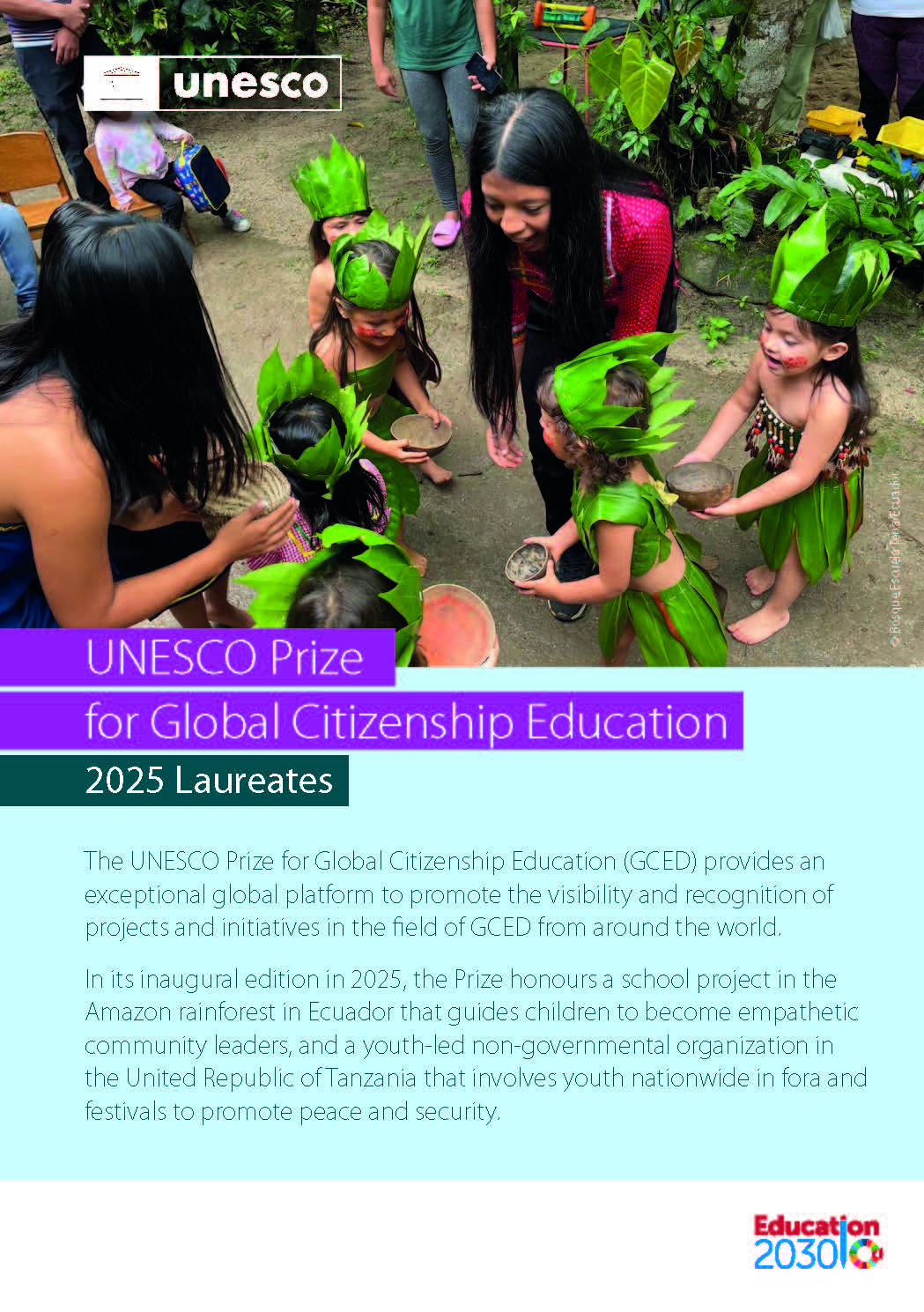 UNESCO Prize for Global Citizenship Education 2025 Laureates
 -
 Confronting Inequality through GCED: Toward Justice, Inclusion, and Transformation (SangSaeng; No.65, 2025)
 -
 Educator's Guide to Global Citizenship Education: From Asia-Pacific Perspectives