
Regional Consultation in Asia for the Preparation of the International Decade of Indigenous Languages (IDIL) 2022 – 2032
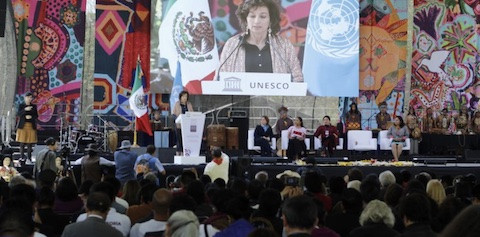
The United Nations General Assembly proclaimed the period 2022-2032 as the International Decade of the Indigenous Languages (IDIL) and invited UNESCO to serve as the lead UN Agency for its organization, in cooperation with the United Nations Department of Economic and Social Affairs (UNDESA) and other relevant agencies including the Office of High Commissioner for Human Rights (OHCHR). A Global Task Force was set-up to provide an international framework for inclusion, openness, participation and multistakeholder engagement in the International Decade.
In this context, UNESCO in cooperation with various stakeholders representing governments, indigenous people’s organizations, native speakers of endangered, minority and indigenous languages, experts, academia and the Global Task Force, is organizing a regional consultation in Asia on 10 and 11 May 2021.
The main objective of the regional consultation is to contribute to the development of the Global Action Plan for the International Decade. This will include:
- Identify regional priorities including strategic objectives, outcomes, outputs, domains of change (thematic considerations) as well as regional flagship and pilot projects for the International Decade in Asia,
- Raise awareness on the importance of indigenous languages, linguistic diversity and multilingualism for sustainable development,
- Forge partnerships among various stakeholders for the establishment of a regional network of partners, national committees and focal points for the Decade in Asia.
Registration Link
https://unesco-org.zoom.us/meeting/register/tJwsde6prjMiE9Ywn7dL9U24xWWICvoXL2z_
Key documents
- The UN Declaration on the Rights of Indigenous Peoples (September 2007)
https://www.un.org/development/desa/indigenouspeoples/wp-content/uploads/sites/19/2018/11/UNDRIP_E_web.pdf - The Yuelu Proclamation on the Protection and Promotion of Linguistic Diversity of the World (September 2018) https://unesdoc.unesco.org/ark:/48223/pf0000368264?posInSet=1&queryId=7c8bc670-b43b-4cd0-a0c5-4077cb738fef
- The Bangkok Statement on Language and Inclusion (September 20219) https://bangkok.unesco.org/content/bangkok-statement-language-and-inclusion
- Summary report on the International Year of Indigenous Languages 2019 (February 2020) https://undocs.org/E/C.19/2020/9
- The Los Pinos Declaration [Chapoltepek] – Making a Decade of Action for Indigenous Languages (February 2020) https://en.unesco.org/sites/default/files/los_pinos_declaration_170720_en.pdf
- Evaluation of UNESCO’s action to revitalize and promote indigenous languages within the framework of the International Year of Indigenous Languages 2019 (March 2021) https://unesdoc.unesco.org/ark:/48223/pf0000376719/PDF/376719eng.pdf.multi
- Evaluation brief: Focus on Indigenous Peoples on the (April 2021) https://unesdoc.unesco.org/ark:/48223/pf0000376830
- The global survey on IDIL 2022-2032 (March-May 2021) http://bit.ly/IDILGlobalSurvey
Contacts
Should you have any question, please contact Ms Misako Ito (m.ito@unesco.org) or Ms Yufan Hu (yu.hu@unesco.org).
URL: