Turning Education Plans into Action
A new Strategy for planning more equitable, inclusive, and quality education systems globally.
Education systems are evolving, and so must planning. From technological advancements, shifting demographics, to constrained public budgets and diverse crises, there are arising and persistent challenges, as well as opportunities to shape a better future.
The 2026-2029 Medium-Term Strategy of the UNESCO International Institute for Educational Planning provides a vision for transforming educational planning into tangible results for education systems across the globe. Building on more than 60 years of experience, the Strategy puts the focus not only on policy and plan design, but on collective and agile implementation.
"Educational planning is about improving learning and well-being for all learners, especially those furthest behind. This requires policies that are not only well designed but also feasible to implement, monitor, and sustain."
Martín Benavides Director of IIEP-UNESCO
Educational planning must lead to action
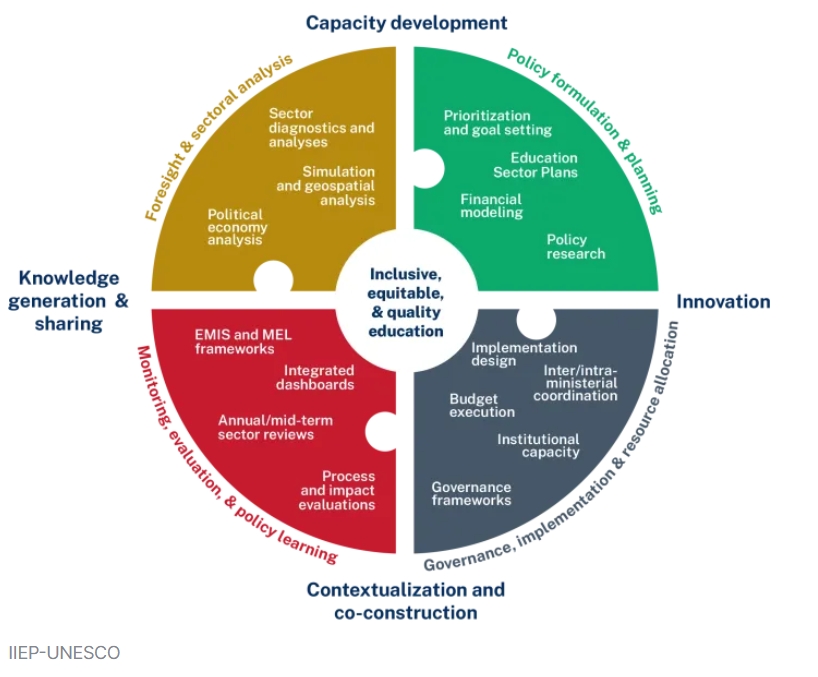
The Strategy focuses on supporting the implementation and sustainability of education policies that expand access, promote equity, and improve learning outcomes. Capacity development is a system-wide process, operating across three interconnected levels: individual, organizational, and institutional.
This involves skills development and tools to support planners, policy-makers, school leaders, and technical staff move plans and policies from paper to practice. At the organizational and system level, it involves strengthening ministries, planning units, and decentralized structures to improve coordination, data use, and service delivery, while fostering governance frameworks that promote accountability and cross-sector coherence.
Collaboration to ensure sustainable reforms
The Strategy emphasizes collaboration and co-construction across the whole education policy and planning cycle. From foresight and sector analysis to implementation, monitoring, and learning, IIEP supports countries in developing adaptive capacity to ensure reforms are sustainable. IIEP’s approach also emphasizes strengthening education data systems and monitoring, evaluation, and learning, allowing evidence-based decision-making and opportunities for continuous improvement.